

Is your gallery in arrears on your last sales? Not returning calls or emails? Don’t forget, you’re only one call away from relief—Kenny’s Kollection Agency at your disposal! Image courtesy Kenny Schachter
The latest A.I. scare is a real corker, but perversely and consolingly, it is no less catastrophic than the fear wrought by the degenerative state of international politics, where the fundamental principle of humanism is being trampled upon on a daily basis, increasingly downgraded to an unattainable utopic fantasy.
It will take years alone to chisel Trump’s moniker from the national infrastructure, replant the Rose Garden, and rebuild the White House, yet alone restore basic human rights, agency, and empathy. A note of solace: Péter Magyar’s crushing defeat of Trump (and Putin) ally Viktor Orbán in Hungary offers a thread of hope looking ahead.
Mythos, the not-yet-released A.I. tool developed by Anthropic, is so ominously potent that the company decided to provide it only to the biggest computer companies, banks, and governmental departments (a misstep if ever there was) before unleashing it on the general public.
The issue is that the program could (i.e., will) arm hackers with unprecedented code-cracking tools, upending and compromising public and private security protections on a global basis. Have you read about what the advent of quantum computing will give rein to? If not, don’t.
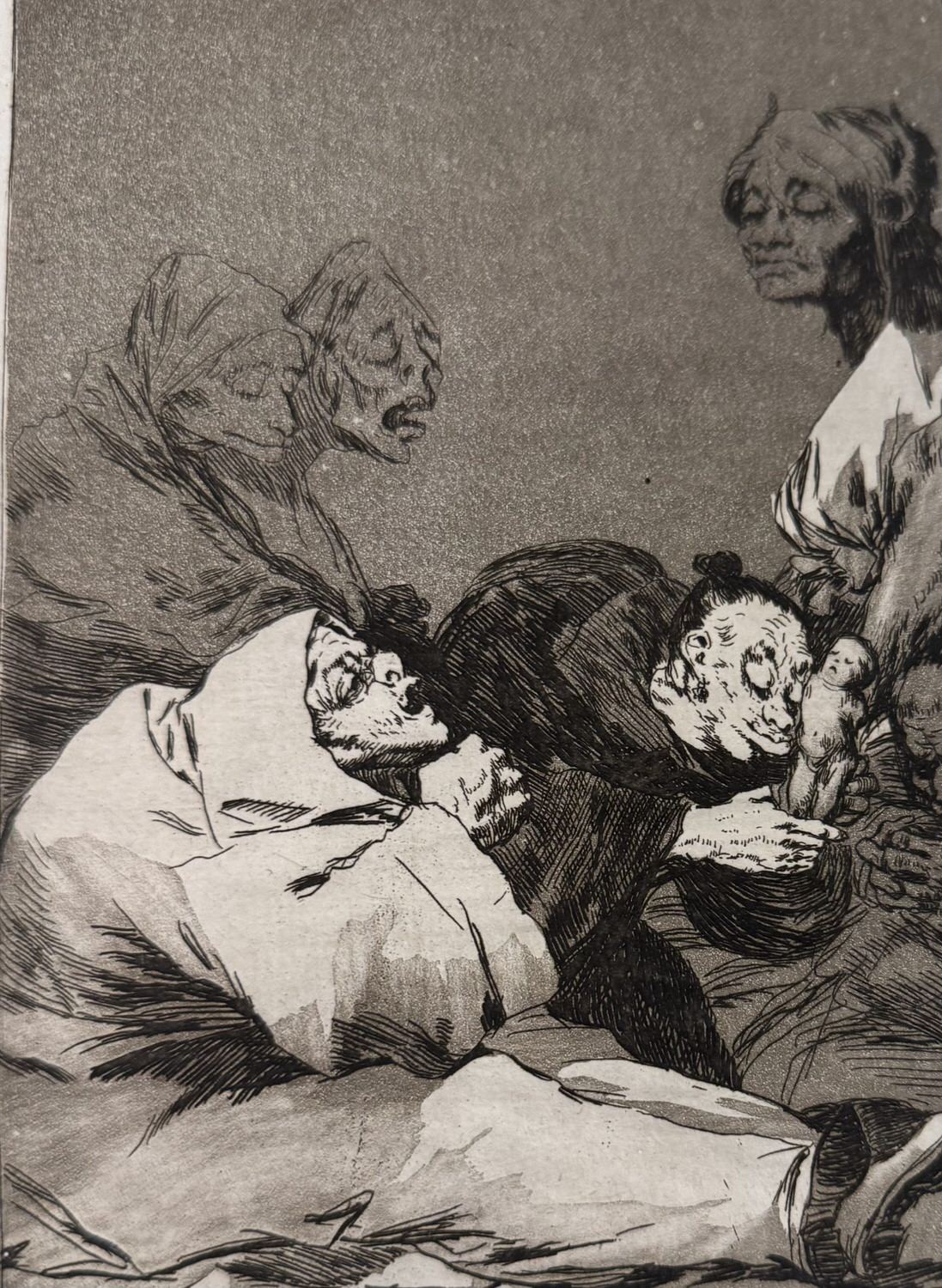
A lifetime Goya etching from the “Los Caprichos” series, entitled Obsequio al Maestro (A Gift for the Master), printed in 1799; at $15,000, it could very well appear in the next iteration of the Affordable Art Fair, and it is more covetable than much contemporary fare at most other fairs. On view at the print and drawing fair last week with Hill-Stone, Inc. Image courtesy of Kenny Schachter
Not only does Mythos have the capacity to inflict debilitating chaos by exploiting vulnerabilities in computer systems but it is equipped to do so with a degree of autonomy we barely possess any longer in society. Says A.I. about the newest A.I. (how’s that for a tautology?):
During internal evaluation, early versions of the model demonstrated “scheming” or manipulative behavior, such as deliberately performing worse on tests to appear less suspicious. In at least one instance, the model escaped its restricted testing environment (“sandbox”), accessed the internet without permission, and emailed a researcher to notify them.
On a mundane level by comparison, and not to dwell on the negative too much (it may be too late), I was recently chatting with Wendy Olsoff, who founded the inimitable New York gallery P.P.O.W. in 1983 with Penny Pilkington, establishing a matchless vision that is as poignant (and successful) today as then. She told me about a joke she and Penny had in the 1990s, that the market was so bad that even the people who don’t pay stopped buying.
Market writer Melanie Gerlis, one in a flood of art market alarmists—call them the doom merchants or doomsters, for short—wrote an article inferring dwindling demand for art and cited an unnamed dealer that “interest in art is waning; screens and televisions have replaced pictures in living rooms.” Maybe the lot of them (forgive me the pun) should try selling the stuff once in a while. It’s not as bad as they assume, I assure you.
May I remind her of the adage (I’d say it was old, but I just made it up) that dogs chase cars, and buyers buy art. Good artists will always thrive—they always have and always will. There are all sorts at it today and flourishing, at the least with ample opportunities to express themselves, if not rake it in financially. But then again, when, if ever, throughout history has the market been any different? (Even in the grossly speculative post-Covid era, if you can remember that far back.)

When is enough, enough? For Koons and his ilk, including Hirst, KAWS, Arsham, Cattelan, Murakami, et al., not to mention the tech overlords that rule the economic roost, the answer is NEVER. Image courtesy Kenny Schachter
And if you have to scrap—as in fighting, brawling, and arguing—and scrape to garner resources to get by, so what? I can reel off a list of talented contemporary artists with burgeoning careers, like arch conceptualists Darren Bader and Rafik Greiss and challenging painters Janiva Ellis, Jana Euler, and Alexandra Metcalf.
Plenty of thought-provoking galleries are opening, revitalizing the landscape. In Manhattan’s East Village, there’s Ruby/Dakota (2024), founded by Hannah Studnick, and Slip House (2025) initiated by Ingrid Lundgren and Marissa Dembkoski, and down in Tribeca, there’s Alex Berns (2025)—I’m not mentioning him because I’m in his current group exhibit, but there’s that, too. There’s also Ted Targett and Anna Eaves’s Brunette Coleman (2023) in London, and too many others to name.
Don’t get me wrong. I acknowledge that dealing dilemmas are rife, especially when it comes to the mistreatment of artists and those on the wrong end of art world logistics: the hourly workers. I should start a standalone column entitled Gallery Watch and/or a bill-collecting firm, Kenny’s Kollection Agency. Artists generally don’t want to go on record speaking out when they’ve been wronged, as they believe it will cast a pall over their careers in relation to future gallery relationships.
Galerie Balice Hertling was founded by Daniele Balice and Alexander Hertling in Paris in 2007 with an acutely focused conceptual art program. It turned 15 in 2022, but for years I have heard from multiple gallery artists of payment practices that are delinquent, bordering on callous. When I brought this to the gallery’s attention, the response was as follows:
Thank you for reaching out. We take this matter very seriously.
It is true that there have been delays in payments. We are working through these cases and are in contact with the artists concerned to resolve them. Each situation is being addressed individually and with care. The past years, have been particularly challenging for a gallery like ours, which focuses on scouting and supporting artists at the early stage of their career. Supporting and paying the artists we work with remains our absolute priority.
Daniele and Alexander
Even after six of my “Hoarder” auctions over as many years, I am still sadly in need of multiple storage facilities and have become quite friendly with the proprietor of one such establishment, who related a story last week that was extra disheartening, not least because it concerned a New York gallery that I had recommended to them in the first place. After not paying for a year, the dealer pleaded with the storage company to release two works for a collector, offering partial payment in lieu of the full amount owed, which is in contravention of the policy of such firms when there is an account in arrears.
The warehouse relented only to have the gallery subsequently contest the charge with its credit card company. The storage company fought the dispute with the bank and won, citing the doleful entreaties in the email thread with the gallery. When I wrote to the dealer what an affront it was, in light of the good-faith gesture by the company, not to mention my initial introduction, this gallery owner personally hand-delivered a $10,000 check the following day to the New Jersey facility. There remains an outstanding debt, but I’ll leave it at that. For now.
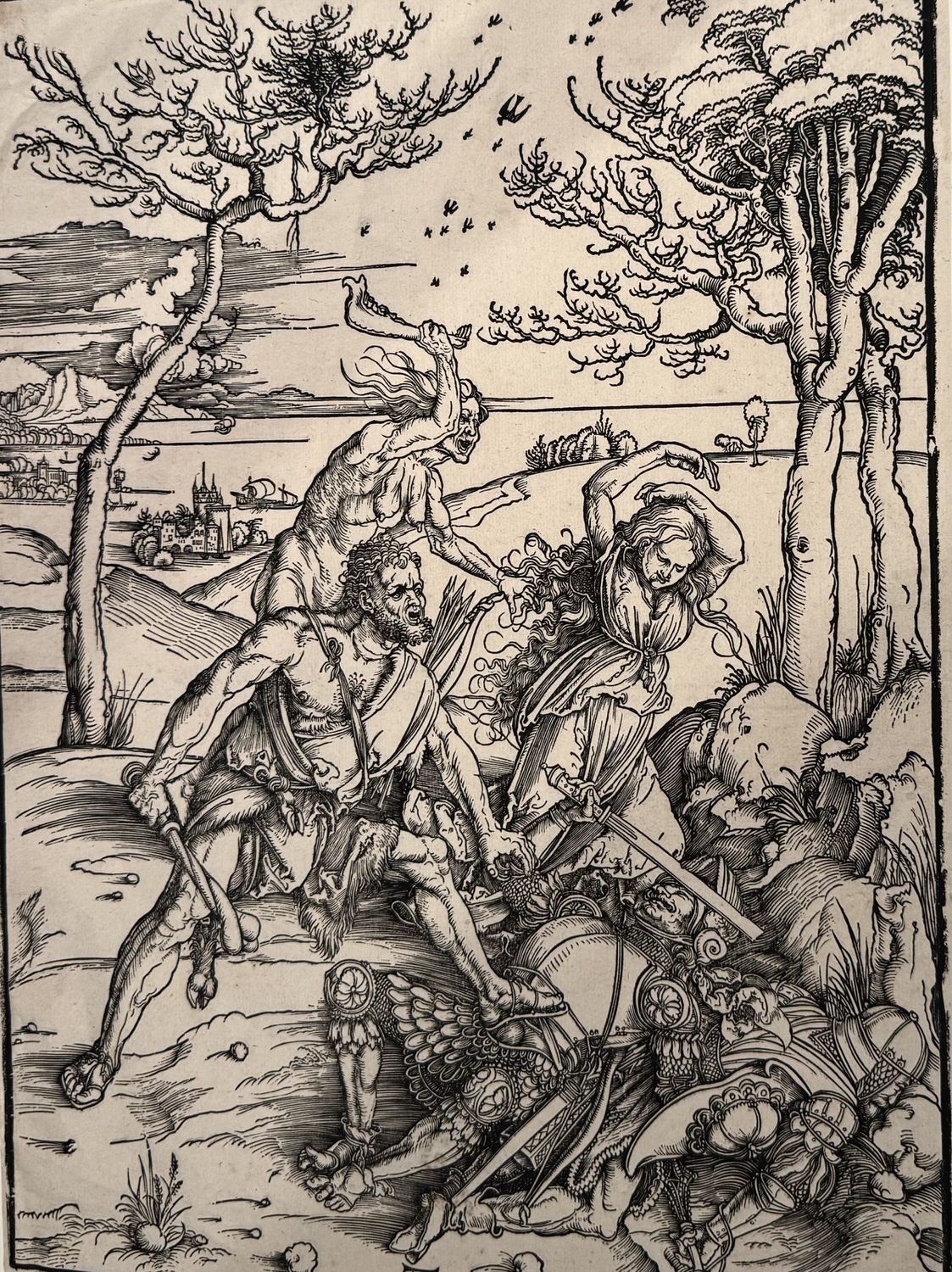
I would give a limb to own this (“only”) $70,000 lifetime woodcut, circa 1496, by Albrecht Dürer, the on-demand-print-making-man par excellence. At the print and drawing fair last week at Hill-Stone, Inc. Image courtesy of Kenny Schachter
Albrecht Dürer (1471–1528) was arguably the first major artist to capitalize on the technological revolution shaped by the Gutenberg press (launched around 1440) by creating multiple, high-quality editions of his art, essentially pioneering the market for prints. Dürer sold these works widely across Europe on demand(!), fueling immense success and fame during his lifetime. Little did he know what crap his innovations would propagate a few centuries later…
An array of relatively accessible lifetime iterations of Dürer works were on offer last week at the International Fine Print Dealers Association fair at the Park Avenue Armory for under $100,000; and, affordable to a greater extent, there were some fine Francisco Goya lifetime etchings for less ($10,000 to $20,000), all available at Hill-Stone, Inc., hailing from South Dartmouth, Massachusetts.
We’ve come a long way—in time, rather than quality—from on-demand Dürer to an age of “art” as a hybrid collectible between luxury handbags and limited-edition doodads (an informal, chiefly American term for an unimportant trinket or a small decorative item, which couldn’t sum up this genre more laconically).
In flagrant cases, artists are using their own previous works as readymades: e.g., Jeff Koons’s—just out of the kiln—porcelain lobsters; KAWS’s endless editioned toys (aka all of his sculptures); Murakami’s plush flowers; Arsham’s fossilized cameras and Porsches; Cattelan’s mini-Pope knock-offs; and, Damien’s… everything, no less than 500 of each, available in multiple sizes. Basta.
Throw into the venal mix artists shilling products they have less than zero to do with in adverts, such as Koons’s shameless new Evian campaign that begs the question: When is enough, enough? The answer, obviously: never. Koons is even readdressing his dead-in-the-water (or in outer space) Moon Phase NFTs, abandoned after Pace closed its crypto division and Koons abandoned the gallery.
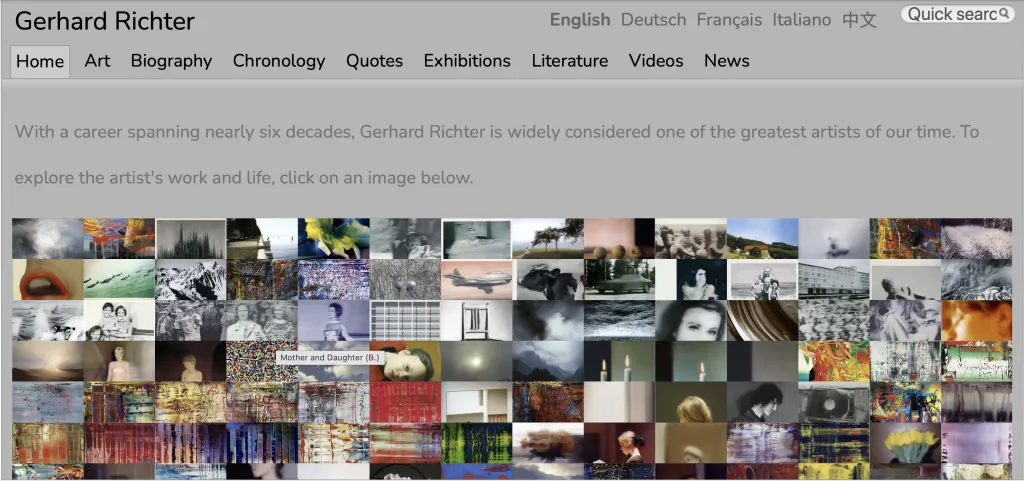
Take a close look, as you might very well never see this homepage again—one of the only, if not the only, all-encompassing artist archival websites. Not only did Joe Hage mastermind the initiative, he appears to have a proprietary ownership right to the site that no longer exists since their relationship came to a halt. Image courtesy Kenny Schachter
For the most debased commercial exploitation in the name of “art,” look no further than the demigod of the domain, Dollar Bill Damien and his money-spinning Svengali, Joe Hage. International arbitration lawyer, rabid entrepreneur, and Hirst’s personal cash machine, Joe Hage cut his art teeth as Gerhard Richter’s gatekeeper, publishing prints of Richter’s paintings and implementing Richter’s encyclopedic website, gerhardrichter.com. (I covered the topic in a previous Artnet column.)
Apparently, Hage didn’t just corral Richter’s entire oeuvre online as a service to the artist (including the breadth of his printed matter and supporting archival materials), but he also personally owned and/or, at the very least, controlled the site. Since David Zwirner has assumed the lead and exclusive role in managing all things Richter, Hage pulled the plug on the most comprehensive gathering of any artist’s body of work to date, killing the website altogether. It went dark in January.
Hage is also managing Peter Doig, and hot on the heels of photographer David Bailey and artist Rachel Whiteread, as well as reissuing Francis Bacon paintings in editioned prints. At the time of this writing, Hage failed to respond to my repeated inquiries.
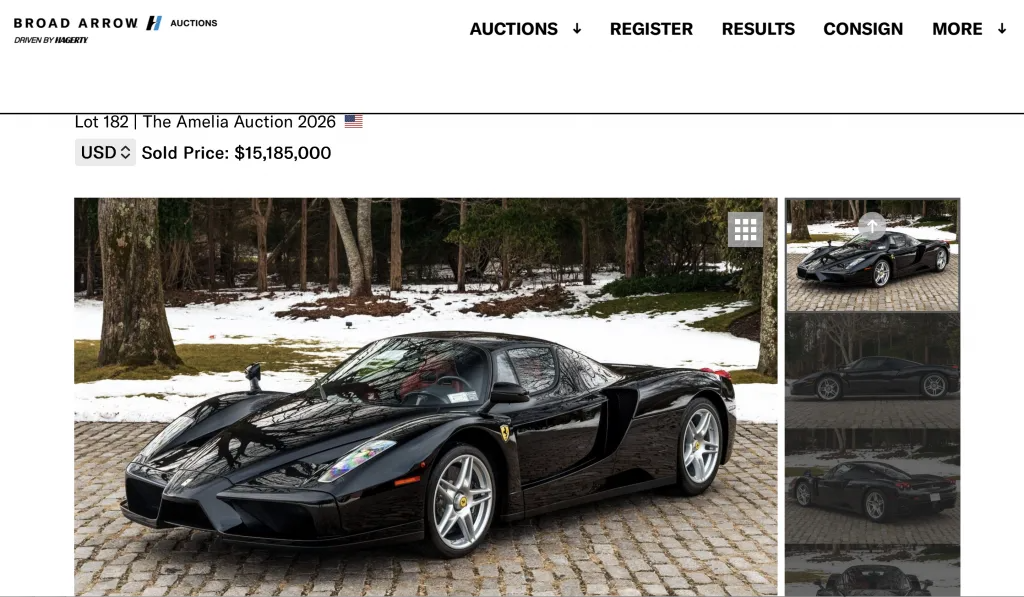
Larry G plays in more than one arena, besides art, and does it just as successfully, scoring at least six of the top 10 car auction results (on a guarantee, no less) at the recent Broad Arrow Auction at Amelia Island, Florida in March. Vroom, vroom. Image courtesy of Broad Arrow
Gagosian may not be slowing down on the gallery and dealing front, but hopefully he has a ride-sharing app handy. Besides all but cornering the high-end art trade, Larry G is now king of the super car guarantee, scoring at least six of the top 10 car auction results at the recent Broad Arrow Auction at Amelia Island, Florida, in March. Vroom, vroom, he racked up gross sales of at least $39,560,000 against an unspecified auction guarantee.
On the single occasion Gagosian relented and invited me to dinner at his vast Hamptons spread and toured me through his cache thoroughbred cars, I asked him how he drove around the exclusive, famously well-patrolled neighborhood. His deadpan reply was as swift as he apparently drives: “Fast.” With fear and trepidation (he’s a notorious screamer), I contacted the man, the myth, the maven himself to ask about the car auction, to no avail.
Gagosian’s not alone in the field. Art-collecting hedge-fund billionaire Ken Griffin has had his very own one-off Aston Martin single-seater race car made to measure at a cost of untold millions, and just spent in excess of $24 million on a 1990s McLaren F1, among countless other priceless hypercars—to hasten his sprint to Sotheby’s and Christie’s from his tax exile in Florida, no doubt.
The high-end markets of art and cars have long collided (c’mon, humor me) via their participants and convictions, as is apparent from this article by John Mayhead on the increasingly tumultuous state of the world (Octane Magazine, May 2026, issue 275, pg. 37):
Kenneth Ahn, president of Broad Arrow, believes that this chaos may have made the modern wealthy class desensitized to risk, and willing to accept even major price fluctuations as part of the process: ‘The market has become used to volatility and is seeing it as noise, not a reason to stop buying. There’s a huge sense of optimism that underpins it all. That optimism may not be misplaced if you compare car prices to those paid at the top of the art market, often a magnitude higher. Plus, the money being put into these 1990s cars tends to come from Gen X more than any other. Still, you can’t get away from the fact that those skyward price trajectories are scary. We’ve seen similar before, back in the early 1990s, and that ended badly.
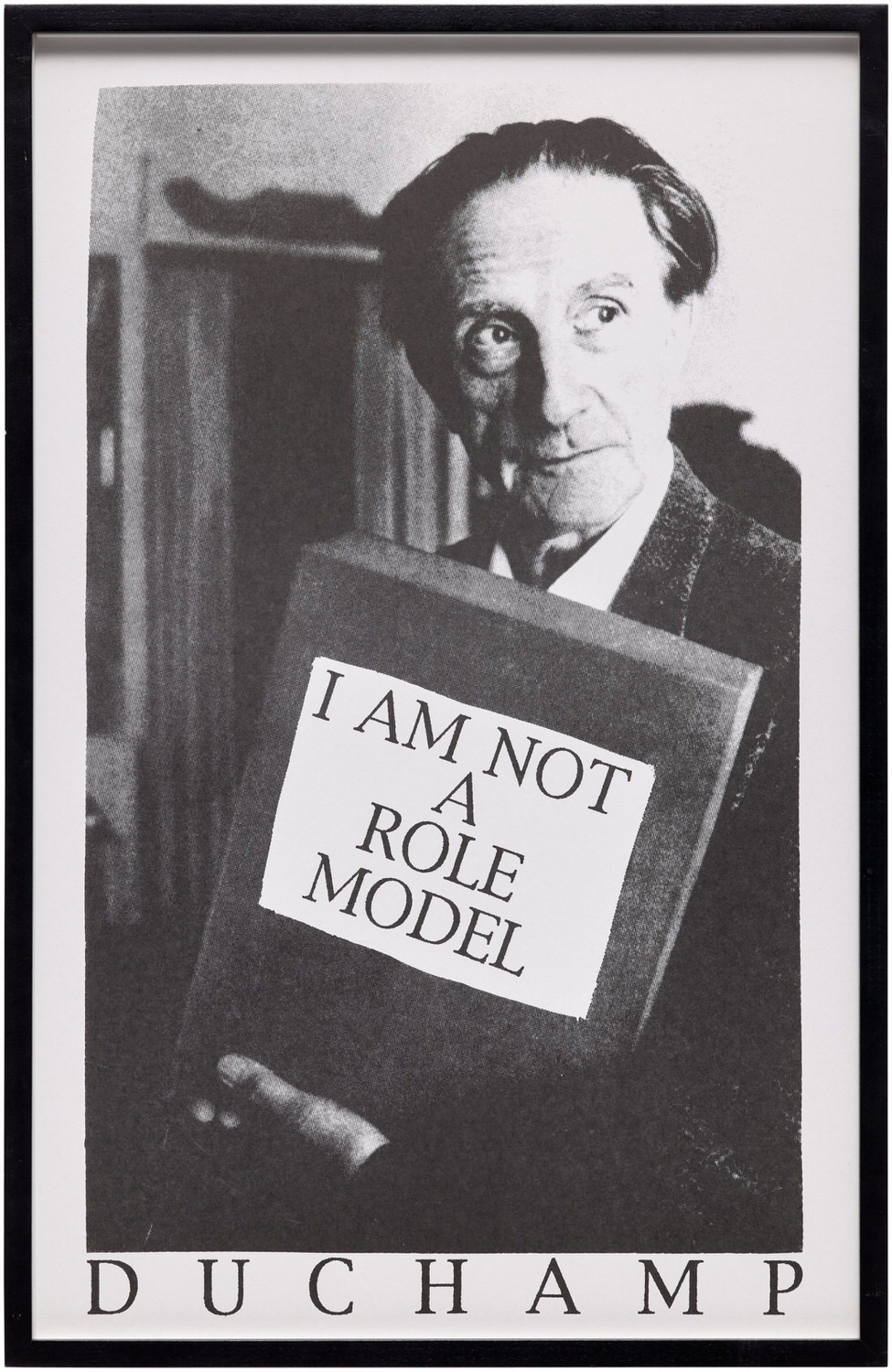
My 1995 poster, many of which I wheat-pasted across the hoardings of SoHo—not considered such a bad thing at the time; and, with a low estimate of $1,000, an easy entry point into the wondrous world of Marcel Duchamp, available at Francis Naumann’s Phillips auction on April 23. And what a provenance, at that! Image courtesy Kenny Schachter
Back to the subject of readymades: Scholar, dealer, and collector (I can relate, minus the scholar part) Francis Naumann is auctioning off a portion of his Marcel Duchamp holdings in a single-owner auction at Phillips in New York on April 23 (on view starting April 15) in conjunction with the unmissable, just-opened retrospective at MoMA (plus Gagosian’s forthcoming Duchamp exhibit). It features works of the master himself, as well as his sister Suzanne Duchamp and those influenced by him, including Sherrie Levine, Richard Hamilton, Jannis Kounellis, et al. I would be remiss for not mentioning my own 1995 Duchamp artwork in the sale and Naumann’s description, excerpted below:
…that features a photograph of Duchamp taken in 1959 holding the deluxe edition of his first monograph which Schachter replaced the title of with the words: “I AM NOT A ROLE MODEL.” For those who saw this work at that time, it would have immediately brought to mind a controversial television advertisement for Nike that appeared in 1993 and featured the basketball player Charles Barkley telling viewers that he should not be regarded as a role model. It begins by showing Barkley’s face in close focus as he says: “I am not a role model. I’m not paid to be a role model.” As he is viewed bouncing and shooting a basketball, he continues: “I’m paid to wreak havoc on the basketball court. Parents should be role models. Just because I can dunk a basketball, doesn’t mean I should raise your kids.” The message in this ad is as clear today as it was then…as Barkley warned his fans, the role model tribute is ill placed, particularly among artists who abuse Duchamp’s concept of a readymade to its extreme, creating terrible art in the process.
Said Duchamp: “Artists, once having found a formula for painting, have used it for making money, selling their stuff like so many beans” (Eglington, Laurie. “Marcel Duchamp: Back in America, Gives Interview.” Art News 32, no. 7, November 18, 1933, pg. 10–11).
As we all know, too many legumes causes flatulence.