
A spoof on Eyes Wide Shut, featuring Tom Cruise in addition to Nicole Kidman, might have helped Brancusi’s exquisite head at Christie’s better than Nicole’s solo promo effort in a market so jacked up that almost $100 million was viewed as a disappointment. Photo courtesy Kenny Schachter
In a sign of the times, and the further degradation of the New York Times, a guest on its The Opinions podcast, New Yorker writer Jia Tolentino, described stealing little items, mainly from Whole Foods. Tolentino, who lives in a lovely Brooklyn townhouse, said that she didn’t feel badly because it’s a big corporate chain, which is admittedly hard to argue with. (I’ve boycotted all things Bezos for three years.) Nadja Spiegelman, of the Times, coined a word for the viral fad: “microlooting.”
I was thinking what my own take on microlooting might involve. A good place to start would have been the whirlwind spring auctions and art fairs in New York, which have now come to an end, and the prime gallery exhibits that accompany them. Business was generally brisk across the board throughout the two weeks, so who’d have noted the disappearance of teeny gems like James Ensor’s 6¼-by-8½ inch Still life with Stingray (sold for $140,800 on an estimate of $70,000–$90,000) at Sotheby’s or Georgia O’Keeffe’s double-sided 10-by-8 1/8 inch Maple Leaves and Flowering Cactus (sold for $1.68 million on an estimate of $700,000–$1,000,000) at Phillips?
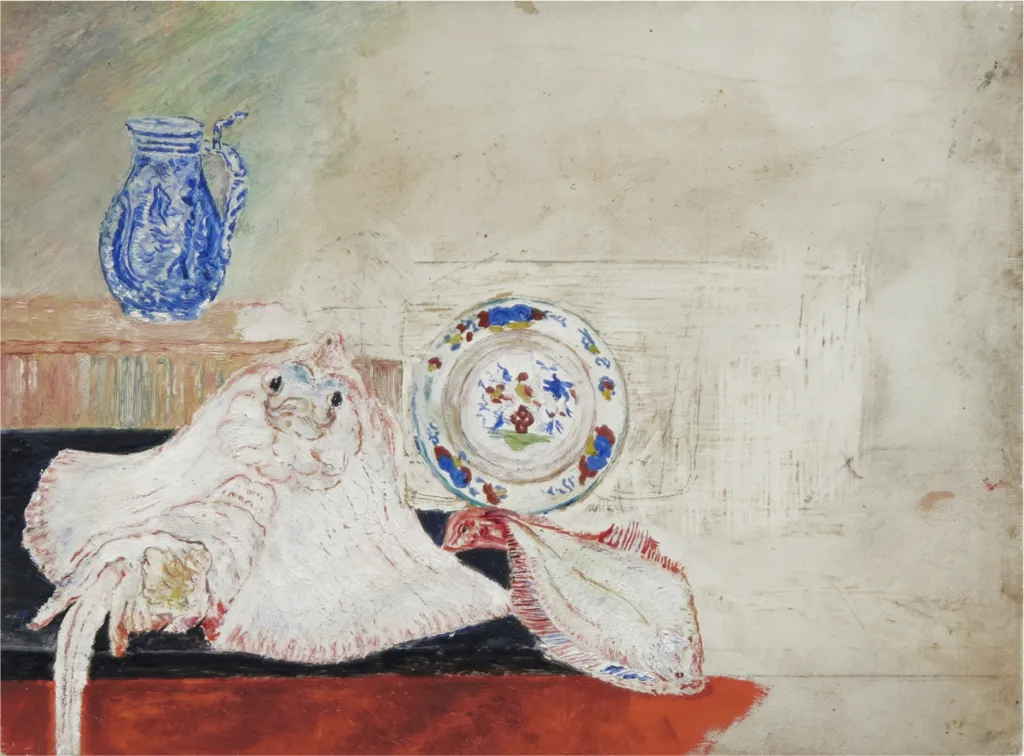
More important than size mattering is surely what you do with it—like how James Ensor painted this covetable micro-gem that sold at Sotheby’s for $140,000 on an estimate of $70,000 to $90,000. It was painted circa 1890–95.
For self-preservation alone, I would not filch from Larry G’s inaugural Marcel Duchamp foray at his new Madison Avenue storefront gallery, where iron-fisted, uniformed security guards outnumber the artworks. They incessantly barked at me to stand back two feet from the works upon entering the disappointingly small space, then shadowed and chided me every step of the way. Next time I’ll bring opera glasses to view the art. And to think that I wasn’t even clad in my signature polyester trackies—I’ve since changed my look to age-appropriate attire. About time, many would say.
Indicative of the tough economic climate that abounds is the local 3-D printer I found online to test run some maquettes for my upcoming fall sculpture installation, which will incorporate my 1990s curatorial archives, at the flourishing upstart gallery Alex Berns in Tribeca. While discussing the piece, I discovered that the printer has a full-time career as a tax lawyer. Given that he also used to teach piano lessons, perhaps I’ll give the ivories a tickle while waiting for my next model to output.
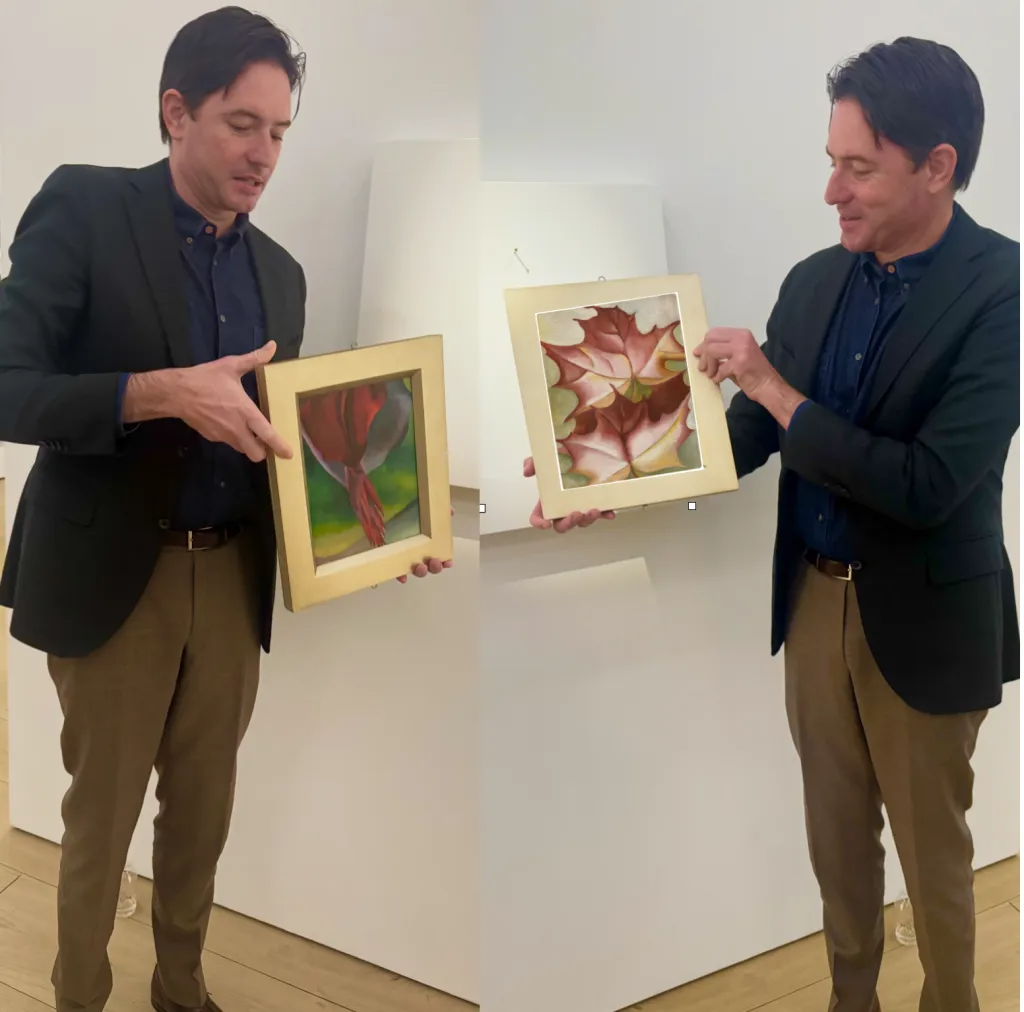
The indefatigable and always charming Phillips contemporary art advocate John McCord, dutifully showing off the two-sided attributes of the little Georgia O’Keeffe painting before the auction house’s sell-out contemporary art evening sale. Photo courtesy Kenny Schachter
Another signal we are in the midst of a period of cautious uncertainty was the peculiar scenario of the scion of a contemporary art–collecting family that’s also a major force in the speculative auction guarantee business. This woman drove her Lamborghini to the airport en route to Manhattan, then checked into a Holiday Inn Express with an eye to cutting expenses. She related that the front door of her room was adorned with a sign warning of the perils of human trafficking and a number for the National Human Trafficking Hotline. At a daunting $400 per night (only in New York), I can’t imagine the venue being a hotbed for such activities.
Despite the healthy (if not thriving) auction and fair season, there were plenty manning the multitude of booths who were wearing grimaces plastered across their faces—indicative of zero business at hand. And so I particularly noted the strong but inconsistent TEFAF, where the proceedings were lava-like.
We live in what might be the most hyperbolically riven, bifurcated global economy in history, with an economic landscape resulting in the wealthiest-wealthy class (ever), while the rest suffer ruthlessly rising prices coupled with mercilessly dwindling opportunities, not to mention many enduring agonizing, inhumane conditions. Others simply tread water, struggling to maintain the status quo. That bell curve has always been the case, but it appears to be becoming far more exacerbated. If it gets any worse, I shudder at the thought of what might transpire. And you should too.
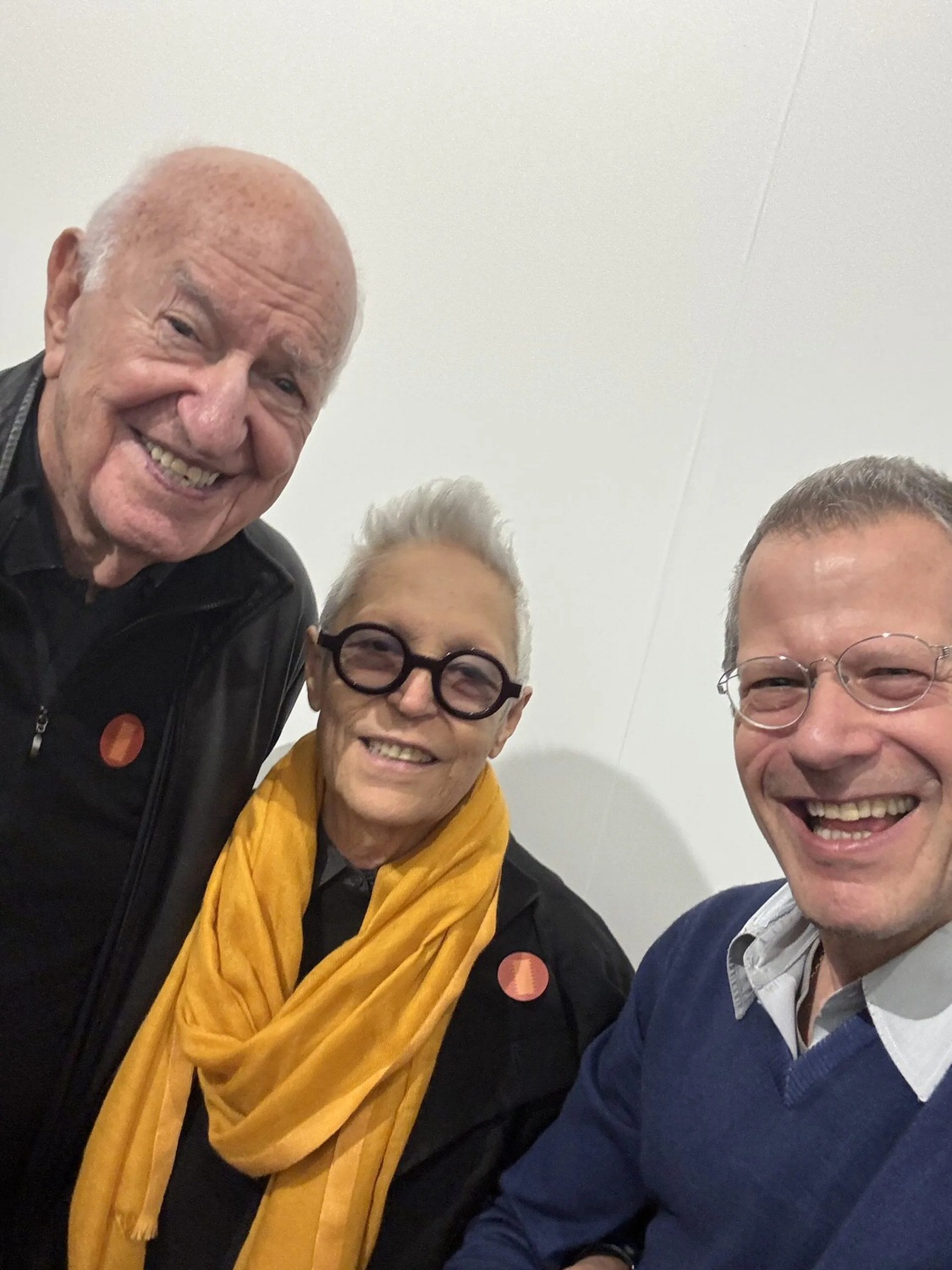
The Rubells and me at the Independent Art fair, where I discovered something that Mera covets as much as augmenting their still expanding art collection—sex! Photo courtesy Kenny Schachter
The divide is especially apparent in the art world. On one hand are legacy collectors like the legendary Rubells, who are as hooked on their art addiction as they were 60 years ago. Mera told me herself that their voracious passion extends to sex. Taken aback, I asked her with who, to which she responded by pointing to her husband, Don, who scurried away as quickly as his 85-year-old frame allows. Apologies to their children for the nature of this writing.
Contrary to the endless (digital) ink spilled about the dire straits of the art industry and the lack of younger generations picking up the mantle of collecting, I refer to my kids and their friends, who continue to buy and sell art to young and old alike. Adrian, 29, has a new exhibition at Amanita Gallery, 1 Freeman Alley, New York, through June 28, that had already done well by the opening last week (with a solo booth at Liste in Basel coming next month). And Sage, 23, sold out a since-closed exhibit at Tripoli Gallery on Long Island. Sorry for airing their affairs; they’re often as unamused by me as Jason and Jennifer Rubell will be reading this column, but I can’t squelch my pride in their perseverance and tenacity.
Why dealers don’t show up for the openings of art fairs they’re participating in runs the gamut. At last week’s Independent—a vibrant, lively affair—David Kordansky had skipped town to attend his latest opening in L.A., while the proprietor of Jupiter Gallery had not yet paid for his booth.
Last March, I had a solo show at Jupiter, which is run by Gabriel Kilongo, who previously worked at Mitchell-Innes & Nash before launching in Miami and then expanding in 2024 to New York in the former digs of James Fuentes on the Lower East Side. He couldn’t have chosen a less propitious time for Jupiter’s move, on the cusp of a devastating decline in the ultra-contemporary market (which continues to languish), or in a less accessible neighborhood amid the ongoing gallery exodus to Tribeca.
My show was a generally positive experience, in spite of being cited as the worst of the year, only three months into 2025, by one writer. I suppose that’s a distinction in itself. I sold the majority of the works after the exhibition (which Gabriel encouraged), but struggled to get paid for the few the gallery did manage to place, even those stemming from my existing relationships. The amounts were modest, but nevertheless, the process proved vexing; when I repeatedly chased the dealer, he gaslighted me by acknowledging my frustration while accusing me of being “disrespectful and unappreciative” in the same breath. To be clear, I remain thankful for the opportunity to exhibit.
Yet things have been considerably harsher for many artists similarly situated at the gallery. Over the past year, the messages have been filling my inbox fast and furiously, pertaining to Kilongo’s allegedly errant payment practices, after my last columns bringing attention to the delinquencies of other galleries said to be involved in such behavior. Additionally, there have been allegedly unpaid storage bills, resulting in forced auctions and sales that artists say they were not informed of. You’ve been warned.
The gallery’s space on Delancey Street has recently been shuttered by order of the Marshal of the City of New York, while the Miami space remains in business, despite a handful of allegedly outstanding bills and lawsuits arising over claims of withheld proceeds from sales or works destroyed due to substandard storage and shipping.
There is a real reluctance among affected artists to be publicly identified, since speaking out about art world disputes can impact future gallery relationships and/or job opportunities. It’s a futile conundrum, where artists’ hands are tied, limiting their ability to seek redress for non-payments, a situation made worse by their persistent lack of resources to pursue these matters. More often than not, such circumstances fuel the ongoing imbalances that enable galleries to carry forth in the same alleged manner unabated.
In Kilongo’s own words to me:
The past few years have involved an extremely difficult operational period while expanding the gallery and navigating a broader market downturn. During that time there have been delayed obligations, many of which have since been resolved and others continue to be actively addressed.
Over the life of the gallery, we have paid artist commissions totaling roughly $2M and supported artists through exhibitions, placements, and long term investment in their work. While there have been delays during a difficult period, my commitment has always been to support artists and honor obligations.
Another since-closed New York space, 1969 Gallery, owned by Quang Bao, has allegedly accrued debts of well over $200,000 to artists and staff over the past year, prior to the closure of its space in Tribeca. I have heard from nearly two-dozen aggrieved artists previously associated with the gallery; and, while Bao is no longer operating a physical space, I have been informed that he continues to try to sell the works of other unsuspecting artists. My attempts to contact him for comment via phone and message were to no avail.
I cannot over-stress the need, more than ever, for artists and potential employees to conduct due diligence by reaching out to associated artists and others affiliated or knowledgeable about any given gallery or art business before joining forces. Forget buyer beware. It should be ARTISTS WATCH OUT!
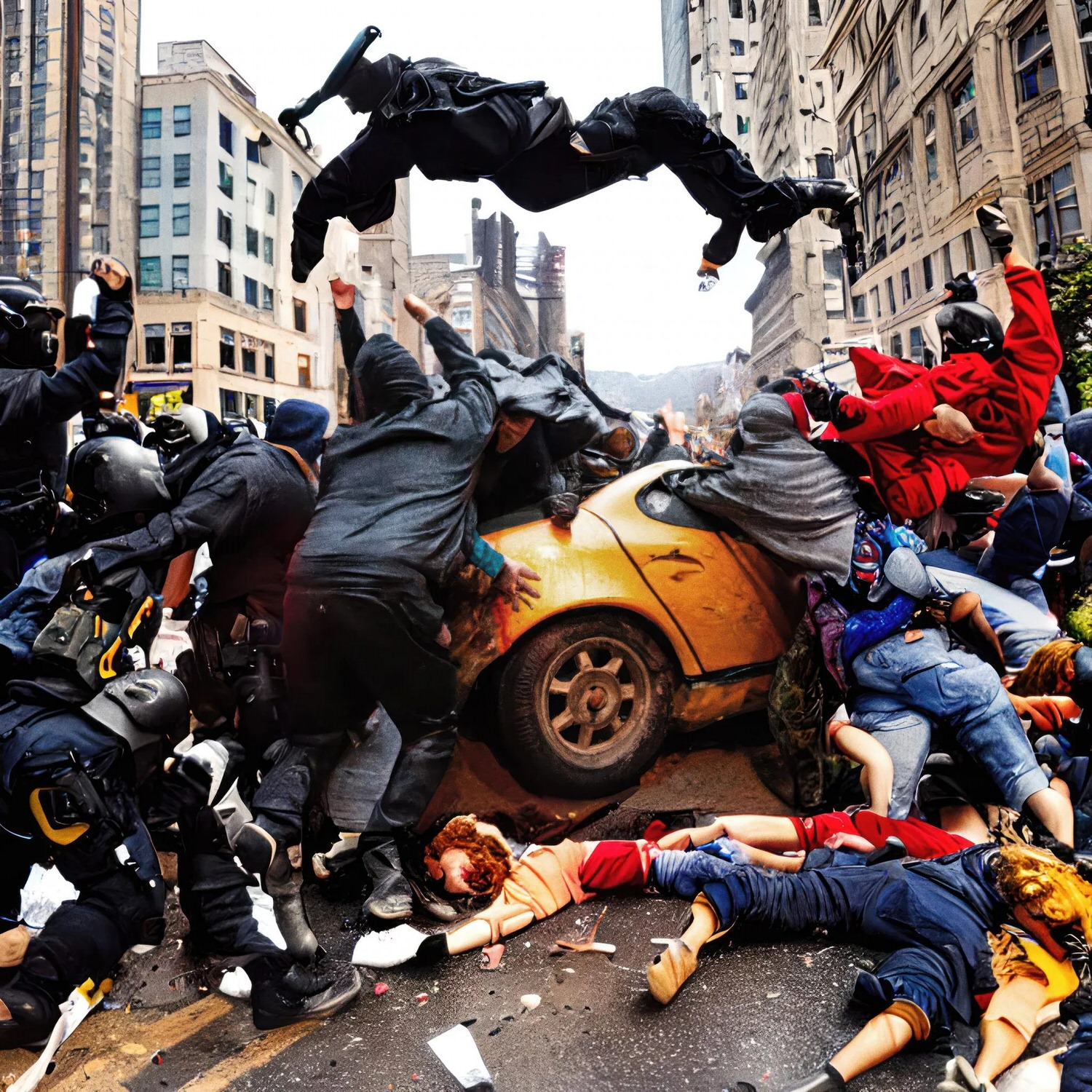
Kevin Abosch’s photo that was sold unbeknownst to him at a judicial auction that appears the new norm when galleries go belly up. The image is apt for a tragically divided society riven with hate and hostility, which can only get worse with an ever-exaggerated divide between those that have far more than anyone rightly should and those that tragically scrape for food, medical care, and education. Photo courtesy the artist
I previously wrote on the allegedly unscrupulous business practices of Italy’s Dynamic Art Museum, a misnomer if ever there was one. Kevin Abosch, an artist and friend found out days ago that photographs consigned to the institution were sold at a judicial auction by court-ordered administrator, a move that he will contest through the courts.
I am no longer actively covering the auctions, but not for the reasons that Jerry Saltz bemoans in this week’s New York magazine. Jerry sounds like your caustic old uncle moaning about Thanksgiving dinner, from the stuffing to the pumpkin pie. Accusing the art market en masse of signifying a force of moral turpitude and the quintessence of a demonic boogeyman is a hackneyed trope at best. Yawn. Besides, look no further than the collections of kings and popes from centuries past: You will be hard-pressed to find many that opened their churches and palaces to the hoi polloi.
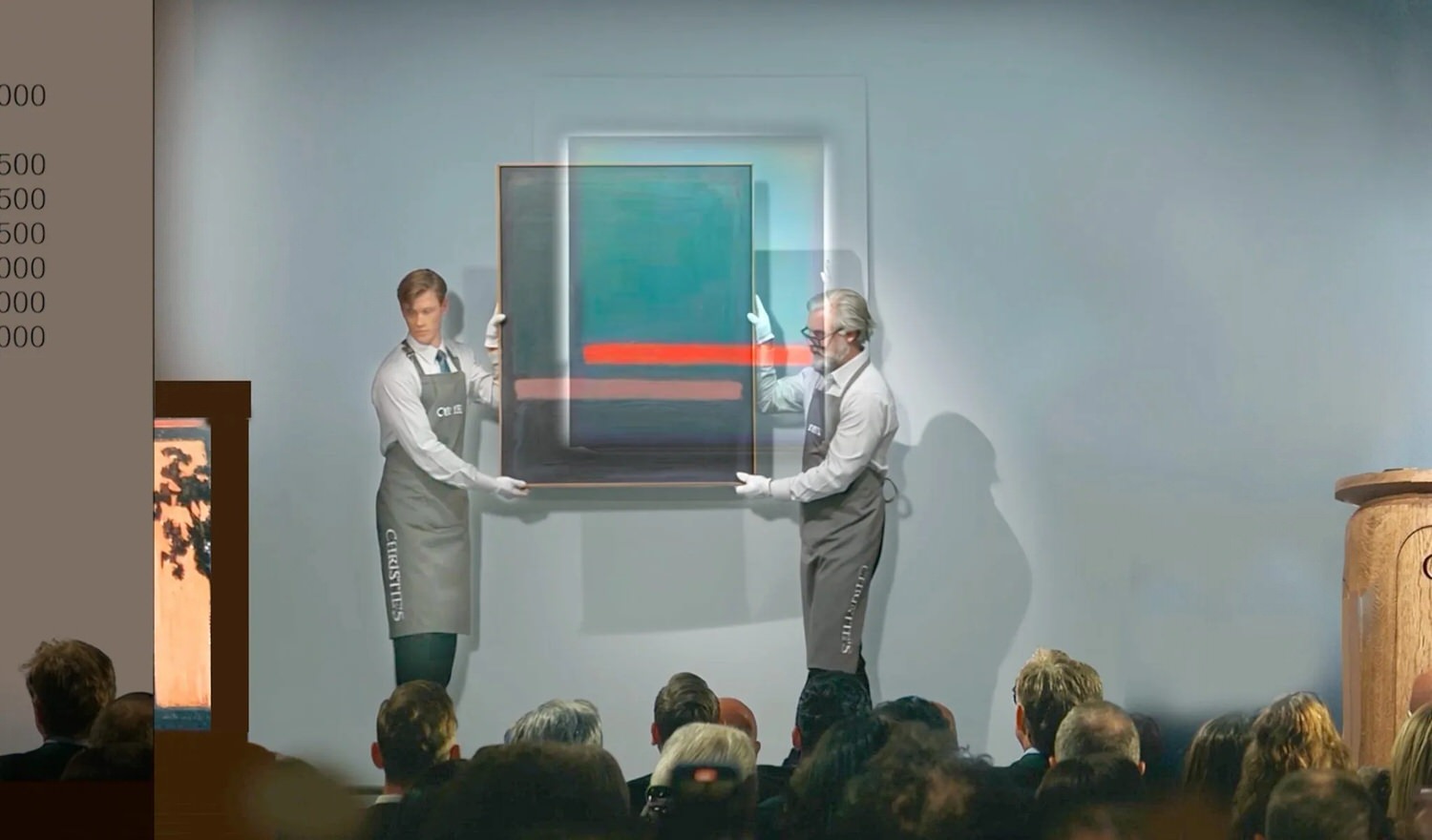
Lights! Filters! Auction! Disclaimer: This artwork is an embellishment strictly for purposes of satire only. Photo courtesy Kenny Schachter
What I will report is that pre-sale jitters on Agnes Gund’s somber Rothko motivated Christie’s to accept what I’ve been told (by more than one source in the know) was a $70 million guarantee, from—incongruously, of all people—the Warhol-, Basquiat-, KAWS-, and Condo-hoarding Mugrabis. It sold for just shy of $100 million, a handy profit and no money down. As intriguing, I uncovered that the painting was lit with filters so bright (to make the muted colors pop), that upon removal of the work for a private inspection, you could still see a ghost-like, chromatic vestige of the outline of the painting remaining. Neither Tico nor David Mugrabi replied to my inquiries on the subject. The auction house did not immediately reply to a request for comment.
If seeing Nicole Kidman entranced in a come-hither waltz with a Brancusi head in a Christie’s promo video wasn’t preposterous and ineffectual enough (I’d rather they’d roped in Tom Cruise and reenacted a scene from Eyes Wide Shut), now Pace is engaged in an even more banal dance, jumping into the tchotchke business with Brancusi’s estate to manufacture knockoffs—excuse me, posthumously produced editions (picking up the baton from Kasmin Gallery). Brancusi is sure to enjoy his most prolific year to date.
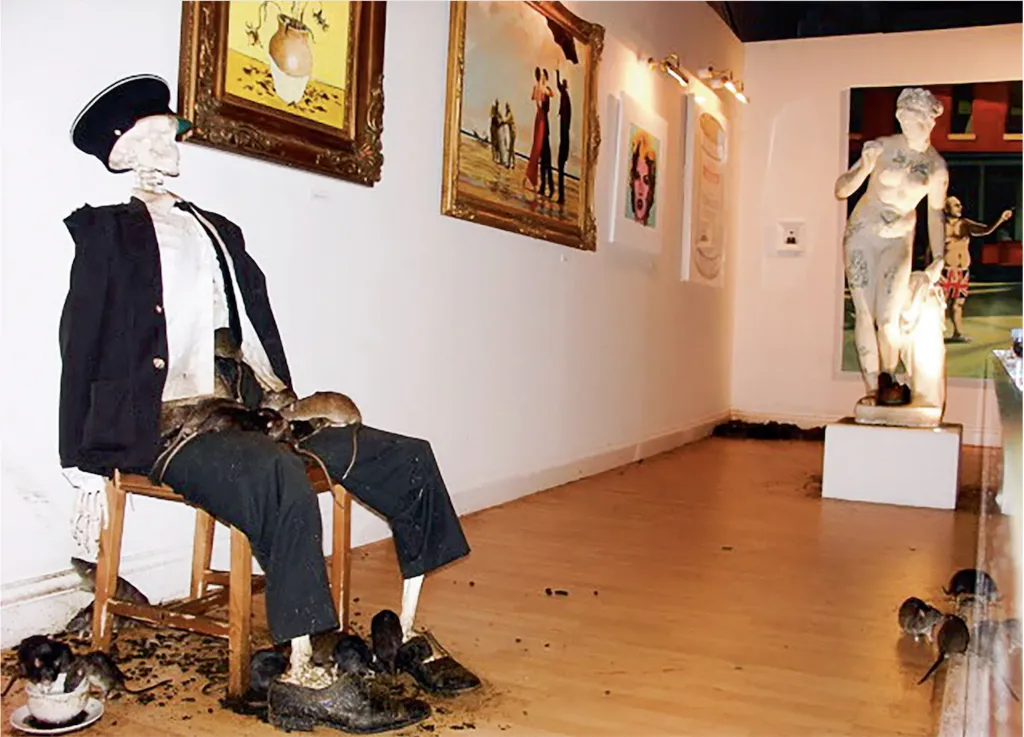
Banksy’s “Crude Oils” exhibition in London, 2005. Not recommended for children… or anyone else for that matter! Image courtesy of Banksy Explained website.
In 2005, in what was street artist Banksy’s first indoor art show, I dragged one of my kids—who was all of about 10 years old at the time—to an empty storefront in London’s Notting Hill that was heaving with hundreds of running-amok-rats, climbing up and down the pants of uniformed, security-guard skeleton sculptures and graffitied flea-market paintings. (What Gagosian gallery will resemble after the apocalypse.) The rats had free rein throughout the space, trundling over our shoes and ankles. Let’s keep this between us and away from child-welfare services, please.
Nothing from the aforementioned London outing was, at the time anyway, intended as a bauble for the crassly rich; it was, rather, a poignant, unsettling, conceptual conceit in total. I do not particularly value the later example (remade nearly a decade after the fact) of those stenciled canvases that was recently auctioned by Loïc Gouzer’s Fair Warning for $18 million at, fittingly enough, the local Tiffany’s outlet, but I do admire and respect Loïc’s maverick, risk-taking stance in relation to the staid, archly conservative art market from which he so prominently hails.
Banksy can be a witty commentator on art, economics, and politics—he is an artist who will resonate historically for generations to come, I assure you. As stated, the painting was originally sold by Danny Comden, an L.A. actor-writer-director-producer-art dealer (hats off to a man as hyphenated as I) who was gifted the work by Banksy after successfully acting as the artist’s California agent. I can disclose that the work was previously sold by Gouzer for $12 million during Covid and subsequently guaranteed by a collector for his Fair Warning app for $13 million. Loïc was also underbidder, on behalf of a client, for the infamous Banksy that was shredded immediately post auction at Sotheby’s in 2018.
Engraved into Gouzer’s tombstone will be that he masterminded the sale of the Salvator Mundi (ca. 1500) allegedly by Leonardo da Vinci to Saudi Crown Prince Mohammed bin Salman for $450.3 million—so much for getting what you paid for. Recently reported in Artnet is the existence of a sister painting to the one owned by MBS, a work heralded today primarily for the price it fetched.
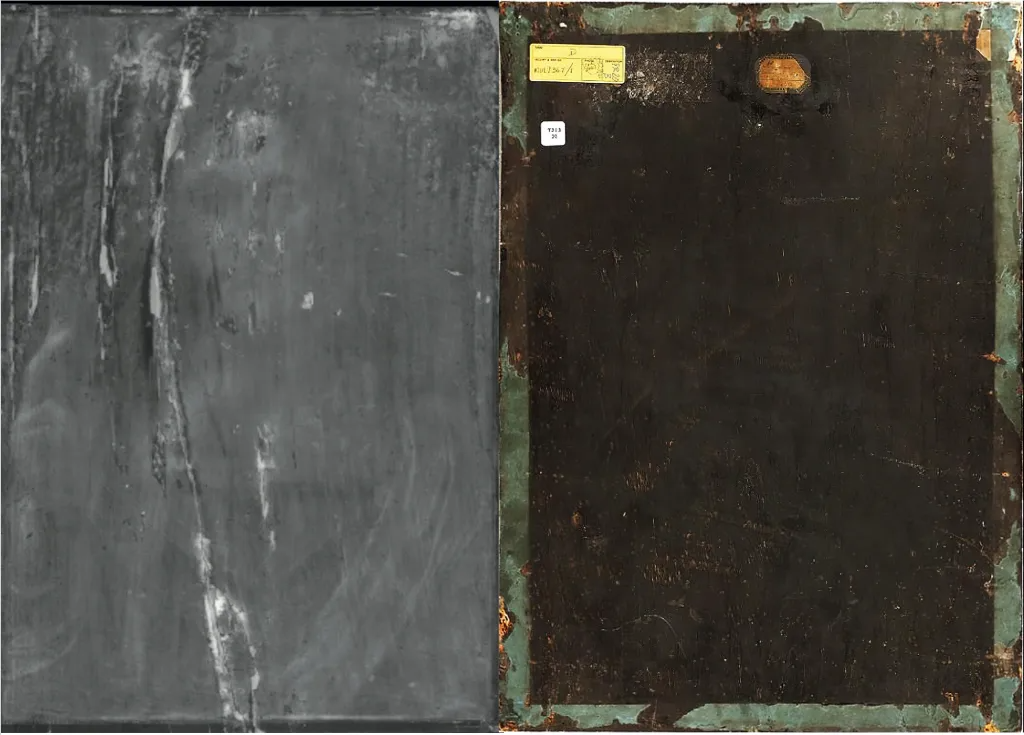
On the left, the inferior wood of the $450 million MBS Mundi, courtesy of Ben Lewis’s “The Last Leonardo” 2019, Harper Collins UK, Penguin Random House/Ballantine USA and Mondadori, Italy; and on the right, the recently exhibited Maastricht version in a fine walnut, as preferred by Leonardo, which could be yours for a bargain basement price of under $100 million [the new $1 million at auction these days].
Unlike the $450 million Mundi, the work alluded to above has a much better provenance, having been exhibited in 2019 at the Louvre as a “version by a faithful pupil of the master, doubtless painted under his supervision and with his possible intervention” and, in 2021, at the Prado museum as “studio of Leonardo, authorized and supervised by him.” Additionally, that Mundi, exhibited in March of this year by Agnews Gallery at TEFAF in Maastricht, was painted on a walnut panel, as favored by Leonardo, versus the knotted, far inferior wood in the version that ended up on the Prince’s yacht in an infamous 2019 story that I broke.
I can reveal that the owner of the Maastricht Mundi is Jacqui Safra, a Swiss financier, serial entrepreneur, movie producer, and ravenous collector of Old Masters, previously engaged in a high-profile dispute with Christie’s over the forced, below-market sale of art they had taken as collateral for a cash advance. He’s also the owner of the Encyclopedia Britannica; which, if you’re too young to remember, was our Wikipedia and Google—rolled into 26 volumes, one for each letter of the alphabet, which was a great tool to copy verbatim while cutting corners for grade-school book reports.
Safra is presently thick in the middle of negotiating the sale of his Mundi, via Agnews, privately and/or at an upcoming auction in the vicinity of half the reserve of the Mundi sold at Christie’s, which might—or might not—very well be the deal of the century. A potential bargain at today’s prices for art, where $100 million is the new $1 million. Ugh.
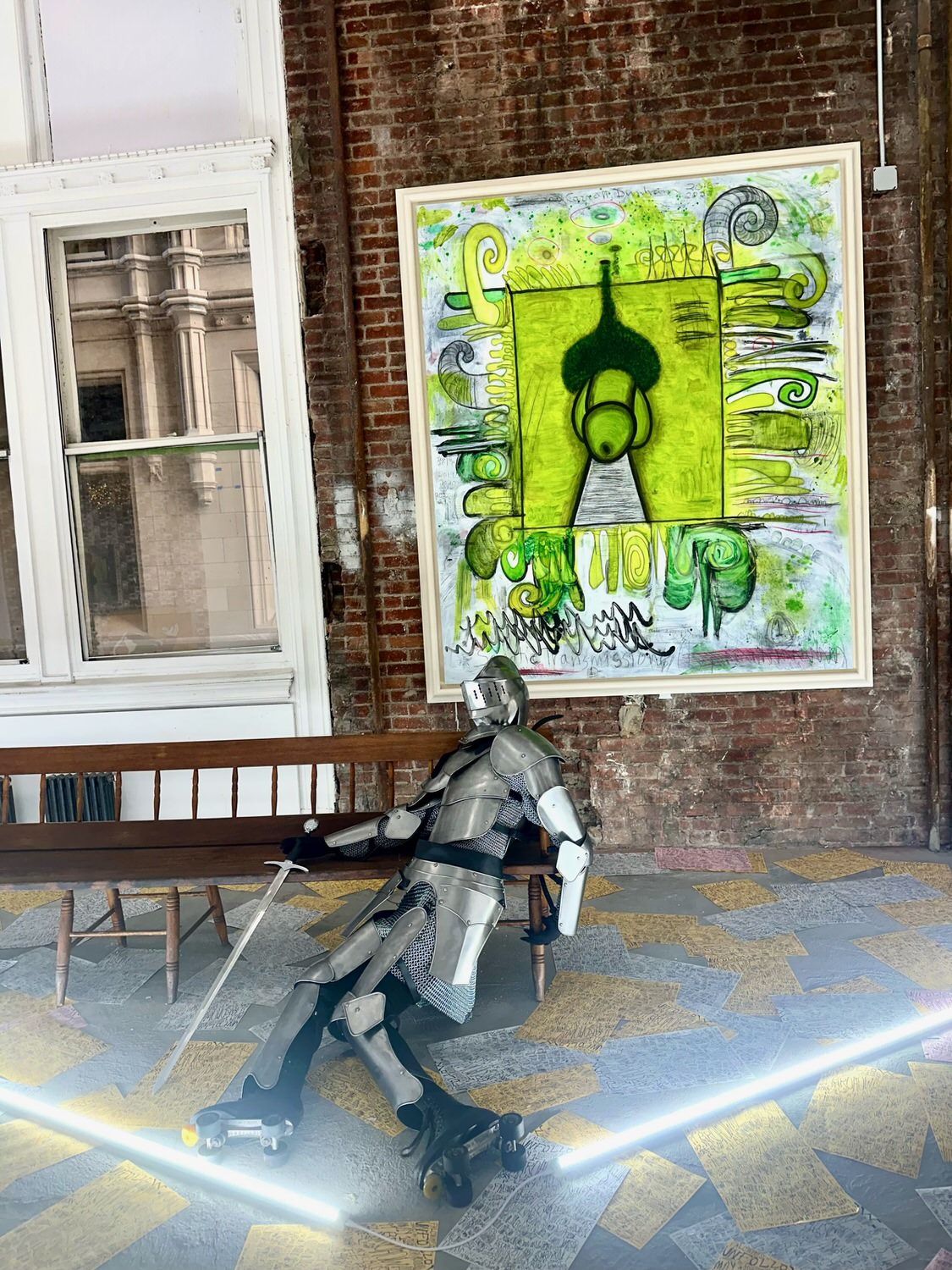
Olaf Breuning and Carroll Dunham at “Unfollow.” Image courtesy of Falcon Art Collective
On a more positive, hopeful note is the massive, buzzy group show “Unfollow,” curated by Paololuca Barbieri Marchi, Marco Boggio Sella, and Robert Storr at 111 Broadway in New York City, through May 31. The block-long, monster-scaled space is organized by Falcon Art Collective, a group of like-minded artists who industriously ferret out free locations, like we did in the early 1990s, when resources were similarly tight. Take note, Josh Kline. The exhibit is chockablock with artists from multiple generations, known and emerging, and is brimming with energy. It’s not to be missed, so hurry!
Thankfully, I haven’t had to resort to pilfering in my personal life—never say never—but I have engaged in some economizing of my own by stocking up on Plantraw granola and other organic foodstuffs, so much so that the company contacted me to offer my very own personalized discount code (Kenny10), replete with a QR link, and encouraged me to share it with likeminded shoppers. In full transparency, I am now the recipient of the occasional new product offering gratis due to my patronage. Every little bit helps.