

Good thing this Getty’s gross grotto is private, to save us from it. That’s something to be thankful for. Image via Kenny Schachter
As we roll into February 2026, Mr. Green still hasn’t shown up (the turn of phrase used by lawyers for the withdrawal of counsel due to a client’s inability to pay). I am referring to the ongoing market downturn for emerging artists, young and old, and the small to mid-sized galleries that continue to struggle to sell their works. This was exponentially exacerbated by a period of rapid expansions that, in hindsight, occurred at the least propitious time imaginable—the early 2020s—before a systematic implosion occurred across all sectors of the economy, the stench of which still lingers strongly.
The frenetic pace of international gallery bloating was analogous to the American car industry investing a trillion dollars into electric vehicles before reversing course after gas tanked and drivers switched lanes back to hybrids (Puns “R” Us). What many in gallery land failed to foresee or comprehend was that we were (and continue to be) squarely in a transitory art economy that has never existed before in its present guise. Other than the few anointed artists who still manage to buck the trend, non-canonized work from all genres is, at best, sputtering ahead.
One dealer told me: “Even the hills are looking for someplace to run.” Selling contemporary art is akin to working in a supermarket where a potential buyer swaggers in, ruthlessly negotiates down the price of a quart of milk, doesn’t pay for six months, and then returns it claiming it’s rancid. There has been much talk of a K-shaped economy amplifying blatant inequalities, where the rich get incomprehensibly richer and everyone else declines. The world is small and the art world minuscule, thus the concentration of hardship is as interminable as it is grueling.
I believe, though, that the economy is “i”-shaped. We live in a monetary caste system, a top-to-bottom hierarchy perpetually inflating and compounding, with a little disconnected dot floating above that signifies wealth far beyond the conception, never mind the reach, of mere mortals, including successful ones. The speckle above contains the mammoth monied class, comprised of global tech overlords, hedge funders, industrialists, property tycoons, and an elite hodgepodge of others.
In art, there’s the likes of Klimt, Van Gogh, Modigliani, Magritte, Monet (or Mon-ey, as Paul Thek referred to him in his writings), and others. And then there’s Basquiat illustrating the “point” on another level altogether. (Read on!)
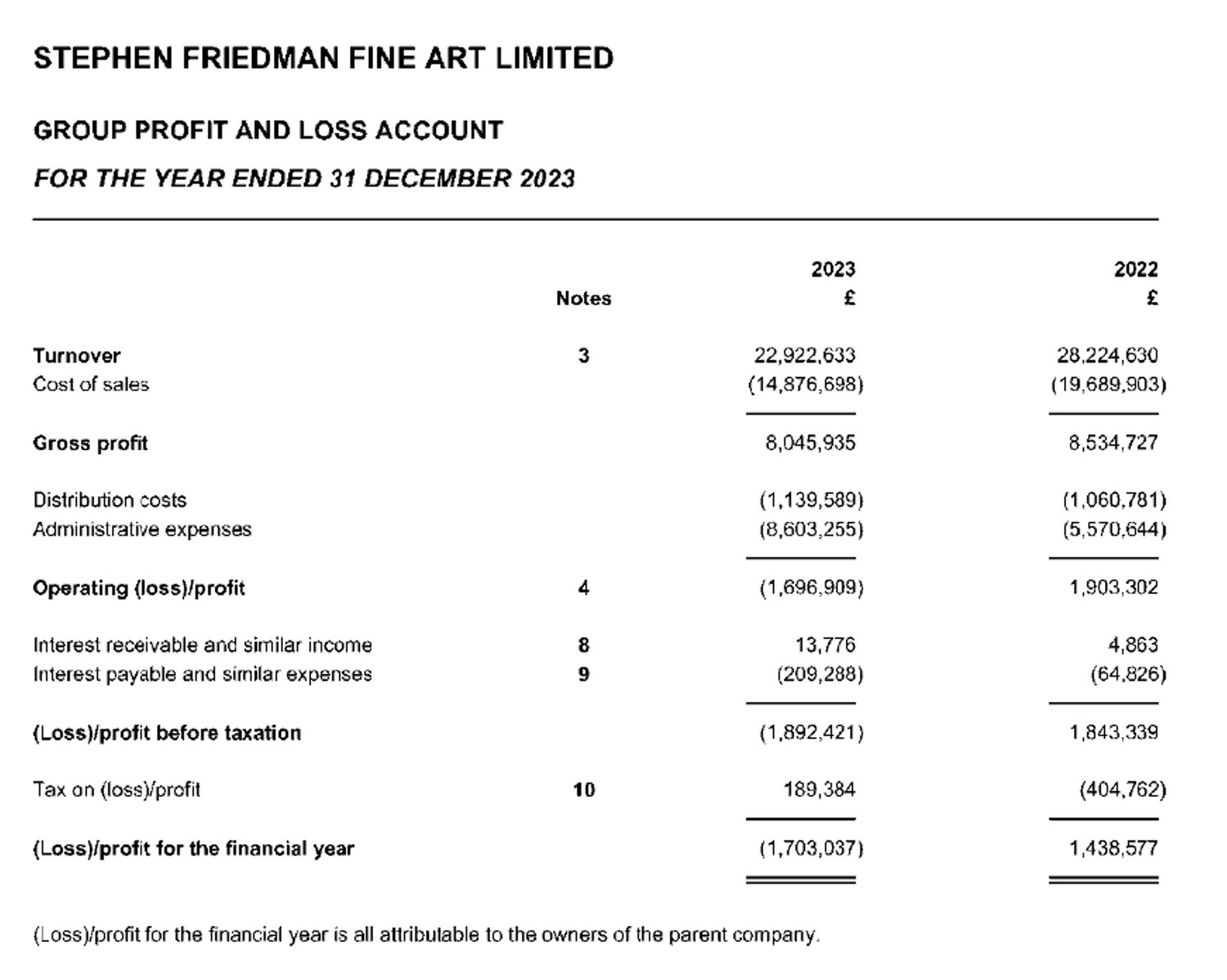
I am not one for numbers, but I can figure this equation out, and it’s not happy. Sadly. Image via Kenny Schachter
An Art Market Case Study: London’s Stephen Friedman Gallery
Where are Stephen Friedman Gallery’s accounts? Its 2024 financial reports are overdue, according to the U.K. Companies House database, and the London firm seems to be in serious financial straits.
Not long ago, the gallery’s success appeared to be mushrooming. The profits it reported in 2022 were more than double the previous year. In 2023, the gallery, whose roster includes David Shrigley and Yinka Shonibare, moved into a large new space on Cork Street—Mayfair’s premier gallery address—and expanded overseas with a New York outpost in Tribeca. Yet the annual report and financial statements of Stephen Friedman Fine Art Limited for the year ended December, 31, 2023, tell a more complicated story. The company recorded a loss of £1.7 million (about $2.33 million at the present exchange rate), larger than the profit it had made the year before.
The auditors signed their report in February 2025. They stated that the business’s ability to meet short-term operating cash requirements was reliant on obtaining external financing and the outcome of discussions with creditors to extend normal payment terms. The auditors added that these factors created a “material uncertainty” that may cast doubt on the company’s ability to continue as a going concern—accounting language used when there is uncertainty over whether a business is expected to continue its operations for the foreseeable future.
This concern was echoed in the company’s own accounts. Its financial statements, approved last February, explained that the business relied on bank facilities to meet its day-to-day cash needs. The gallery’s forecasts showed a period of several months during which additional borrowing would be needed to meet its commitments. The statements also said that wider economic conditions were creating uncertainty over demand for the artworks it sells. Friedman, the sole director of the company, concluded that, until additional financing was secured, there remained a material uncertainty over its ability to continue as a going concern.
Someone by the name of Alison Jayne Mosheim, of Pentland Group Limited (who I have reached out to, unsuccessfully), is indicated in the company filings as the owner of somewhere between 25 and 50 percent of the gallery. Pentland is a British privately held multinational company that owns and invests in businesses in the sports, outdoor, and fashion sectors, including Speedo swimwear. She’d be well-served to start swimming—away from what may very well be a sinking ship.
Late in 2025, Stephen Friedman told the Financial Times that he would close its New York space, only a few years after opening, with the explanation that he wanted to concentrate on activities in London and that he was adding three new U.K. directors. He said:
…the decision to close [New York] was not specifically financially related, but we spent money fixing up that space and money fixing up this [London] space and we had losses in that year [2023], for the first time in a long time. [Now] we are very much back on track [financially] and in a position to focus more time, investment and other resources to enhance the London operation…
In my digging, which involved reaching out to a handful of gallery artists, I heard allegations of outstanding sums owed to artists and vendors alike—in some instances, substantial sums. Additionally, one source told me that an “emergency” call was scheduled with gallery staff last week; I have yet to determine the outcome. Repeated attempts to reach Friedman and the gallery by phone and email have been unsuccessful (even during business hours). The writing is on the walls; but, it appears, the paintings may soon be off of them—at this stage, closure may very well be a fait accompli.
Conclusion: The only thing worse than over-aggressive, premature expansion is borrowing money to effectuate such a misguided strategy.
A Los Angeles Mystery
Dealer Matthew Brown has a seemingly far healthier balance sheet, but both of his spaces in Los Angeles (where he founded his gallery in 2019) have closed and are listed for rent, after expanding to New York’s Tribeca in April. To pick up on Janelle Zara’s recent Wet Paint column (someone convince her to stay!), Brown hasn’t staged an L.A. show since September, and no new L.A. location (or show) has yet to be announced. As I type, the gallery is “by appointment only” in the city, though any rendezvous would need to transpire in a parking lot—in fact, that would be a very L.A. way.
The Basquiat Bonanza
Jean-Michel Basquiat belongs in a category of his own in just about every respect.
He is currently the subject of a just-opened exhibition at the Louisiana Museum outside Copenhagen called “Headstrong,” which has works on paper depicting—you got it—a cache of craniums (through May 17), and he remains a perennial market maven, breaking one record after another, despite an unremitting torrent of economic upheavals. All pretty astonishing, especially since he lived only until 27 and still managed to create around 2,500 to 4,000 works.
I can reveal yet another monetary milestone (not that that’s indicative of anything good in the world, but we’ll leave that for now). Ken Griffin has been on a Basquiat binge that has amounted to approximately $500 million, if not more, washing down one painting by the artist after another, including spending $35 million for the 1984 canvas Pez Dispenser, from the estate of long-time Basquiat dealer and catalogue raisonné publisher Enrico Navarra.
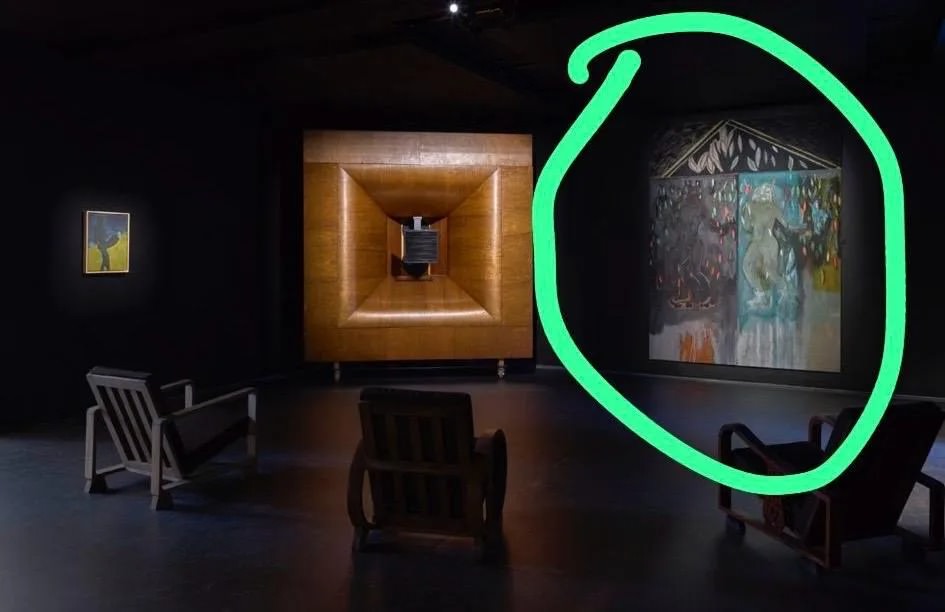
How much is that Doig-y in the window (of the Serpentine)? Too much, if you have to ask. Illustration by Kenny Schachter
Doig and Damien in a Diamond Dot of Their Own Devising
Speaking of stupidly expensive art, here’s an artist who’s tragically turned from kind of fabulous to fatally fatuous. Damien Hirst has just unveiled a grotesquely ostentatious amethyst grotto tackier than words could tell at the private estate of Mark Getty, the grandson of oil tycoon J. Paul Getty, in Buckinghamshire, England. (The estate is called Wormsley: good name for it.)
In a recent podcast, Hirst revealed that the most influential person in his life is none other than Joe Hage, his single-minded business manager. Hirst also revealed that he may give up painting, as he is the first artist in history to profit more from the sale of his prints than his brushwork, through Hage’s publishing company Heni. Hirst might want to spend some time brushing up on his art history now that he’s not painting. That distinction belongs to 16th-century artist Albrecht Dürer, who proclaimed that printmaking was more lucrative than painting, leading him to halt production on paintings for a period to instead focus on engraving and woodcuts.
Peter Doig certainly doesn’t have much in common with Hirst, other than the fact that they share Hage as a business manager. This may account for the fact that two of Doig’s recent works in his museum exhibition, “House of Music,” at the Serpentine in London (open until February 9) are quietly for sale via my old friend Larry G, from $4 million (for a paper mounted to canvas) to $7 million for a canvas. (Don’t worry: Doig’s also has Heni prints on offer from Hage.) In other words, the Serpentine shares much in common with Sotheby’s new Breuer outlet—two museums flogging art, one present and one past. Lord have mercy on us all.