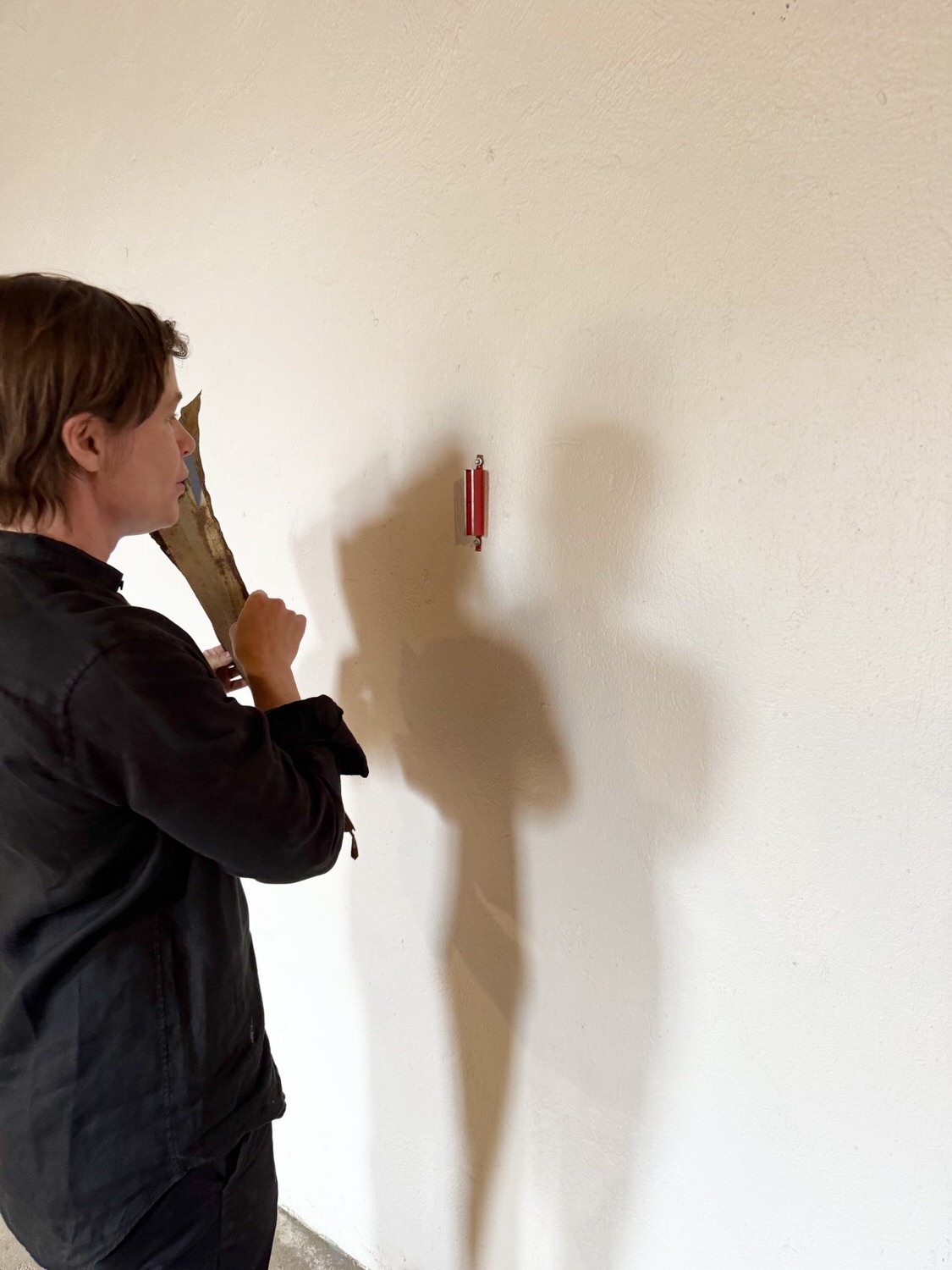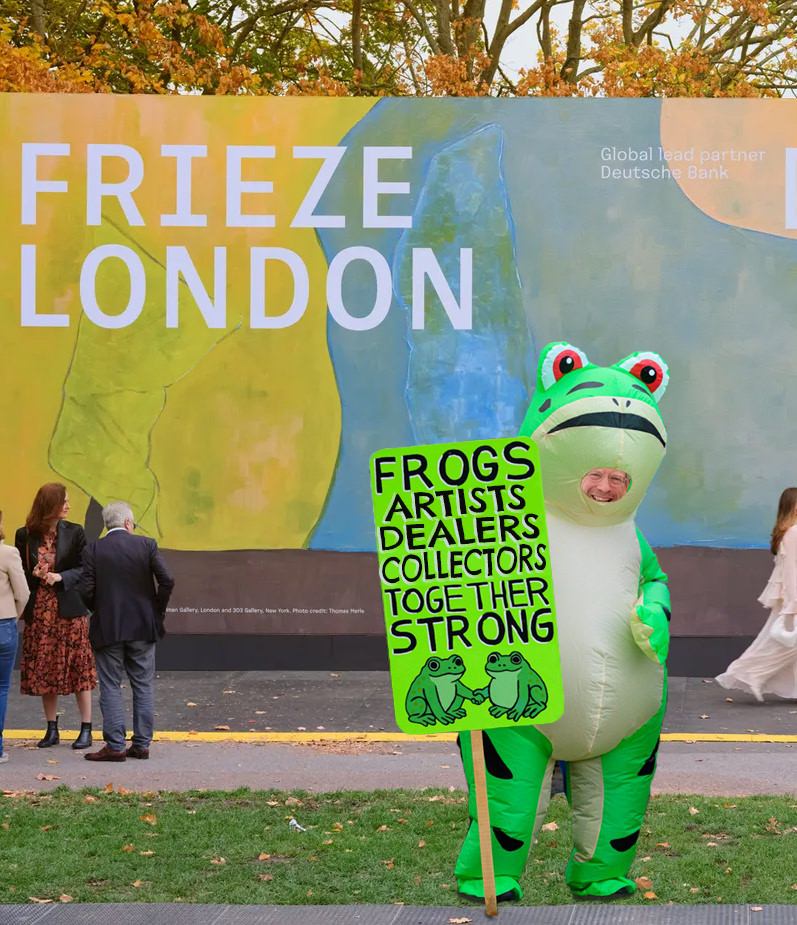
Just back from the preposterous Portland ICE invasion on the basis that it’s a hotbed of terroristic activity, now donning my frog costume protesting the onslaught of negative media that flies in the face of the robust, thriving community of artists, dealers, and collectors. Photo courtesy Kenny Schachter
The largest U.S. protest to date, with 20 million people, remains the First Earth Day in 1970, a demonstration to draw attention to environmental issues that was organized by U.S. Senator Gaylord Nelson. The second largest is Hands Across America (1986), with seven million people, an effort to raise money and awareness of hunger and homelessness that was organized by Ken Kragen, co-founder of USA for Africa, which involved participants holding hands in a chain across the country. Sadly, we haven’t fared particularly well on either issue.
The No Kings protests on Saturday came in close behind them, with more than five million taking part in the marches against the authoritarian policies of President Donald J. Trump and the alleged corruption in his administration, according to some estimates. (Organizers put the number at nearly seven million.) The voices of sane, peaceful Americans cannot be easily squelched, and the protests reminded me that I shouldn’t be—too—embarrassed to acknowledge where I hail from (before my family immigrated). Naturally, His Petulant-cy responded by posting an A.I. video of himself piloting a fighter jet, dropping poop on the far-bigger-than-his-inauguration crowds.
All the power to the fearless, inflatable-frog-clad activists railing against the systematic brutality of ICE and the National Guard deployed in that hotbed of international terrorism, Portland, Ore. I’m going to don my frog suit and head to the nearest art fair to object to the onslaught of negative media coverage that flies in the face of the robust, thriving community of artists, dealers, and collectors that doggedly prove them wrong year after year.
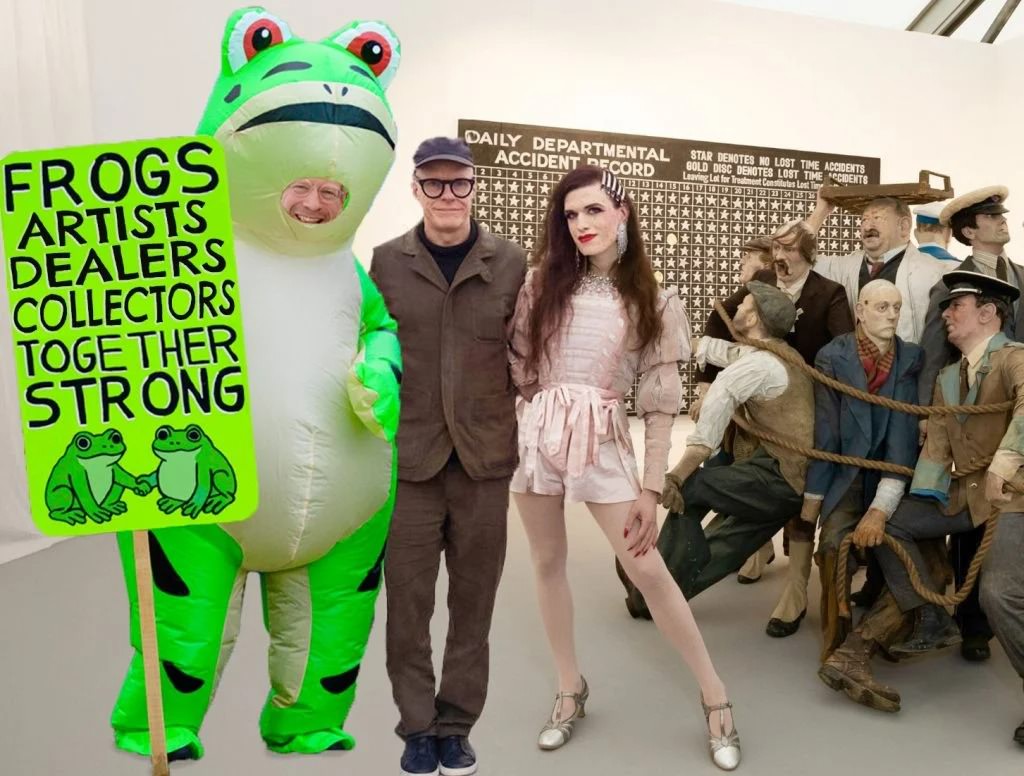
Alex Margo Arden, who won the inaugural Nicoletta Fiorucci Foundation Prize, and me in my frog outfit at Frieze with Ginny on Frederick gallery, along with Hans Ulrich, who manages to be everywhere at once: He must have that Star Trek beam-me-up-thingy. The artist’s work was also acquired by the Arts Council Collection. Photo courtesy Kenny Schachter
On a more pedestrian front, JPMorgan Chase CEO Jamie Dimon recently warned about potential peril in the $1.7 trillion private debt market after a handful of large-scale (and -profile) defaults. He compared them to “cockroaches,” inferring that, where there is one, there are probably more. But Dimon’s fear-mongering misses the point. Look at the succession of relentless cycles throughout history, economics and otherwise: a rash of new initiatives invariably crop up to fill the void left by the deceased or departed. The same could be said about the doom and gloom that continues to pervade art world reportage.
Forgive me for repeating myself, but please indulge me: Yes, one gallery folds here, another there, and so damn what? The repetitive headlines are monotonous and disingenuous, as Led Zeppelin called it in 1973’s “The Song Remains the Same”:
Any little song that you know
Everything that’s small has to grow
And it’s gonna grow now
Push, push, yeah
To that effect, read Scott Reyburn’s encouraging New York Times article on enterprising enterprises last week and the captivating artists and galleries he highlights. The title says it all: “Britain’s economy has slowed, and sales at blue-chip galleries are down. But among young artists and emerging dealers, the mood is upbeat.”
About a certain, flourishing bicoastal gallery (that will remain anonymous—I gave my word), I can report that persistent, spiteful rumors about them shedding one of their beachheads and retreating back home are not only false; they are, in actuality, looking to expand in New York by opening a second space.
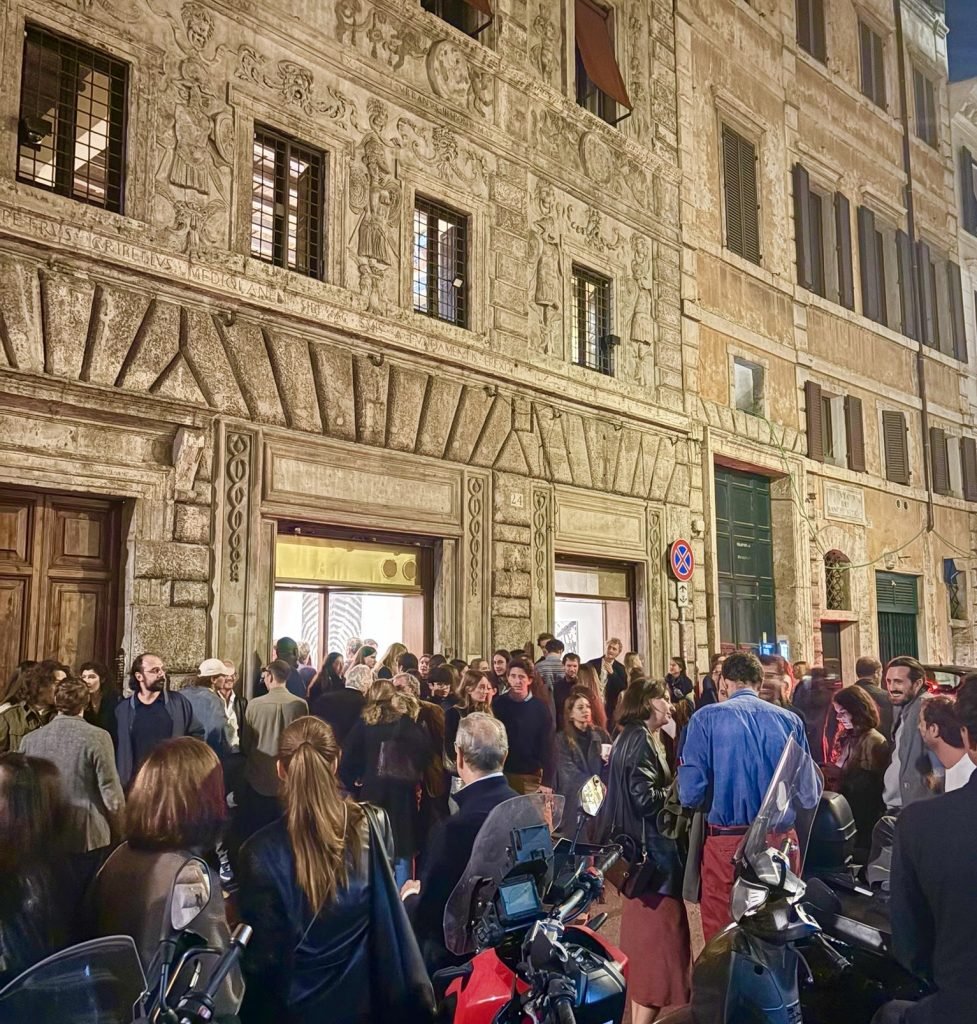
Amanita’s raging Rome opening a short while ago: Art action on the front lines never gets old, tired, nor will it ever, though I am beginning to. Photo courtesy Kenny Schachter
Along the same lines, with two spaces and a bar on the way in New York, Amanita inaugurated its third location in Rome on October 9 with a show by Daniele Milvio. (Disclosure: My son Adrian shows with them!) The exhibit, rammed with spillover crowds at the opening, has since sold solidly at prices ranging from €12,000 to €22,000 ($14,000 to $25,600). The unorthodox model that has enabled Amanita to buck the bleak kismet of late involves having four 20-something stakeholders (the bastards) equally vested in the fate of their business, shouldering various aspects of the partnership. Counting employees, they are nine in total, helping them remain lissome and flexible in the face of economic uncertainty and vicissitudes.
A brief note on Frieze, which was deemed a success, and Paris Basel, which I confidently predict will best it, just in time for the premiere of the Cartier Foundation, yet another venue to showcase contemporary art in a city teeming with it. A New York dealer I just spoke to reported their most profitable results ever and has now landed in Paris to begin setting up a Basel booth. Sounds grueling from where I’m perched at present (New York City). The grande dame of the art trade, Georgina Adam, whom I revere (how is her age nowhere on the internet, I need to know?), recently asked in the Art Newspaper, “Is Art Basel Paris set to consume the Swiss original?” to which she answered: “the answer seems still to be a clear… no!”
The highlight of Frieze Week was undoubtedly the blockbuster Kerry James Marshall exhibition, his largest outside the U.S., at London’s Royal Academy of Arts (RA), curated by Mark Godfrey, Tate curator from 2007 to 2021. I previously reported that the owner of the $21 million painting Past Times (1997), Puff Daddy, had sold the work at the onset of his, uh, legal situation. After the fact, I discovered the $30 million buyer reneged.
Godfrey had contacted me to determine the ultimate owner of the work, as he told me that the RA under no circumstances would borrow from disgraced Diddy. I can now confirm that it has indeed been sold, as confirmed by Godfrey. What Mark didn’t reveal, though I can now disclose, is that he’s likely next chief curator of the museum after the recent expiration of Adrian Locke’s term. (Godfrey told me after publication: “I am not a candidate for the RA job and I don’t quite understand why you wrote that in your article.”)
More intriguing (and juicy) is what a prominent birdie whispered into my ear about the new buyer! It was Larry G, after another offer of $29 million was turned down. Diddy paid $21 million, remember: The rich get richer, even while rotting in Brooklyn’s notorious Metropolitan Detention Center. It went to Gagosian for $30 million, or just above, and not to Ken Griffin; flush as he is, he’s isn’t a fan of KJM (if that’s possible!). Larry G did not respond to my text seeking comment. (See photo.) So, if it wasn’t for Larry, perhaps Jeff Bezos? Bear with me, I’ll find out… I always do.
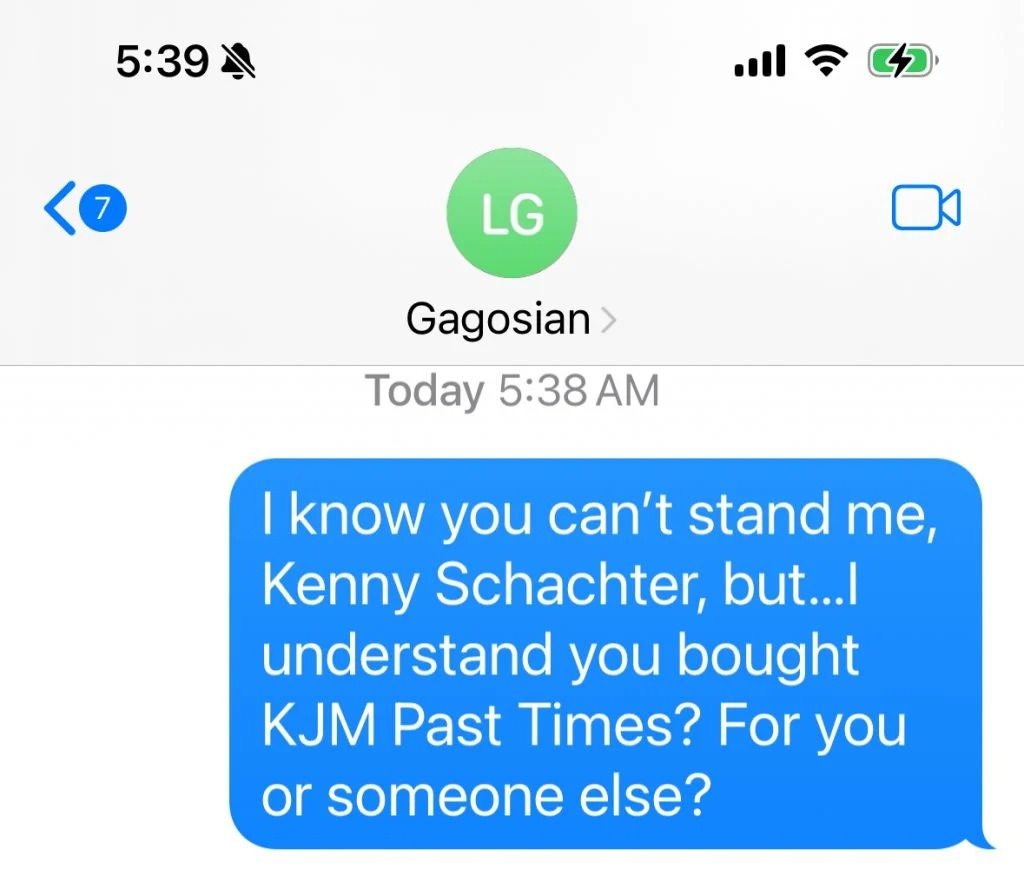
Photo courtesy Kenny Schachter
Regarding the hullabaloo about London galleries—big, medium, and XL—reporting substantial year-on-year losses, you merely have to read between the lines (or a forensic accountant does) to get a clearer picture of what is actually at hand. The apparent U.K. money misfortunes that have befallen behemoths Hauser and Wirth, David Zwirner, and Almine Rech are more the outcome of forum shopping than anything else, with everyone searching for cheaper tax regimes. For example, tax refugees Manuel Hauser and husband Iwan Wirth picked up sticks from London and relocated to Switzerland; along with the rest, they are essentially rerouting secondary sales through more financially advantageous jurisdictions.
To wit, observe the exoduses from states like New York and California to Florida and Texas. The same could be said for countries like Italy, the Bahamas, Luxembourg, Switzerland, and Portugal, picking up the slack from countries like the U.S. and U.K. These geographic destinations have come to resemble freeports, the designated secure warehouses near major international airports where goods can be stored without paying taxes and duties until moved to collectors (yes, they still exist aplenty, guilty as charged your honor)—but these are freeports for people.
From 2020’s Brexit to the cessation of the non-domicile tax in April (a tax structure that offered significant advantages for foreign income), the social and economic problems that seem to obstinately vex the U.K. (I can concur after living there 15 years) are entirely self-wrought. They don’t seem to learn. Indulge me one more song reference, in this instance from Radiohead’s landmark 1995 album The Bends:
You do it to yourself, you do
And that’s what really hurts
Is that you do it to yourself, just you
You and no one else
Problems on another level continue to plague Simon Lee’s gallery business and everyone associated with it. Not only did His Majesty’s Revenue and Customs service (the grandiose nomenclature for the U.K. tax authority) shutter his flagship London space (there were also venues in Hong Kong and New York), forcing him into involuntary receivership, but the mess is compounding by the day, especially for its former artists (including Lisa Brice and Sonia Boyce), employees, and those it did business with: art fairs, collectors (who never received art they purchased), secondary consignors, galleries, banks, shippers, and logistics companies.
Adding insult to pecuniary injury are the clawback provisions of the bankruptcy code, which are legal tools intended to ensure against unfair treatment being given to preferential creditors. The insolvency practitioners managing the proceedings have cast a wide net—and continue to do so—in an effort to collect as much from as many as they can; the extent of which is not only unfair but unjust considering they have sued artists and workers who are in no position to disgorge their earned commissions and wages. The only parties that will benefit from such futile efforts are the bankruptcy administrators and, as per usual, the lawyers! A well-known artist told me:
It’s costing us plenty to try and deal with all the unpaid storage and importation fees, etc. There is a lot of stuff going on around clawbacks. So far, we haven’t been affected since Simon neglected to pay us any more money during the clawback period, but the details are kind of crazy, as the winding-down entity’s lawyers are threatening the people who worked during that period for their wages. This seems a lot more randomly mean than when Madoff investors who’d managed to get some money out before he went down were clawed back, since in some way they were passive investors who knew that an investment had risks. Since I am not affected, I don’t think I should comment, but those who are have been deciding about how and when to go public.
If you’ve wondered what felon Inigo Philbrick has been up since his release from prison last year, here you go. I was contacted recently by Nimrod Kamer, a ubiquitous pest who is the self-proclaimed “most ambitious social climber alive.” (He’s appropriately named, nimrod also meaning a foolish or inept person.) I have a soft spot for him, for some odd reason, and here is how our chat transpired:
Nimrod Kramer: Btw Inigo hired me develop a shroom coffee powder. With his wife.
KS: The Great Mushroom Swindle.
NK: A new frontier.
KS: Of hallucinogenic fraud You serious?!
NK: Yeah they got few investors.
KS: What’s your involvement? Illegal, no?
NK: I’m doing reels and research. It’s a tremella shroom powder just like @dirteaworld (look up)
My curiosity was piqued, so I got in touch with the man himself, who’s the subject of an entertaining BBC documentary that you can watch here (if you’re outside the U.K. you’ll need a VPN: ask your kids). I’m not just saying this because I’m in it, but the Times of London characterized the program as a “complex financial saga both neatly explained and deftly personalized by the juicy drama of human acrimony, most especially from the charismatic U.S. art magus Kenny Schachter, a former friend of Philbrick’s. Here is the conversation that ensued:
KS: You starting some coffee co?
Inigo Philbrick: Lattes for cons?
KS: Eh?
🍄☕️
IP: Not sure a coffee company makes much sense — Starbucks seems to be having a hard time
Ahh mushrooms!
KS: 😀
IP: No coffee.
KS: What is it?
IP: A beauty supplement — something Victoria is into
KS: Ahh ok
IP: Chinese medicine made modern basically
KS: Ahh, not the trippy variety 🤣
IP: Hydration. Extends life in fruit flies and meant to plump skin
Trips are a thing of the past — happily for all
Enjoying Texas?
KS: Trips are thing of past?
Texas fascinating but been loooooooooong
IP: It’s a big place. Marfa beautiful but being there a long time… kinda like a prison sentence.
KS: Ha!!!! Why are trips a thing of past?
IP: Because I don’t take drugs!
And don’t do transcendental meditation either
KS: But everyone else does that would be good pay to get back to parity 💰-wise
IP: Good play you mean?
I think that’s an awfully crowded space
Either way, nice to have some work — have been SO many people offering and so few people following through since I got out.
KS: Offering what type of opps?
IP: You name it but I don’t want this to be the subject of the next dispatch so let’s head the conversation off. Trying to do good things in baby steps.
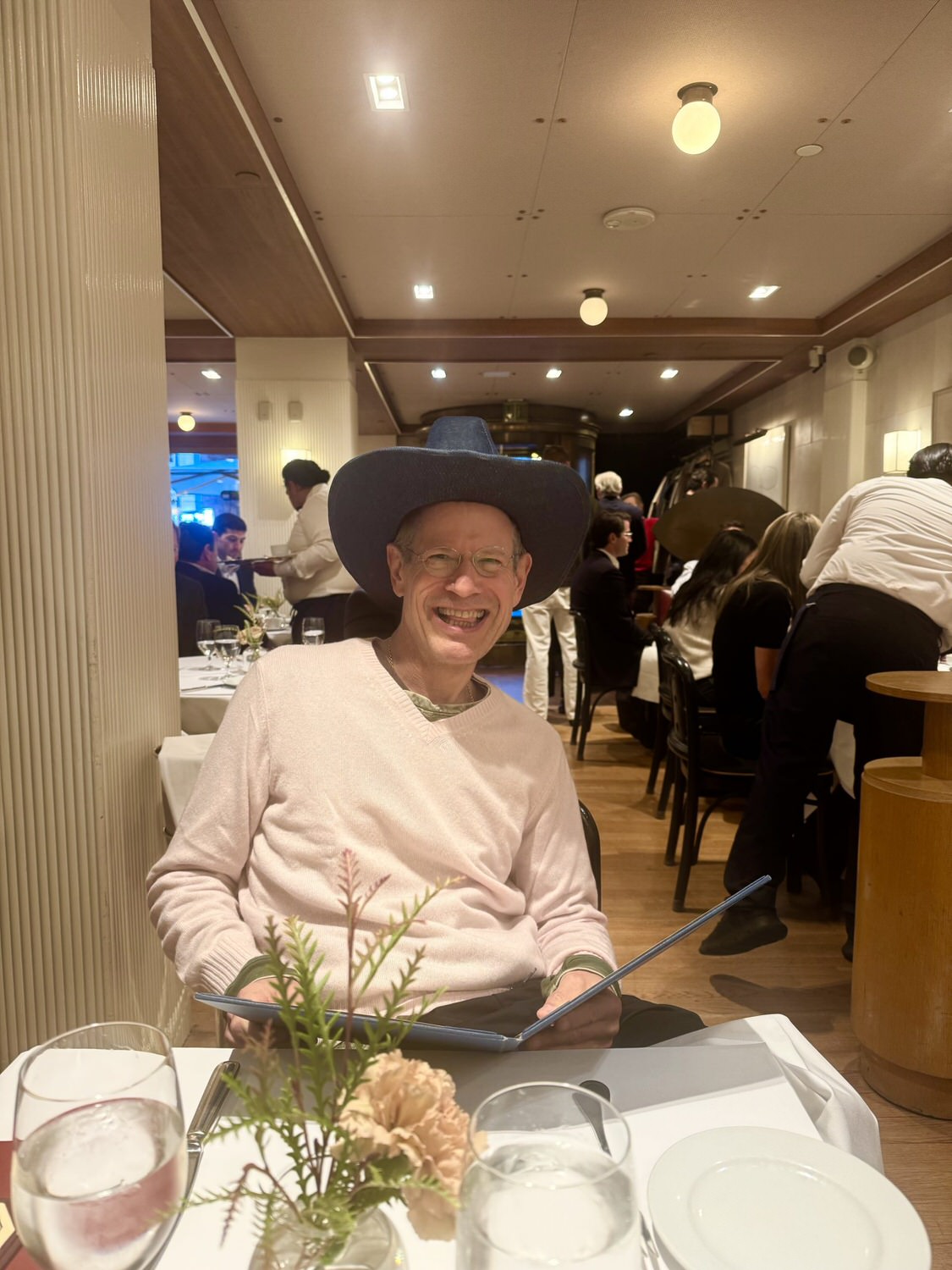
Back in New York City and I can’t seem to shed my hideous denim cowboy hat, which I wore the entire, very long, 15-plus-hour trip home, which entailed a 3-hour drive through the oil fields and two much-delayed flights. When will the alleged leader of our country put its dedicated federal workers back to work? Photo courtesy Kenny Schachter
Some final thoughts on my two-week exhibit and writing residency sojourn in Marfa that came to an end the Sunday before last. I cannot express the scope of what I learned while entrenched in the arid desert environs of the town with a full-time population of about 1,800. I was under the misapprehension that Marfa was swarming with artists and the ilk, but boy was I wrong. That wasn’t exactly the case, even in the midst of the festivities of Chinati Weekend. The revelation for me—besides the stunning, inimitable landscape, which I expected—was the sheer breadth of Judd’s all-encompassing vision and empathetic sensitivities. He made art, design, and architecture whole cloth out of space, as formidable as the metal and adobe he famously plied.
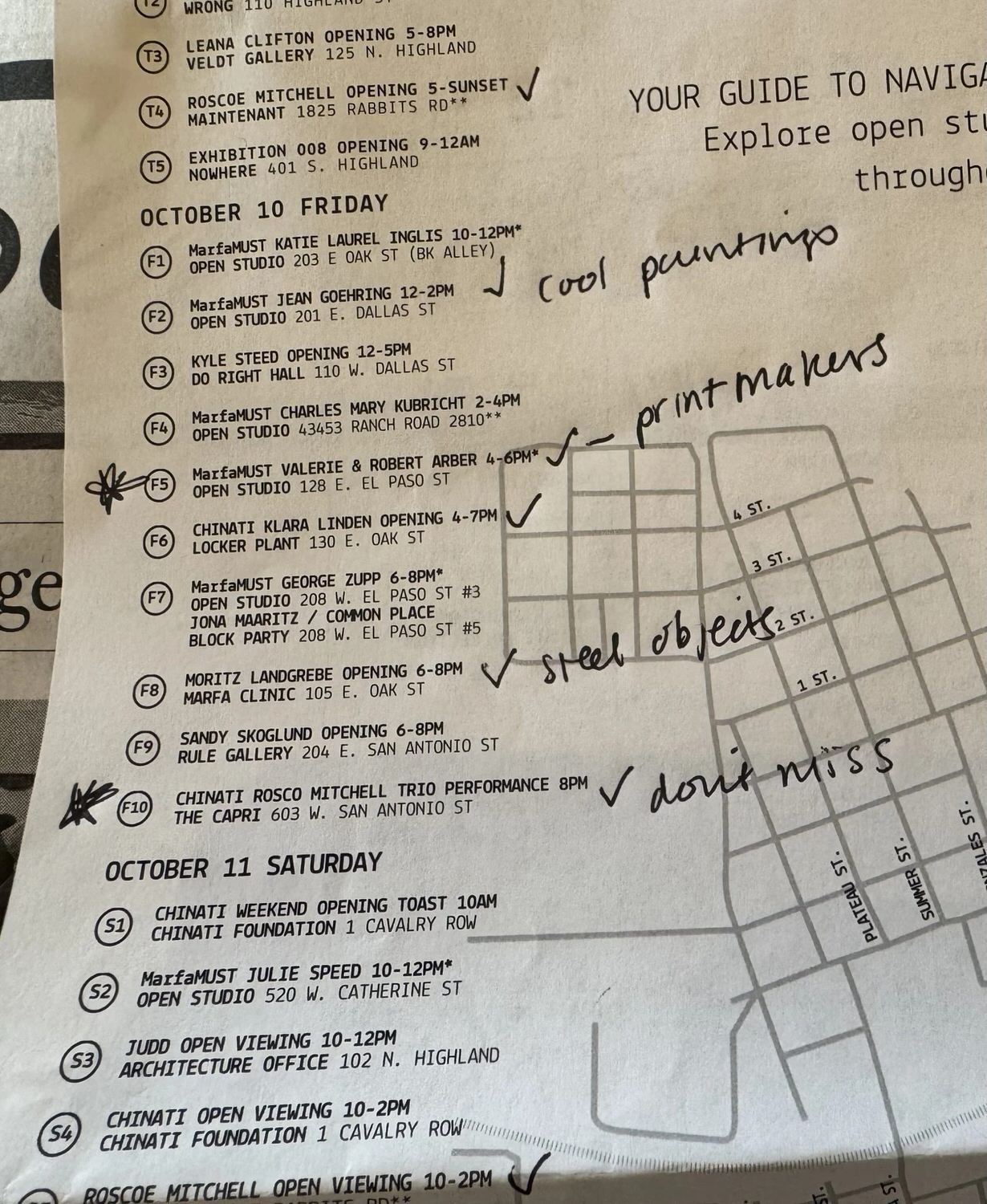
A Chinati Art Weekend cheat sheet, via an anonymous helper. The info proved invaluable. Photo courtesy Kenny Schachter
The Big Bend Sentinel newspaper I wrote for, and will continue to contribute to, is situated adjacent to a bustling café that’s open seven days a week, from 7:30 a.m. to 3 p.m., which is exactly where I plopped myself for the majority of that time. Publicly writing and engaging daily in such an unconventional context resembled a mix between a rodeo and a townhall meeting. I was, for a considerable chunk, post-3 p.m. closing, more alienated than a monk in a monastery: Though they can’t generally speak, they are within breathing distance of their brethren. Being so alone so much slowed down Einstein’s space-time continuum. I wonder if that means I aged less for the duration of the trip?
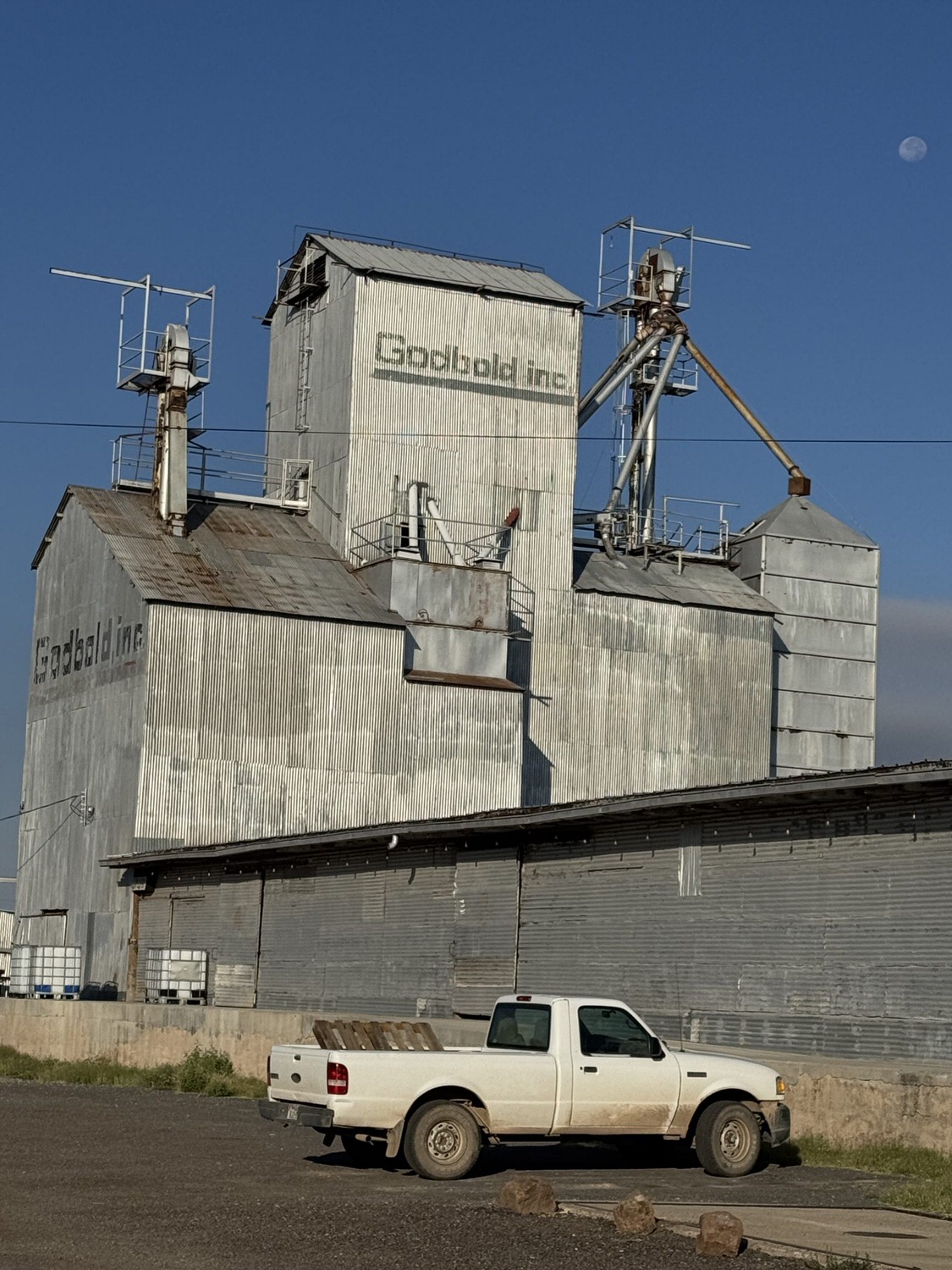
This was Judd’s view out of his bedroom window and across the street from where I was a fixture, perched like a sitting duck for two weeks. I miss it already: as the Terminator said, “I’ll be back!” Photo courtesy Kenny Schachter
My experiences, only fleetingly art related, ranged from discussions of local politics—they voted to raise property taxes 70 percent during my stay, which is under appeal (that looks to be New York’s fate if Mamdani wins the upcoming mayoral race)—to the prospect of computer cooling facilities to fuel the A.I. revolution (bubble). The highlight was getting taken to the woodshed by a cowgirl who admonished me for talking too loudly on the phone while we were both outside, ha, ha! I’ll miss the wailing screech of the freight trains running adjacent to my Airbnb bedroom 24/7 (I now can’t sleep without them), and the genial hospitality of literally everyone I met, Judd related and otherwise. Except for the cantankerous cowgirl, that is.
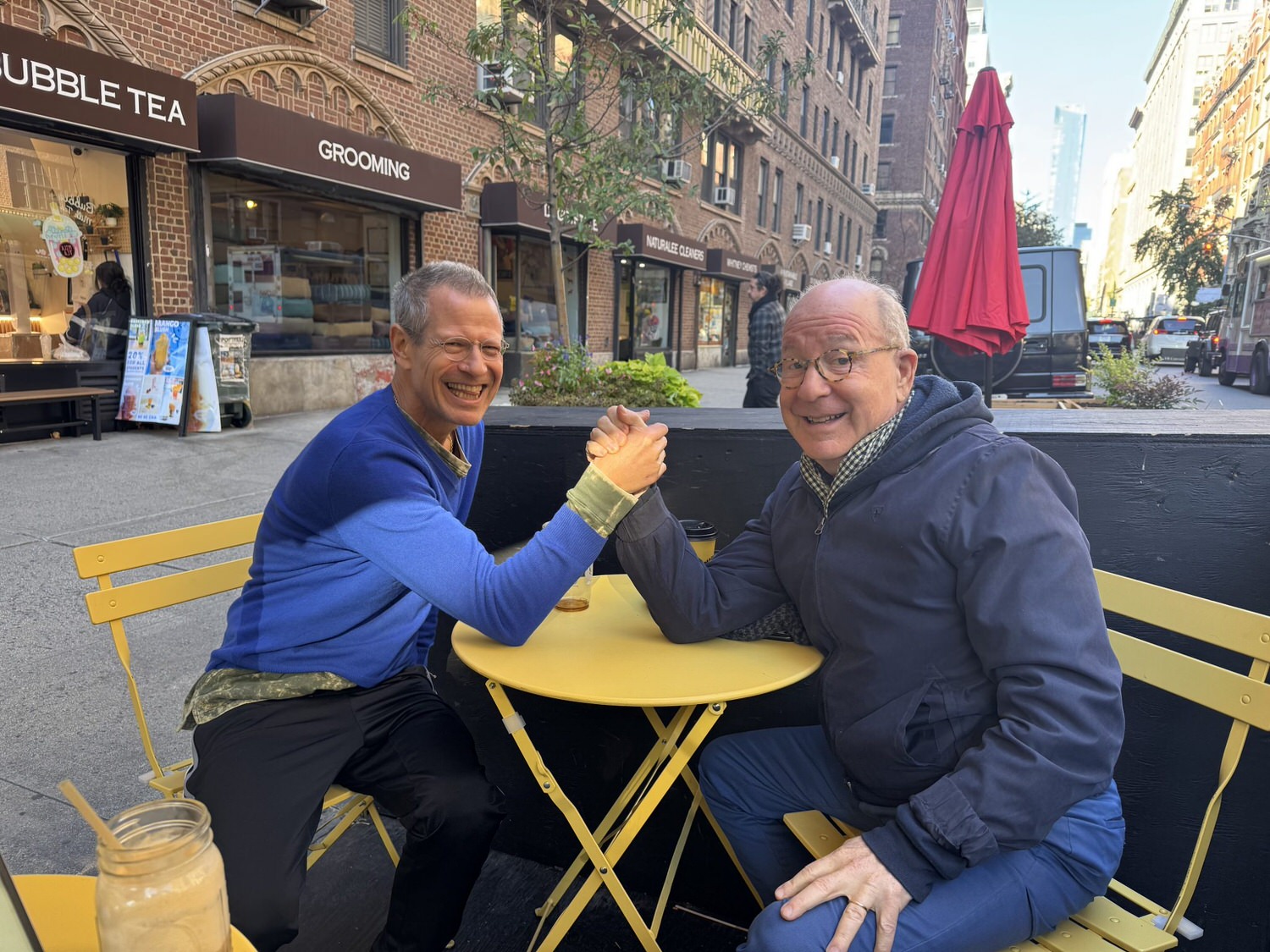
I don’t know what got me more fired-up and inspired—recounting my Texas adventures or talking shop with the critic and lecturer with the widest reach . . . ever. I love Jerry Saltz and Roberta Smith. Photo courtesy Kenny Schachter
In conclusion, there are plenty of obdurate collectors who would go to any length to possess art (including me), perhaps not to the extent of breaking into the Louvre to pinch it—though there are those too—and that won’t subside anytime soon. I promise you.
More photos from Marfa follow below.
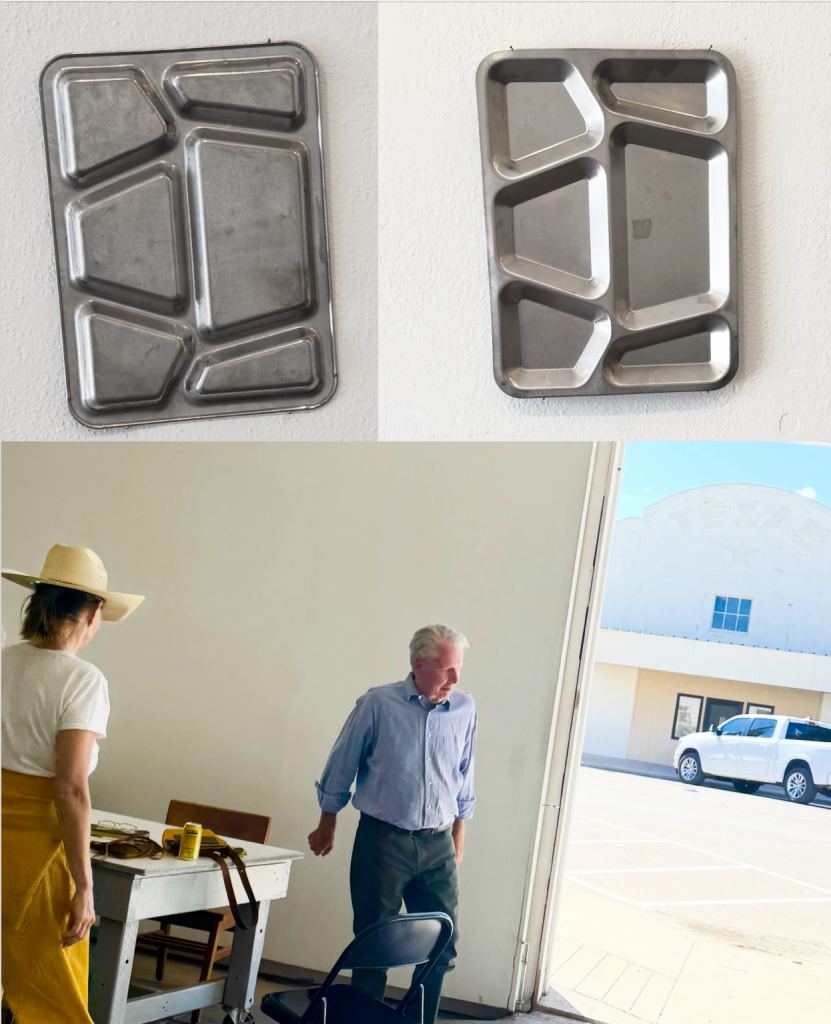
I met my match—gruff and brusque art dealer (originally from Houston) Eugene Binder who, only after exhaustive prodding, owned to being the “maker” of these disused, prison-issue steel meal trays. Marfa residents have a thing for the material. Photo courtesy Kenny Schachter
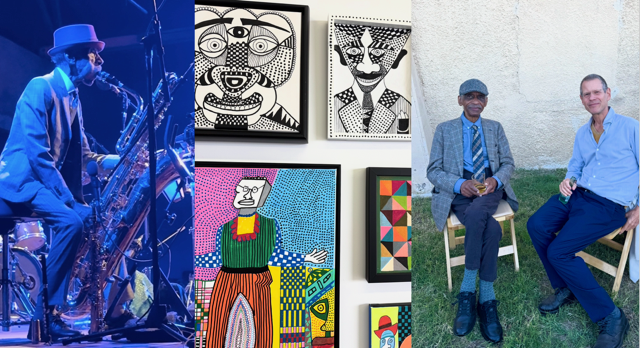
Famed jazz and art impresario Roscoe Mitchell played at one of the Chinati events and exhibited his paintings (with a hint of the Chicago Imagists) at the boxing-art space Maintenant—don’t ask, you wouldn’t believe me anyway. Photo courtesy Kenny Schachter
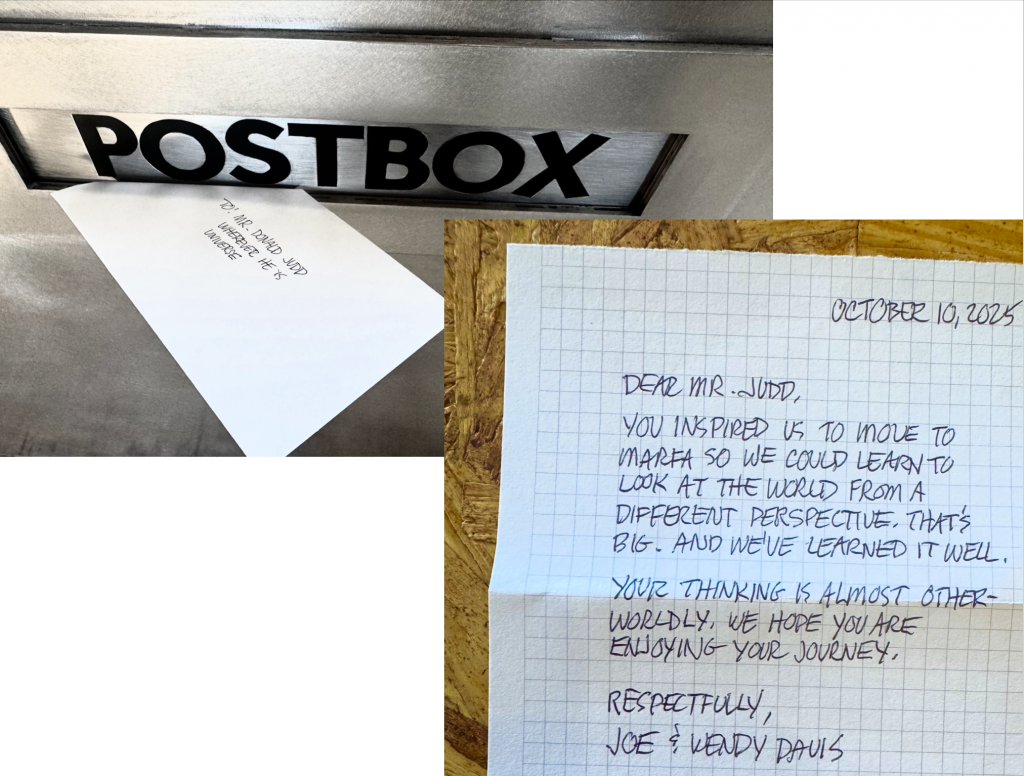
Joe and Wendy Davis came to Marfa thoughtfully prepared with a lovely missive to Judd after reading about my POSTBOX sculpture, before depositing the letter in my piece, full well knowing that what goes in there will never come out, or see the light of day again. Photo courtesy Kenny Schachter
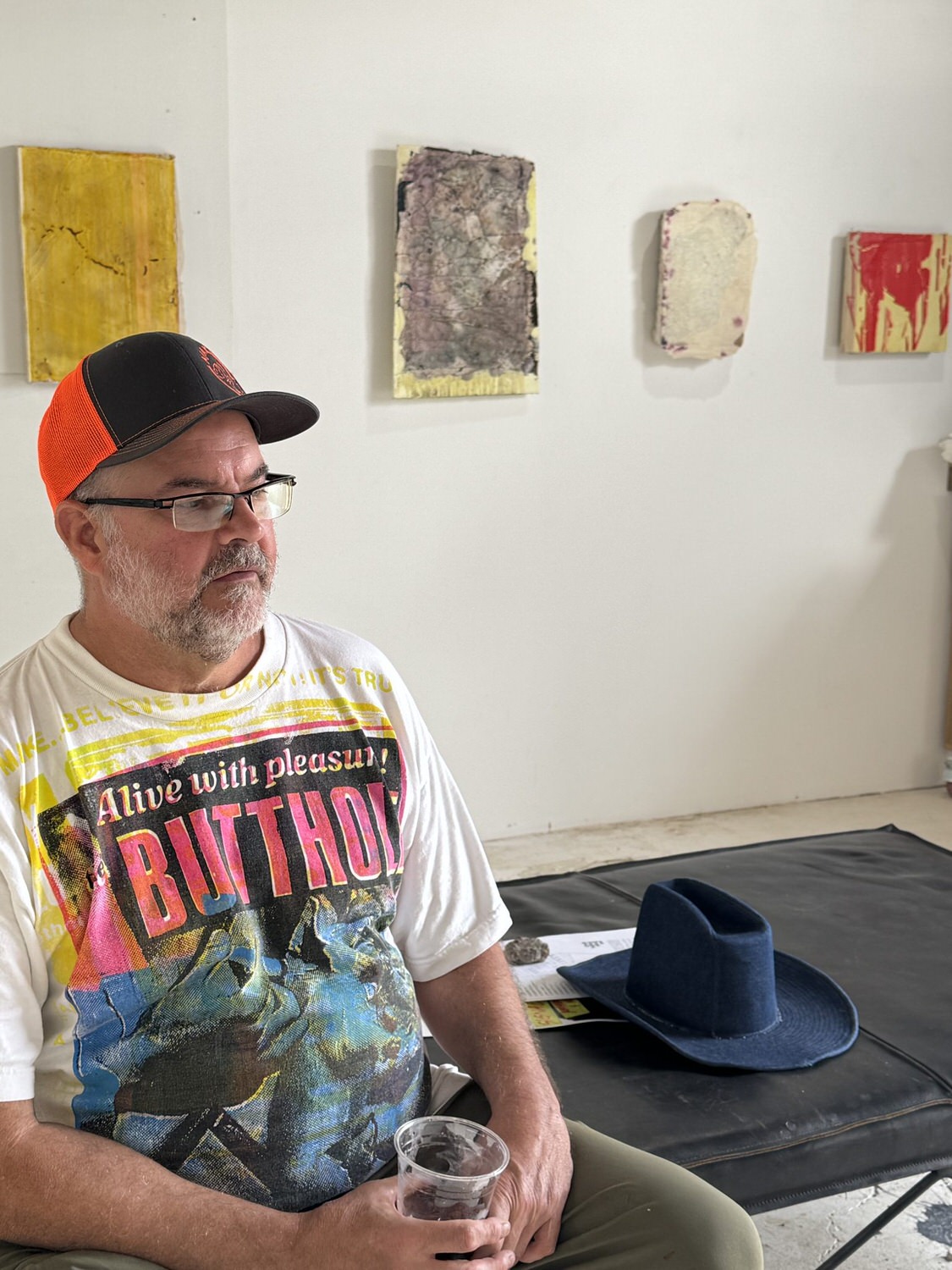
A Marfa resident, one of the 1,800 full-timers, amid his compelling abstract paintings. Successful fresh out of art school, he became dissatisfied with the art world (surprise, surprise). After suffering a debilitating workplace accident about 10 years ago, he moved to Marfa and resumed his art practice. I’m glad he did. He’s wonderful and I’m a fan. Photo courtesy Kenny Schachter
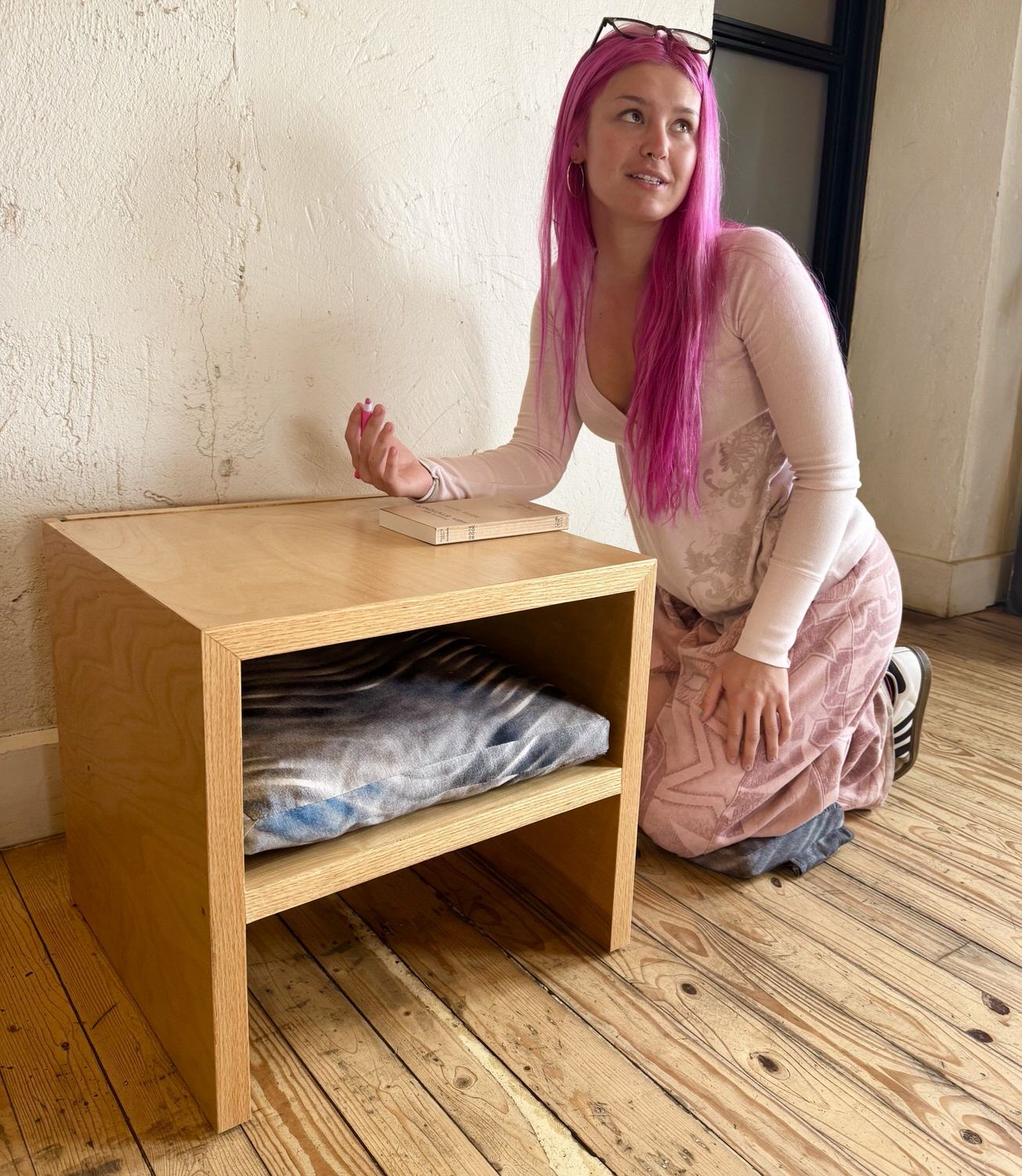
I begrudgingly forgave this very kind Sentinel cafe patron kneeling on my art furniture. She was on a motorcycle trip with her parents and brother from Austin. None had ever heard of Donald Judd, an all too familiar refrain. Photo courtesy Kenny Schachter
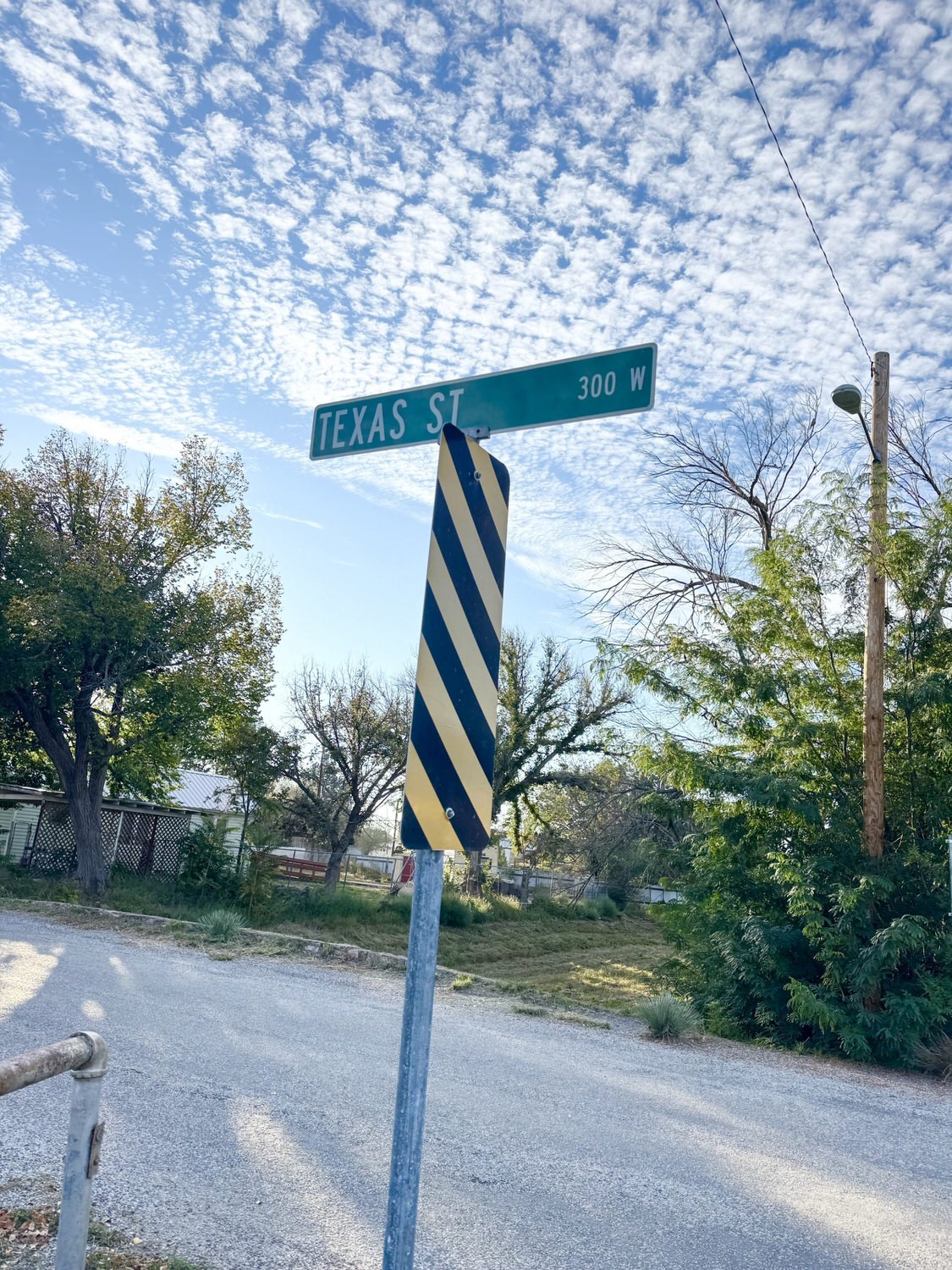
The light and sky alone warrant a Marfa pilgrimage. Photo courtesy Kenny Schachter
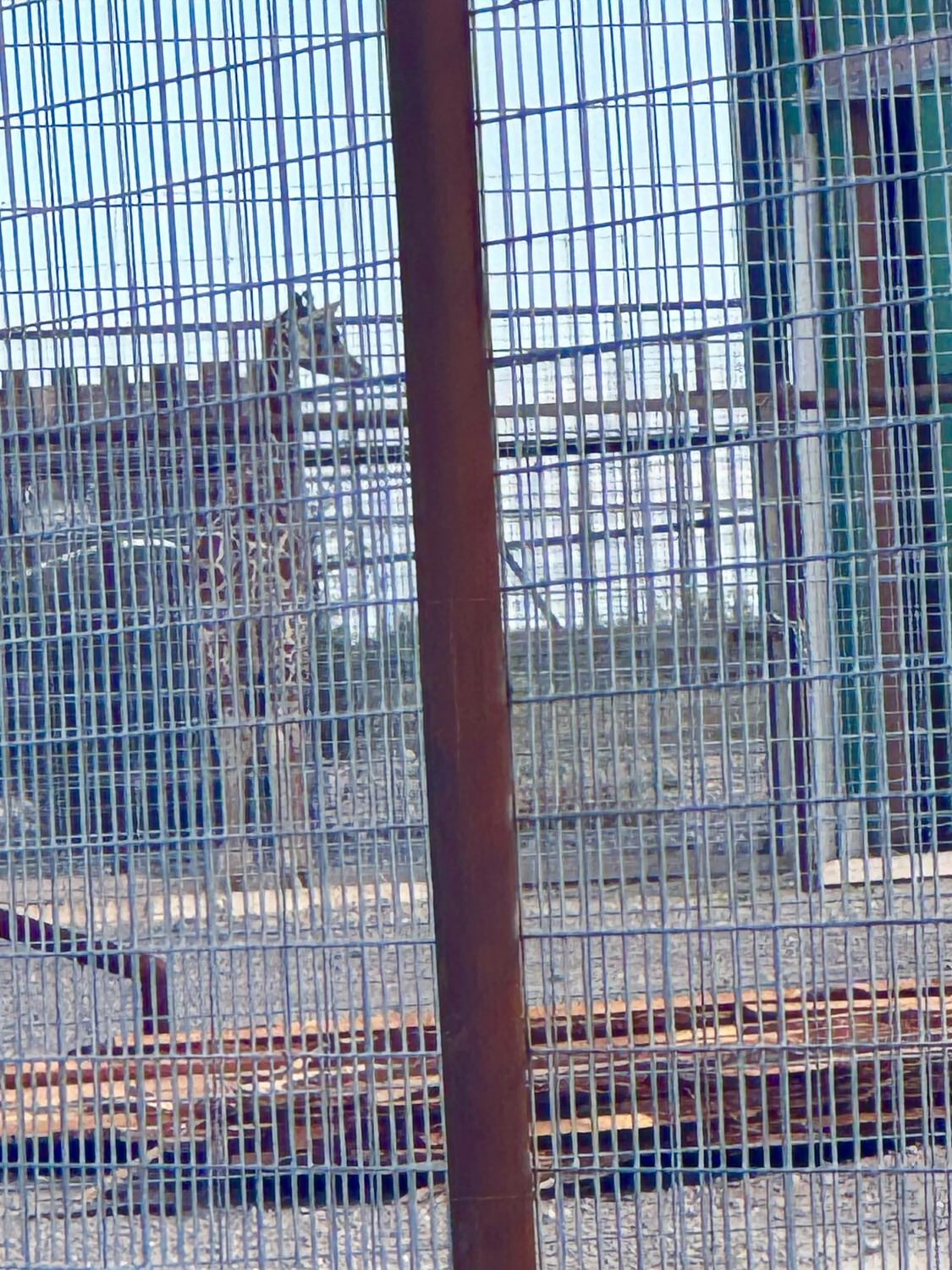
During my writing residency I switched gears and became a junior investigative journalist for the Sentinel, and in my travels uncovered Todd Dalton, previously known as London’s Leopard Man of Peckham, a suspected private zoo animal trader. Look him up, I’m too tired. Photo courtesy Kenny Schachter
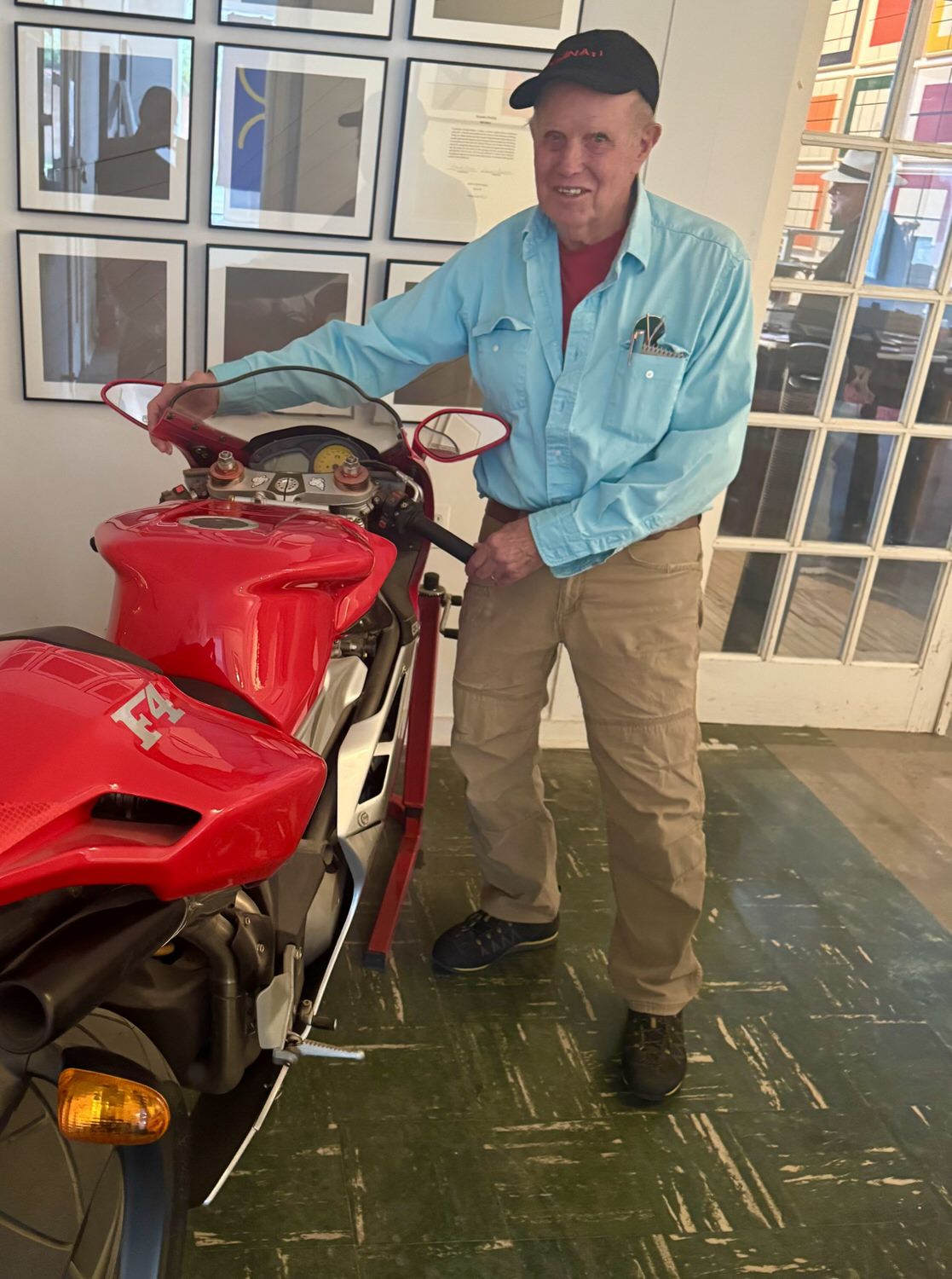
One half of legendary Marfa print publishers Valerie and Robert Arber. They were so passionate and adorable I wanted to take them home, and all of their works by Judd, Bruce Nauman, Richard Prince, and genius part-time Marfa resident Charline von Heyl. While we’re at it, I’d steal his racing-motorcycle collection that I coveted as much. Photo courtesy Kenny Schachter
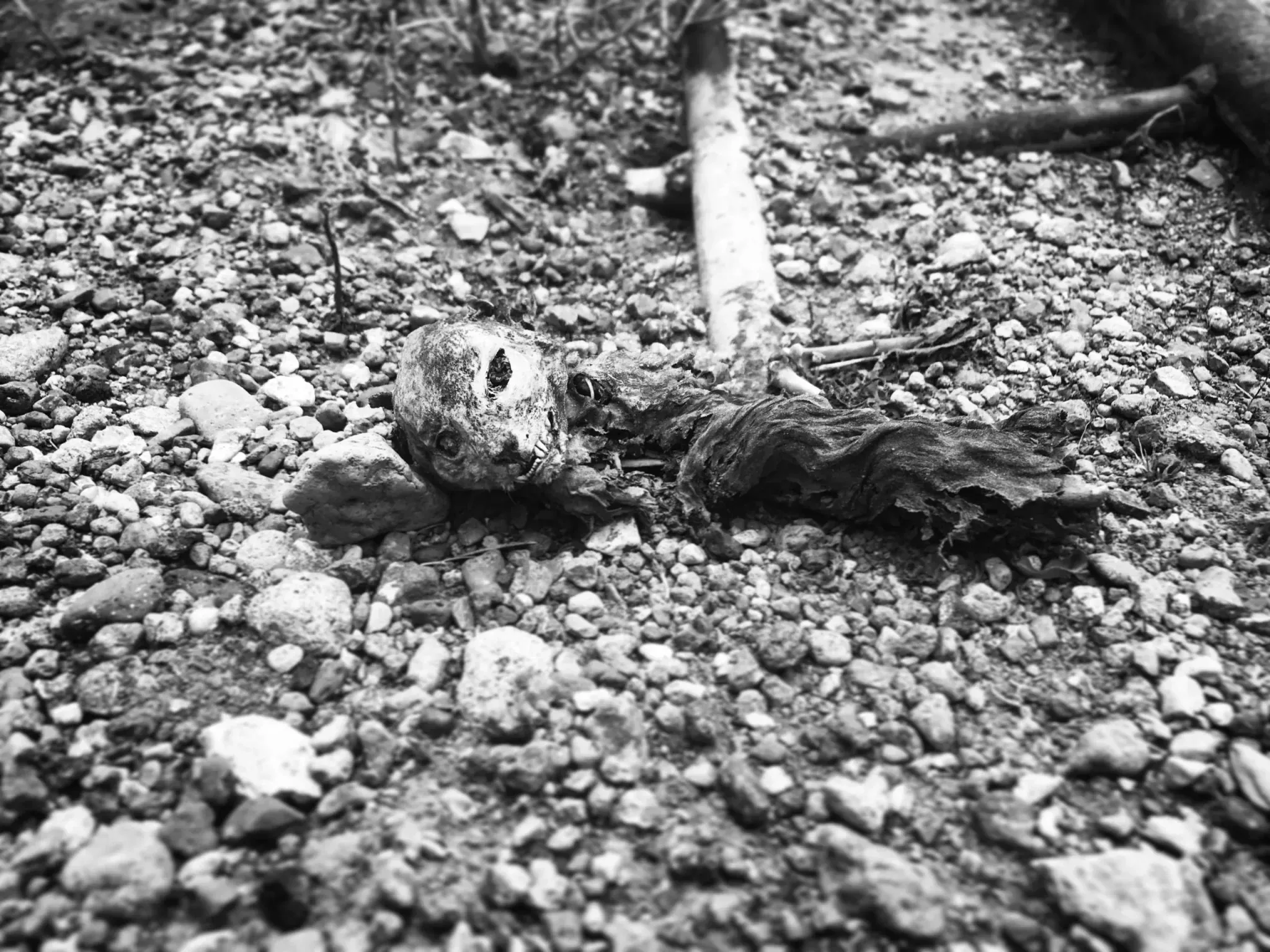
This cat mummy was discovered by my colleague at the Sentinel newspaper, photographer Jennifer Pittinger, at an event for the not-for-profit Marfa Ballroom. After two long weeks of near solitude, I got out in the nick of time. Photo courtesy Kenny Schachter
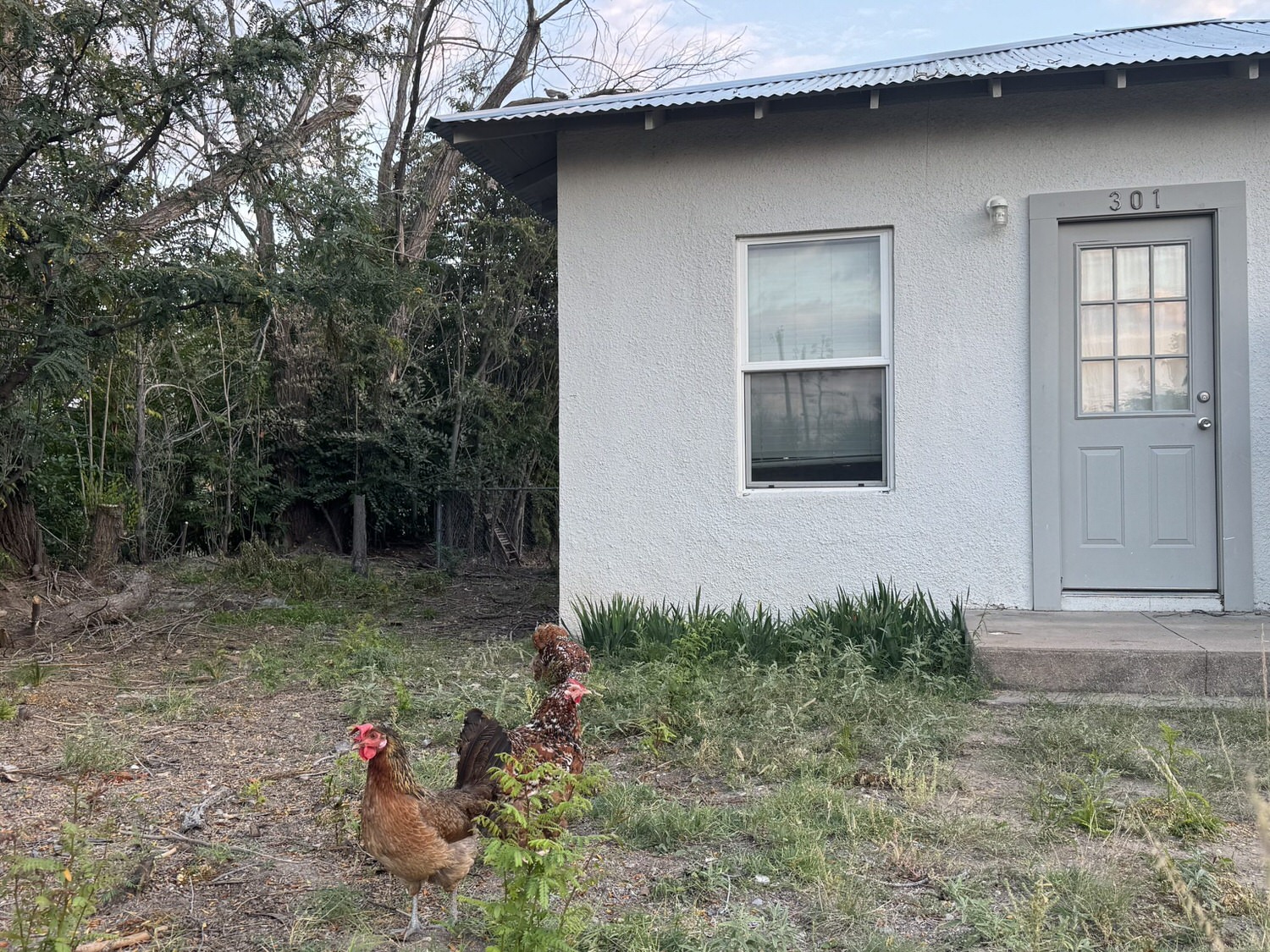
Chickens at my doorstep—they must have heard about my recent series of collaborative installations in London and Chicago. Photo courtesy Kenny Schachter