
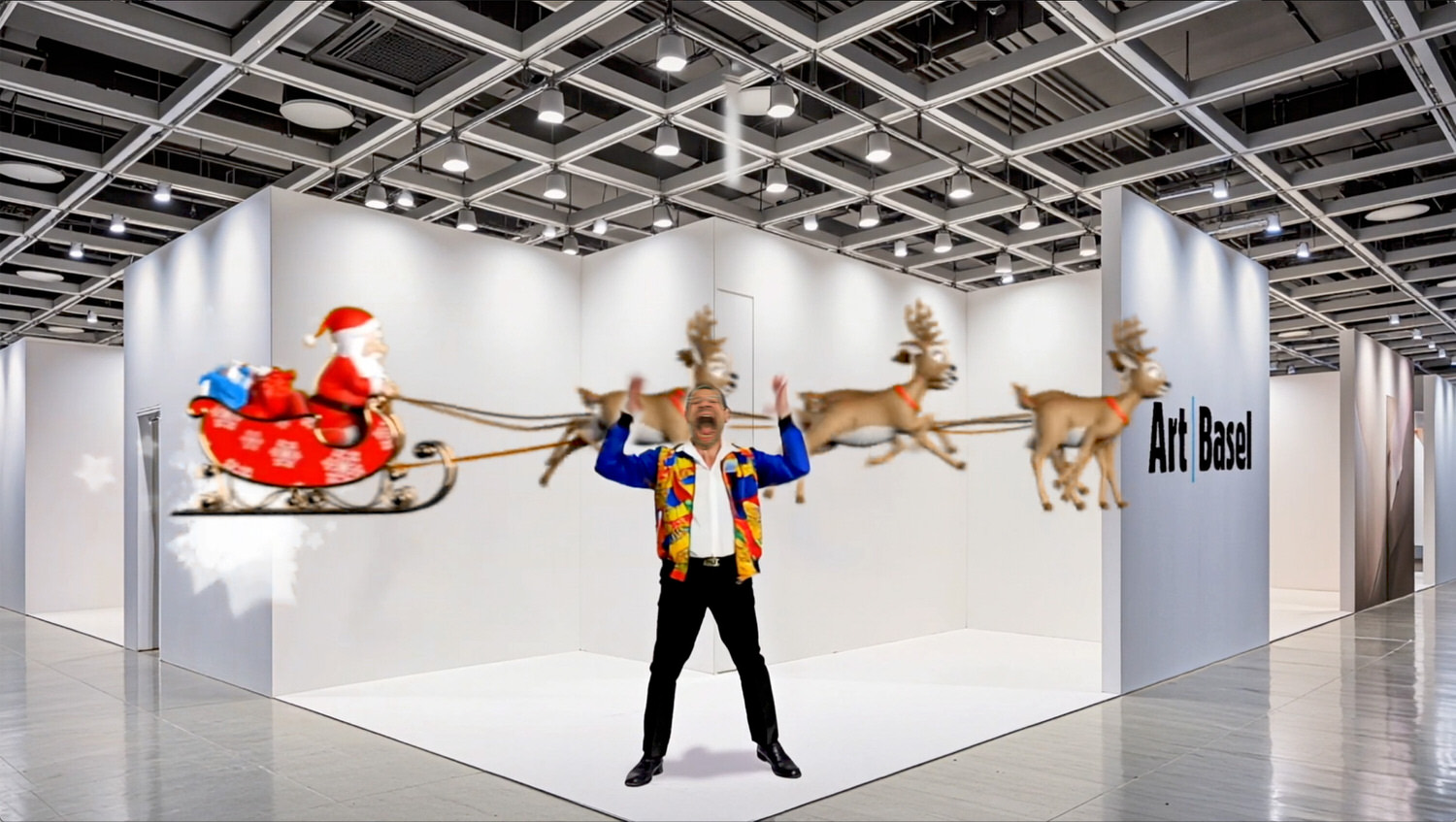
Art Basel Booth Bonanza!!! OUR (steeply discounted, because too many dealers don’t want to go, who can blame them, I sure don’t) PRICES ARE INSAAAAAAANE!!!!!!! Google old Crazy Eddy TV adverts and it will make sense to you! Photo by Kenny Schachter
On the heels of the blowout, benchmark-setting New York fall auctions, which totaled approximately $2.2 billion, smack in the face of a barrage of grim macro-economic news, the downbeat art-market reporting will indubitably be quelled once and for all. I’m not going to say I told you so, but I repeatedly told you so in these very pages. Don’t get me wrong, I am far from gloating and have to hustle for every penny; or I did, before they discontinued the burdensome little coins that cost 3.7 cents of copper to mint.
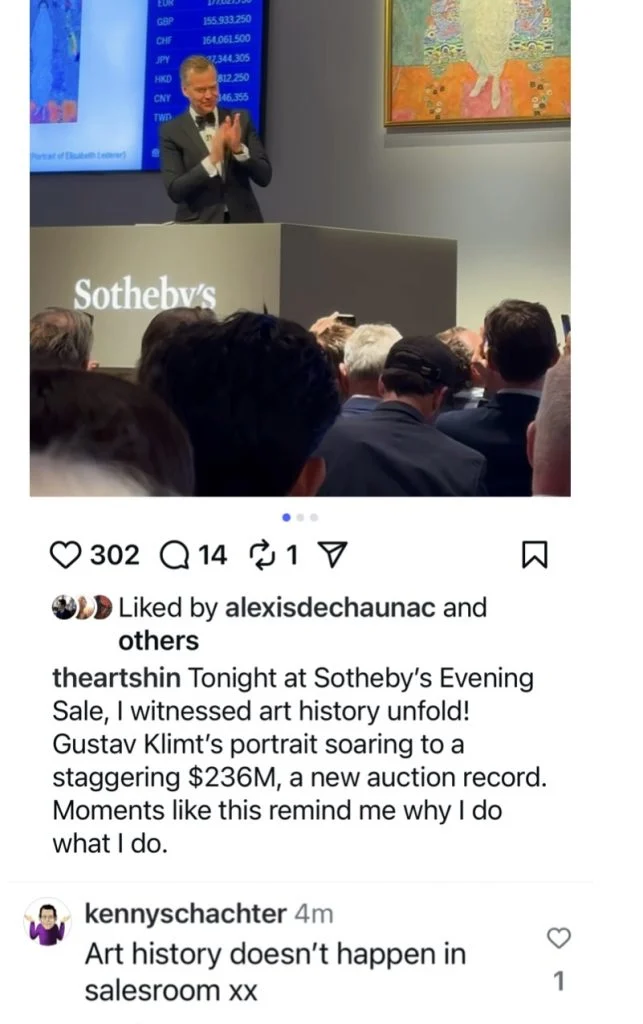
Art history doesn’t unfold in a salesroom. Screenshot of the Instagram account of Hong Gyu Shin of New York’s Shin Gallery, who shot to fame in 2013 for underbidding a Bacon painting at Christie’s to nearly $100 million while still in his 20s. “I loved that painting and I couldn’t control myself,” he said at the time. Photo: Kenny Schachter.
We live in tenuous times, teetering on the brink of catastrophe, and I’m not just referring to Pace Gallery’s precarious balance sheet. On the subject of Pace, things are so financially rocky that Arne Glimcher, its legendary 87-year-old founder, had to parachute in from his Tribeca splinter gallery, 125 Newbury, to tighten the reins at the hemorrhaging Chelsea mothership. He’s certainly got his work cut out for him, a seemingly insurmountable undertaking for someone half his age. But I spotted Arne in the trenches on West 25th Street last week, looking sprightly and up to the task with a group of collectors in tow. Arne and his CEO son Marc did not respond to requests for comment.
When business was booming, a blind eye could be turned to financial indiscretions like those that allegedly transpired over the years at the New York branch of Michael Werner Gallery. But when market tides turned, and star artist Peter Doig departed, co-owner Gordon VeneKlasen’s prodigious expenses became the subject of focus. The dissolution of the partnership is in full swing as I write, and as in any divorce, it’s a timely process to unwind. VeneKlasen is in the midst of picking up sticks and moving to Los Angeles to open an eponymous gallery.
Earlier this year, VeneKlasen listed for sale his West Village home for $20 million, which was published in a lavish spread in W magazine in 2014—a must read in toto! He asked the renowned architect Annabelle Selldorf to design it, W writes, “reimagining the three-bedroom 1,920-square-foot family abode as a one-bedroom refuge that would house his eclectic collection,” including an ivory reliquary of St. Philip once owned by Pope Clement XII. According to W, “Selldorf knew precisely whom she was dealing with.” “Gordon is the most curious and voracious person I’ve ever met,” she said. “He wants it all.”

The Michael Werner Gallery mascot, aka Gordon VeneKlasen’s lab, Silas the art dog, travels and lives better than you or me. Photo: Kenny Schachter.
While in partnership with Werner, 86, VeneKlasen was allegedly expensing things like luxury hotels outside of gallery trips, private travel and entertainment, Hamptons helicopter rides for him and his partner, and on at least one occasion, a solo ride to East Hampton for Silas, his Labrador Retriever, according to my sources, gallery employees both past and present. Auditors and lawyers have been installed at the gallery to sort this out, and its L.A. outpost is closing.
VeneKlasen did not respond to multiple requests for comment. Ditto for the Werner Gallery.
Speaking of Werner, his ex, ex-con Mary Boone, who had expense issues of her own, is crushing it right now, in a lauded art-world second coming. Do not miss her overview of 1980s art at the New York branch of Lévy Gorvy Dayan, up through December 13.
Last week, I ran into swashbuckling 80-years-young Larry G, looking fit, tanned, and in stonking good health while I waited for a friend in the lobby of his gallery at 980 Madison Avenue. Call me brave, stupid, or both (many have), but I initiated a conversation. (This, after futilely querying him for my last column about his acquisition of Diddy’s Kerry James Marshall. By the way, I was correct that Puffy’s painting was purchased by Gagosian on behalf of Jeff Bezos, who bought Christie’s record-setting $43.9 million Canaletto painting as a wedding gift for his new bride.)
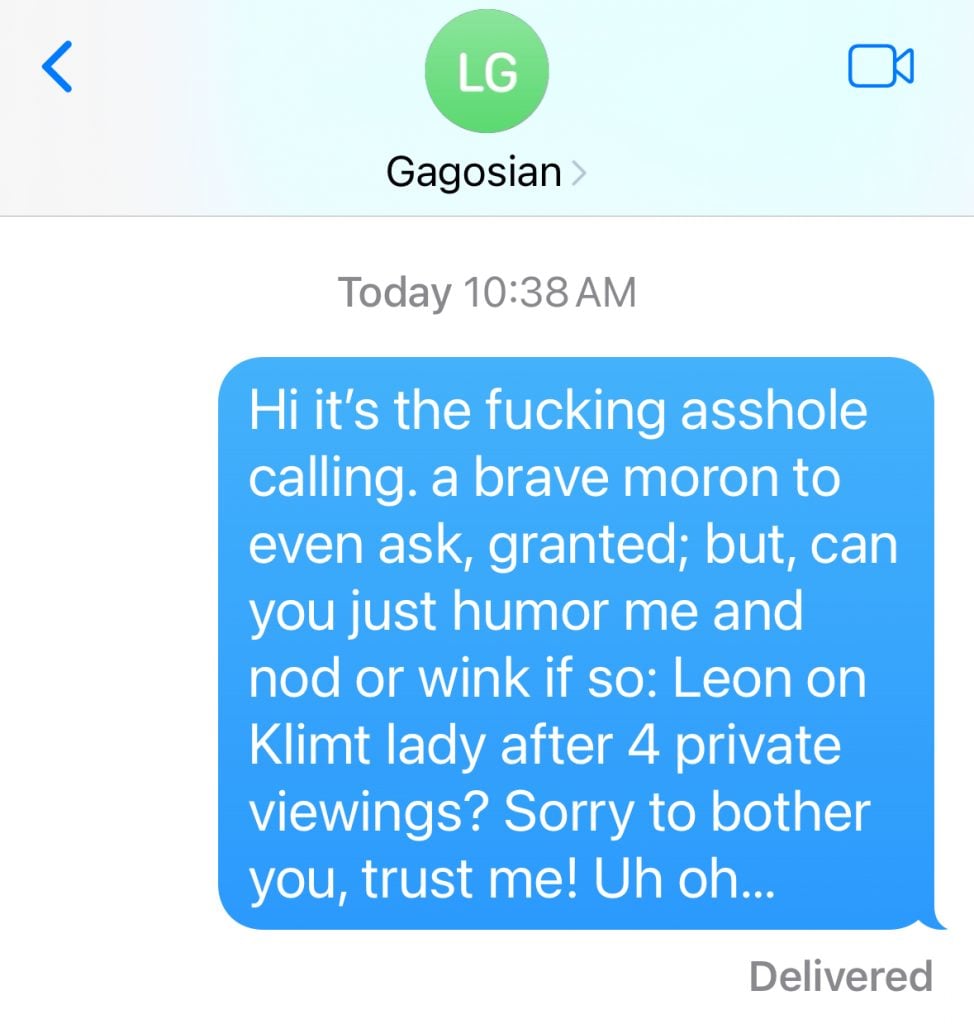
When will I ever learn? Never, obviously! I’m a masochistic thorn in his side (with a sadistic bent). Photo: Kenny Schachter.
Here’s roughly how it went down between me and Larry G:
KS: Hello.
Larry G: Would you like me to call you beforehand and let you know everything I’m planning on buying in advance?
KS: C’mon, everyone wants to know what you’re up to.
Larry G: You’re a fucking asshole!
KS: Yeah, but a professional fucking asshole.
Larry G: You are a really good writer, though…
KS: And you’re like Duveen [Sir Joseph Duveen, 1869–1939, considered the most dominant dealer of all time], there’s no one in your rearview mirror or ahead of you—you’ll be revered in perpetuity.
Larry G: Go on, keep talking, that I can keep listening to…
Returning to the auctions, Sotheby’s mostly. In certain ways, museums are indistinguishable from galleries already, with high-profile monographic exhibitions regularly sponsored by the relevant gallery reps and artworks for sale. Biennials, too.
Kicking it up a notch and bringing the game to its logical conclusion, Sotheby’s has transformed a purpose-built museum, the Breuer Building, which opened in 1966 to house the Whitney, into a hybrid commodities pit/home shopping network/pawnshop, replete with viewing rooms. From the moment the doors opened, lines snaked around the block. And to think, they weren’t even giving away cookies or caffeine.
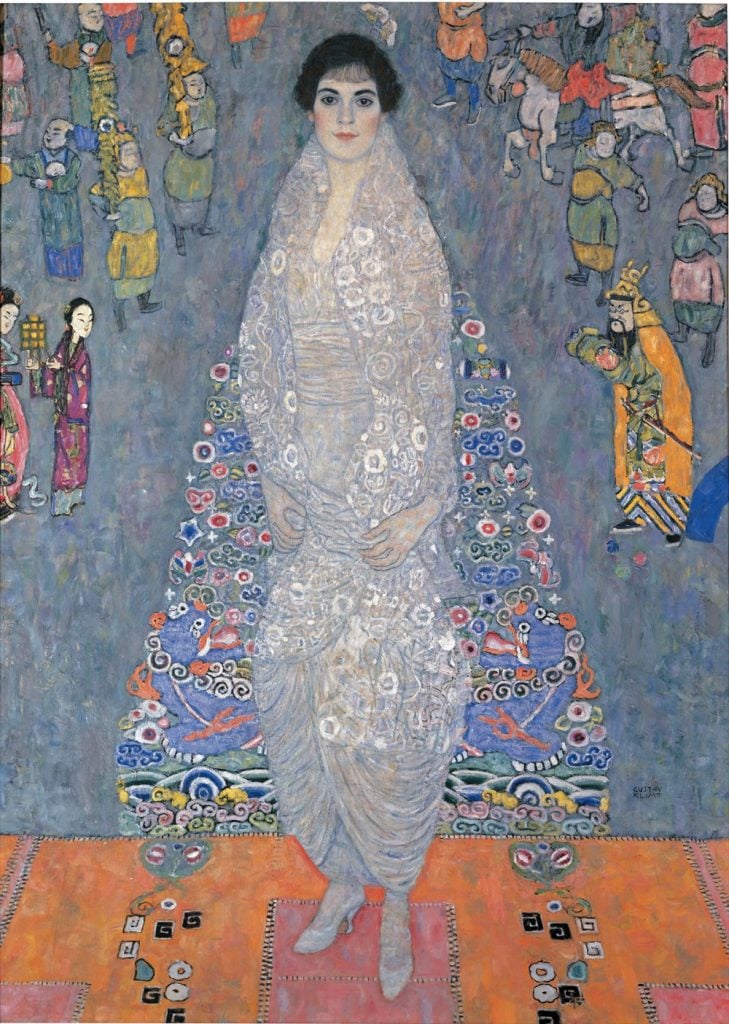
The ultimate destiny of Gustav Klimt’s Portrait of Elisabeth Lederer, whom I colloquially refer to as “The Lady,” remains an expensive enigma wrapped in a monied mystery. Courtesy of Sotheby’s (in more ways than one)
Starring front and center, and weighing in with a nine-figure estimate, was the main attraction, which I referred to as Gustav Klimt’s Lady. I wrote an elegy for the artwork, which is long dead and soon to be lost again, perhaps for eternity (in a freeport or high-end living room).
The Saga of Klimt’s Portrait of Elisabeth Lederer
There once was a collector named Lauder
Who owned a Klimt of a beautiful daughter
She was wrapped in a chiffon shawl
Standing proud, regal, and tall
Surrounded by figures Chinese
Fetching $236.4 million with fees
Having survived a war and a fire
She landed with a very rich buyer
In the countries of oil and sand
The painting did not land
Everyone’s still dying to know
Where on earth will Elisabeth go?
The air is mightily thin in the realm of the obvious players pornographically wealthy (and willful) enough to purchase art, houses, boats, planes, and cars for more than $150 million. (A 1955 Mercedes recently sold for $142.2 million at in a private auction.)
There’s the royally rich families of the Middle East, a handful of Asian collectors, and our very own Jeff, Ken, and Leon. (Bezos, Griffin, and Black have all bought art in the nosebleed stratosphere we are talking about.) Yet, I was confounded at every turn in my relentless efforts to find out the Klimt’s new owner.
From what I could ferret out of the sealed lips of those in the know, or close to those in the know: Bezos wasn’t interested, Griffin was an underbidder, the Middle East didn’t get it, and two Asian buyers landed the two Klimt landscapes. As for Black, who was identified as a main contender after my sources said that he scheduled multiple private viewings of the Lady, the parties are denying it, and a Black rep did not get back to me.

I got early access a few hours prior to public viewing hours at Sotheby’s new Breuer building (owing to my prominent pals, obviously) and the line was already forming, for an auction house no less! The apotheosis of a world defined by the convergence of art and money. Photo: Kenny Schachter.
What I can disclose is that Black purchased Picasso’s 1955 Les Femmes d’Alger (Version ‘O’) from Sheikh Hamad bin Jassim bin Jaber bin Mohammed bin Thani Al Thani (aka HBJ) for slightly more than the record-setting $179.4 million that HBJ paid for it at Sotheby’s way back in May 2015. (I wrote on some of the Sheikh’s art exploits last year.)
Amid the Epstein fallout, one imagines that Black’s been doing a lot of nesting, enjoying his art, which includes Munch’s 1895 Scream (which my friend, grime rapper Skepta, once contacted me to buy, not quite cognizant of the price of admission to that gig). Because of his ties to the convicted sex offender, you may recall, Black decided not to seek reelection as MoMA’s board chairman in 2021, the same year he departed as chairman of Apollo Global Management, the firm he cofounded that earned him a net worth of $13 billion.
Of course, it would be in no one’s interest to identify Black as the Lady’s new owner, if it was him. But be patient. I’ll get there. I always do.
François Pinault bought Leonard Lauder’s Anges Martin for $17.6 million via advisor Philippe Ségalot (former head of contemporary art at Pinault’s Christie’s), after setting the $18.7 million record for the artist, also at Sotheby’s, during Emily Fisher Landau’s estate sale in 2023. It joins many other notable Martin works in the collection.
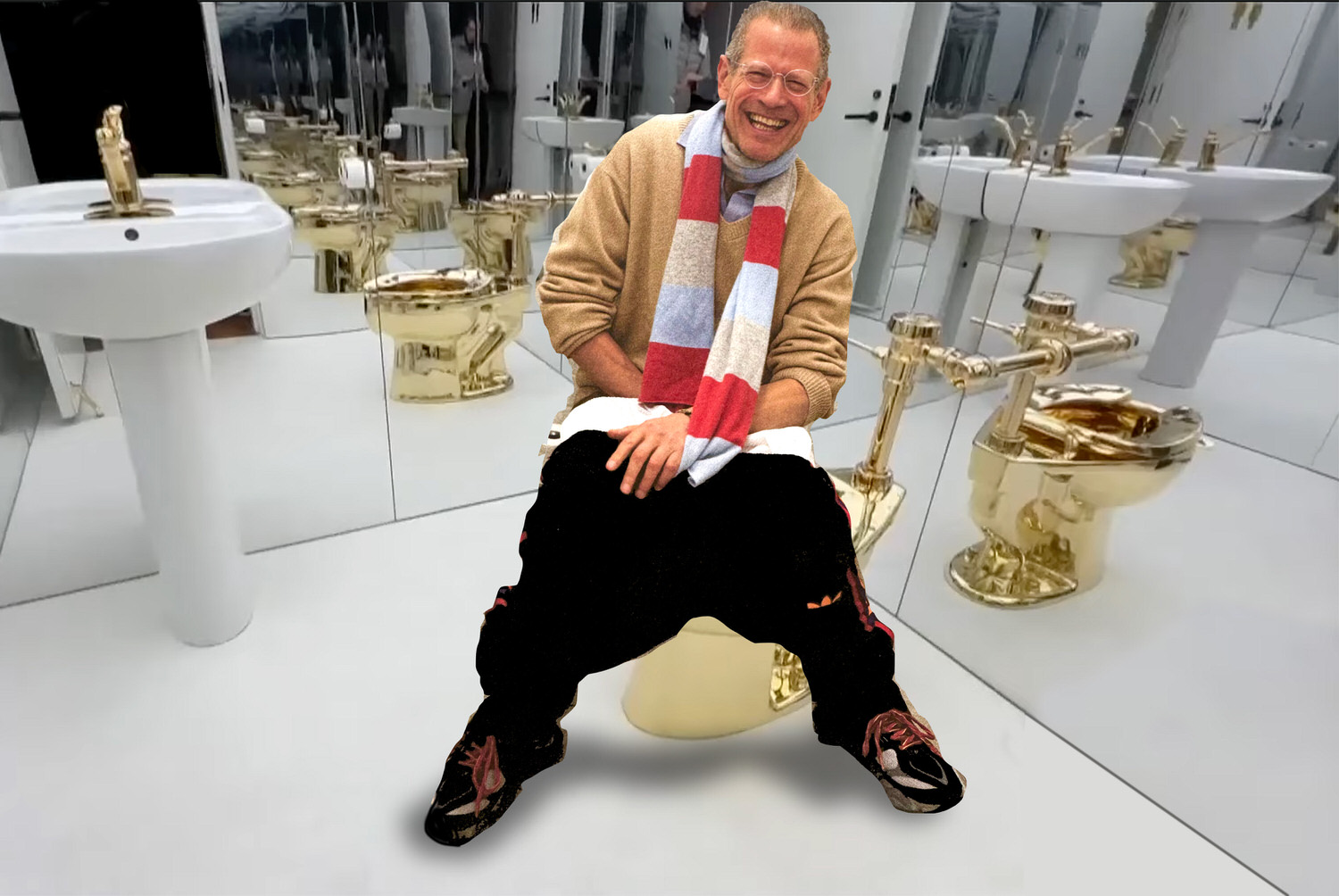
The guard told me it was worth it’s weight in gold; though, when I asked him what he really thought, he responded without hesitation: “It’s not worth the money,” then proceeded to let me use the crapper, because when you gotta go… Photo: Kenny Schachter.
Steve Cohen sold not just the toilet, which in the end was not much more than a straight gold arbitrage (much of Maurizio Cattelan’s recent art is akin to financial tokens). He was also the seller of Christopher Wool’s 1990 Untitled (RIOT), which makes sense in the context of his exorbitant spending on his dismally performing New York Mets baseball team. Cohen’s firm, Point72, did not reply to a request for comment. (I also asked his daughter, Sophie, who’s in the employ of Gagosian; she did not return my email.)
A few brief words on Christie’s, which did just fine in the blinding glare of Sotheby’s big sales. The David Hockney double portrait sold on the $38 million guarantee to Taiwan’s Pierre Chen, joining the famed swimmer that is already in his collection, which I chronicled in September. The Matisse that sold in excess of $32 million, underbid by high-profile advisor to the stars Ralph DeLuca, went to Acquavella (perhaps on behalf of Steve Wynn, but I have not yet been able to confirm that).
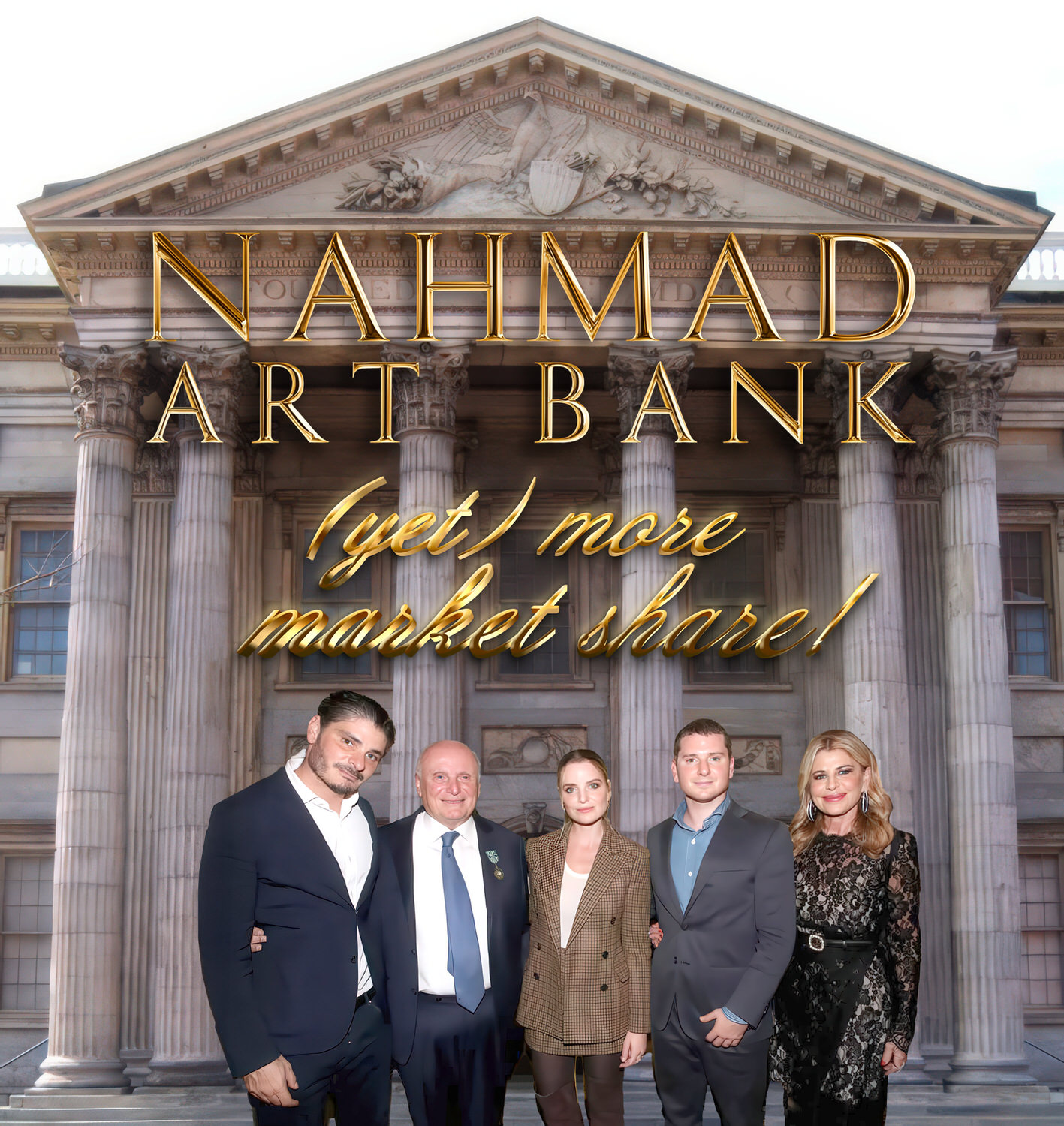
The Nahmad clan started with a bank in Syria (then Lebanon) and now they’ve returned: owning billions worth of paintings not enough, now they’re lending money on art and art receivables at 10 percent interest with a loan book up to $500 million and rising fast, nibbling at Sotheby’s heels. Photo: Kenny Schachter.
DeLuca has landed in Las Vegas via New Jersey, a state much lauded as a domestic haven, since it has zero personal income tax. None other than Damien Hirst has actually taken up refuge in Vegas to skirt the U.K.’s excessive rates. Surely Hirst fled at the behest of his financial guru Joe Hage, the art world’s second-most-prominent trader after Larry G, though Hage is so off the radar that he’s veritably invisible—other than the many times I’ve written about him, which he’s never too amused about, to say the least.
Also, though I am not yet certain, I suspect that the record-smashing Kahlo went to Argentinian Eduardo Costantini. On the subject of Kahlo, there was an elucidating article in the Guardianabout significant works that have gone missing from Mexico’s Frida Kahlo museum, Casa Azul. One of the allegedly missing works “was sold by New York’s Mary-Anne Martin Fine Art gallery for $2.66 million at auction in 2020,” and it offered another allegedly missing work at one point, the paper reports. The gallery did not respond to requests to comment, according to Richard Morgan, who wrote the fantastic, disturbing article. Read it.
Eileen Kinsella recently reported in Artnet on notable drop-outs from this year’s Art Basel Miami Beach, so it’s interesting to see that the Basel brass has taken some initiative in the name of innovation by offering digital art galleries and NFT artists themselves the opportunity to grab a berth at the fair. What wasn’t publicly disclosed was the fire sale price: approximately 50 percent less than the going rate for a standard booth, according to my sources.
(After publication, a rep for Art Basel said in a statement that “the pricing for Zero 10 is in line with other curated, project-based sectors” at the fair and that the initiative had been in development since last year. “While branding and some outreach to participants were finalized closer to the fair, which may understandably have felt late to some galleries,” the rep said, “the initiative itself was not conceived as a last-minute or reactive measure.”)
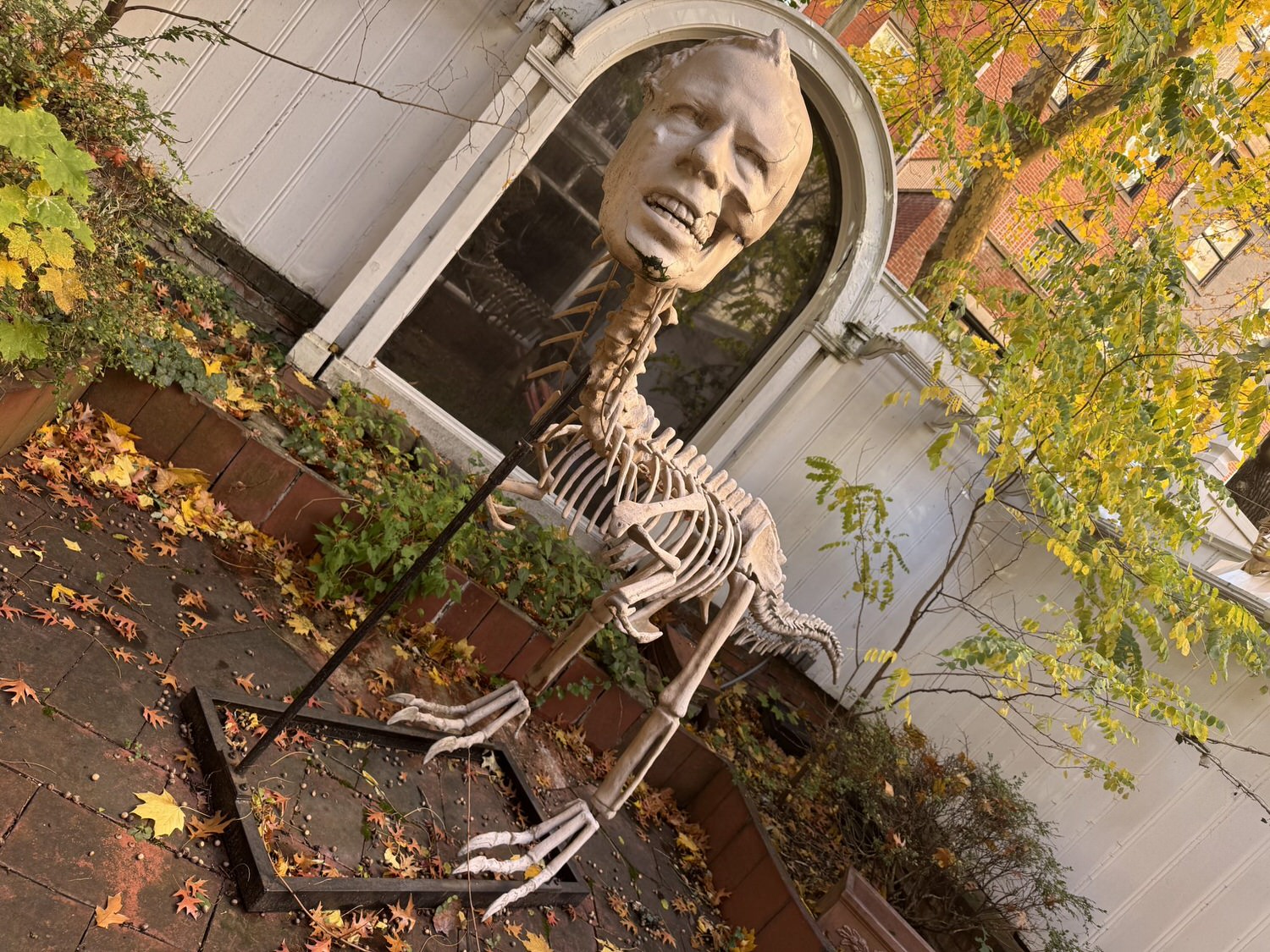
My 2023 zombie sculpture referencing the pillaging of dinosaur skeletons, transformed into over-priced auction baubles for the pornographically wealthy; Phillips just partnered with a “dinosaur guy” and proceeded to sell half a dozen or so—shameful. Photo: Kenny Schachter.
Basel’s antics remind me of the manic TV commercials for Crazy Eddie, the ubiquitous consumer electronics retailer from the ‘70s and ‘80s that flooded the networks before the company flamed out amid a flurry of fraud charges that ended in prison terms for the founders, Eddy and Sam Antar. If not for flogging TVs and stereo equipment, the brothers Antar could have set up an art dealership.
Regarding the upcoming Qatar iteration of Basel: Despite the region being portrayed in the media as the promised land for dealers, because of its supposed community of collectors, that’s more mirage than reality. The only thing that remotely could save it is if the ruling families decide to buy all (or at least a chunk) of the art, dressing it up as a PR success.
I’ve recently given a handful of lectures on the subject of art and economics for Columbia University and the University of Zurich. As discordant as it sounds, art, artists, and money have been familiar bedfellows since medieval times. Nothing’s changed. On every occasion he’s asked, Richard Prince admonishes those who are interested: “You want to be an artist? Don’t.” I’m tempted to add, “You want to be an art dealer? God, don’t.” But joking aside, whether making art, writing, curating, teaching, or even dealing, I’d say why not? I wouldn’t trade a single day of my career for all the gold in the world. Really.