
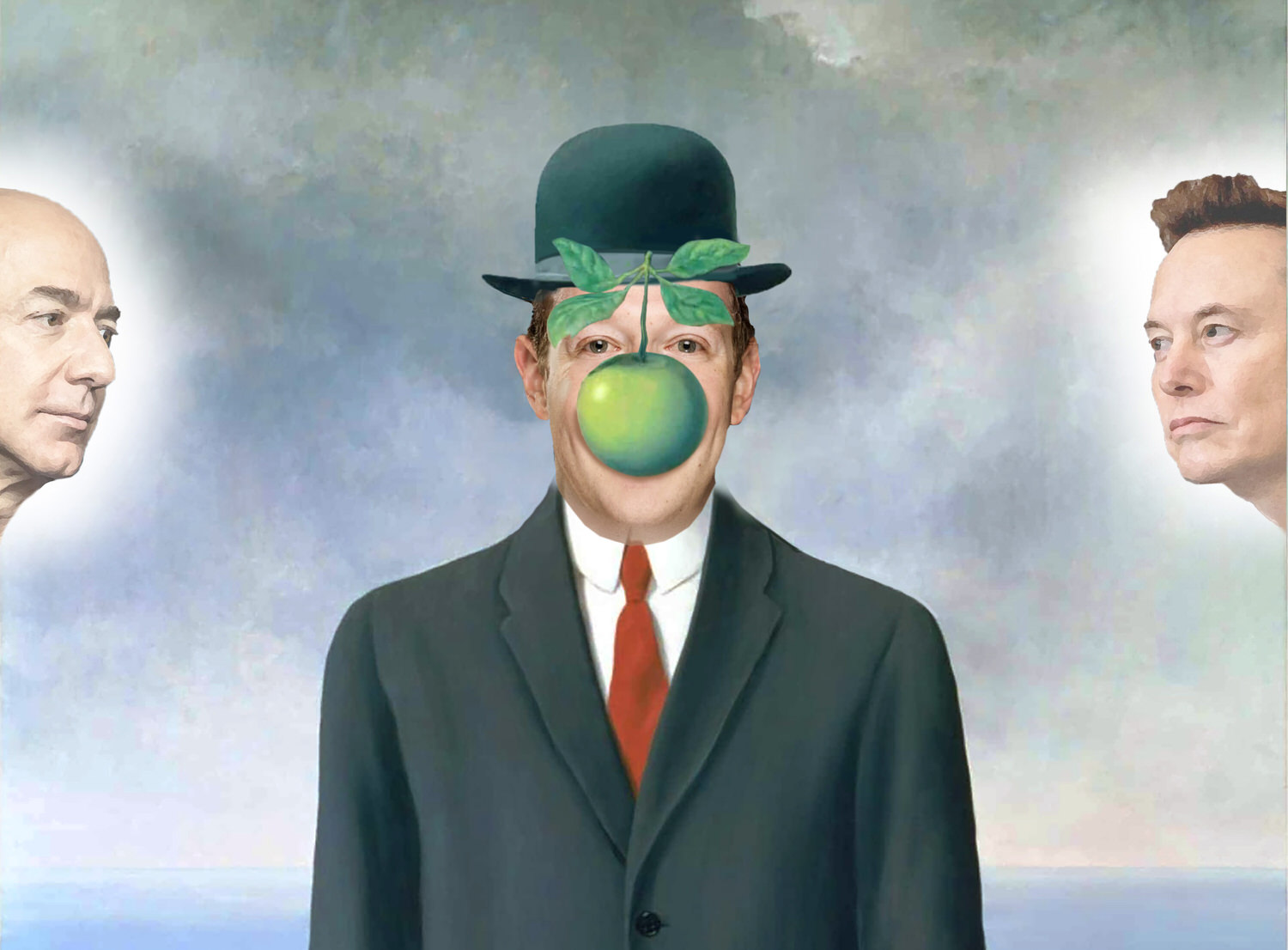
They have our eyeballs, attention, and money—but that’s not enough. Now the techno-feudal overlords are coming for our art! Bezos’s been in for sometime, and now Zuckerberg’s thrown in his (bowler) hat. Could Musk be next? Photo courtesy Kenny Schachter.
A new breed of art (and old-bone) buyers is engaged in a death match of clout chasing, a no-holds-barred competition of ever-escalating expenditures, hunting big-game trophies to flex on the world stage while pursuing diversification hedges, and in the case of a handful of Middle Eastern monarchies, trawling for regional influence and tourism as an alternative to oil. Meanwhile, on the other end of the scale, Gen Zers are finding their footing in their own neoteric collecting communities, tap-tap-tapping away on their devices (aren’t we all), grotesquely enriching the inner circle of feudal techno overlords in the process. Fun.
The Magnificent 7 (if ever there was a misnomer)—Apple, Microsoft, Amazon, Alphabet (Google), Meta (Facebook), Nvidia, and Tesla—have a stranglehold on our minds and wallets (and tragically, our children). Their data-driven platforms exert daily dominance over billions of people and haul in trillions, with some of the spoils of their predatory practices trickling into art over the past five or so years. Jeff Bezos and Mark Zuckerberg, among the most gluttonous of the lot, are making waves beyond the turbulent wake of their energy-sucking, megalith-scaled mega yachts.
In a 2021 Artnet column, I reported on a private bidding process that Christie’s hosted for Frida Kahlo’s definitive self-portrait, which depicts the artist and her beloved birds:
. . . a closed auction amongst a handpicked clique of interested parties. Not a sealed bid—but rather a full-on, real-time, live auction. The result: a whopping $130 million-plus achieved for the work, Me and My Parrot, from 1941.
This one took me a bit of time, but I can now reveal that the buyer was Bezos. Christie’s Katharine Arnold, whose official title fills the front and back of a business card (“Vice-Chairman, 20th/21st Century Art, Head of Post-War & Contemporary Art, Europe”), did not respond to my queries on the subject.
Christie’s is presently in the midst of organizing another of these below-the-radar private auctions, this time for a major Magritte—not at the Kahlo level, but well north of $50 million.
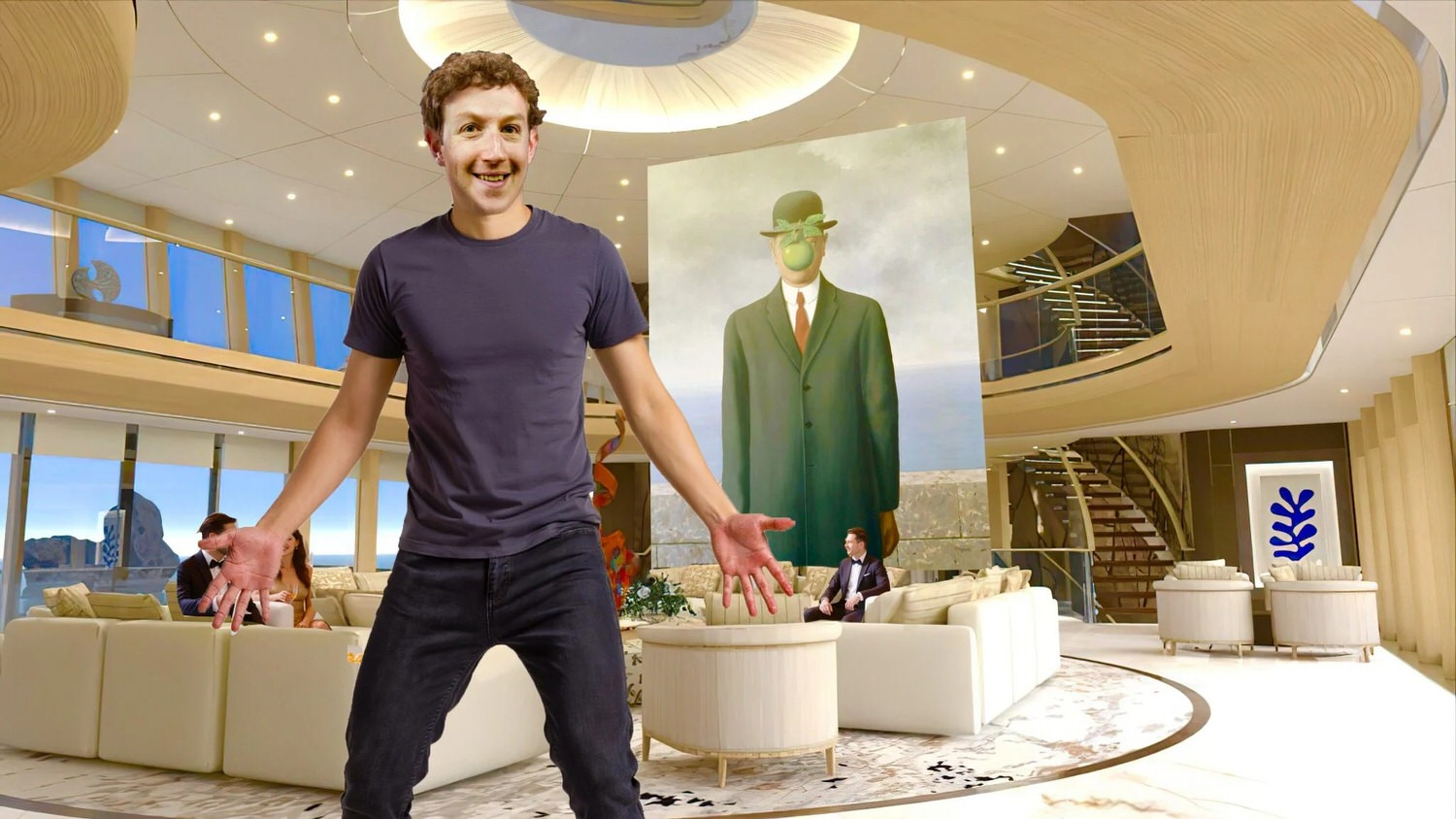
If they don’t rip open the ozone layer by computing alone, there’s always their gas-guzzling monstrous yachts (and short-haul helicopter flights), consuming more fuel for a single outing than the cost of 90 percent of the fare on offer at the fair. Photo courtesy Kenny Schachter
On the subject of the omnipresent, readily recognizable Surrealist, it pains me to have to write about the Meta-owning creep who is masterminding the foreshortening of our attention spans and soiling of our minds (mostly with spam). I can also disclose that Zuckerberg has thrown his hat into the ring—pun intended, sorry folks—of the masterpiece game. A well-placed source tells me that Mark recently bought Magritte’s 1964 painting Le fils de l’homme (The son of man), perhaps his most well known, in a private treaty sale negotiated by Christie’s for roughly $150 million, give or take $20-to-$30 mil. (Lunch money to him.)
Arnold didn’t respond to my inquiry about either, nor did Zuckerberg, when questioned via direct message on Instagram. (Try to send an email to Meta, and you get lost in a labyrinth for days.)
After backing away from his 2023 cage-fight challenge against Zuckerberg (a wise move, given Zuck’s jiu-jitsu status), maybe Elon Musk will throw down the gauntlet to battle the other techno titans in a frenzied art arms race. With his recently negotiated trillion-dollar pay package (we’re doomed), Musk is far better suited to prevail in the somewhat-less-treacherous arena of Sotheby’s and Christie’s salesrooms.
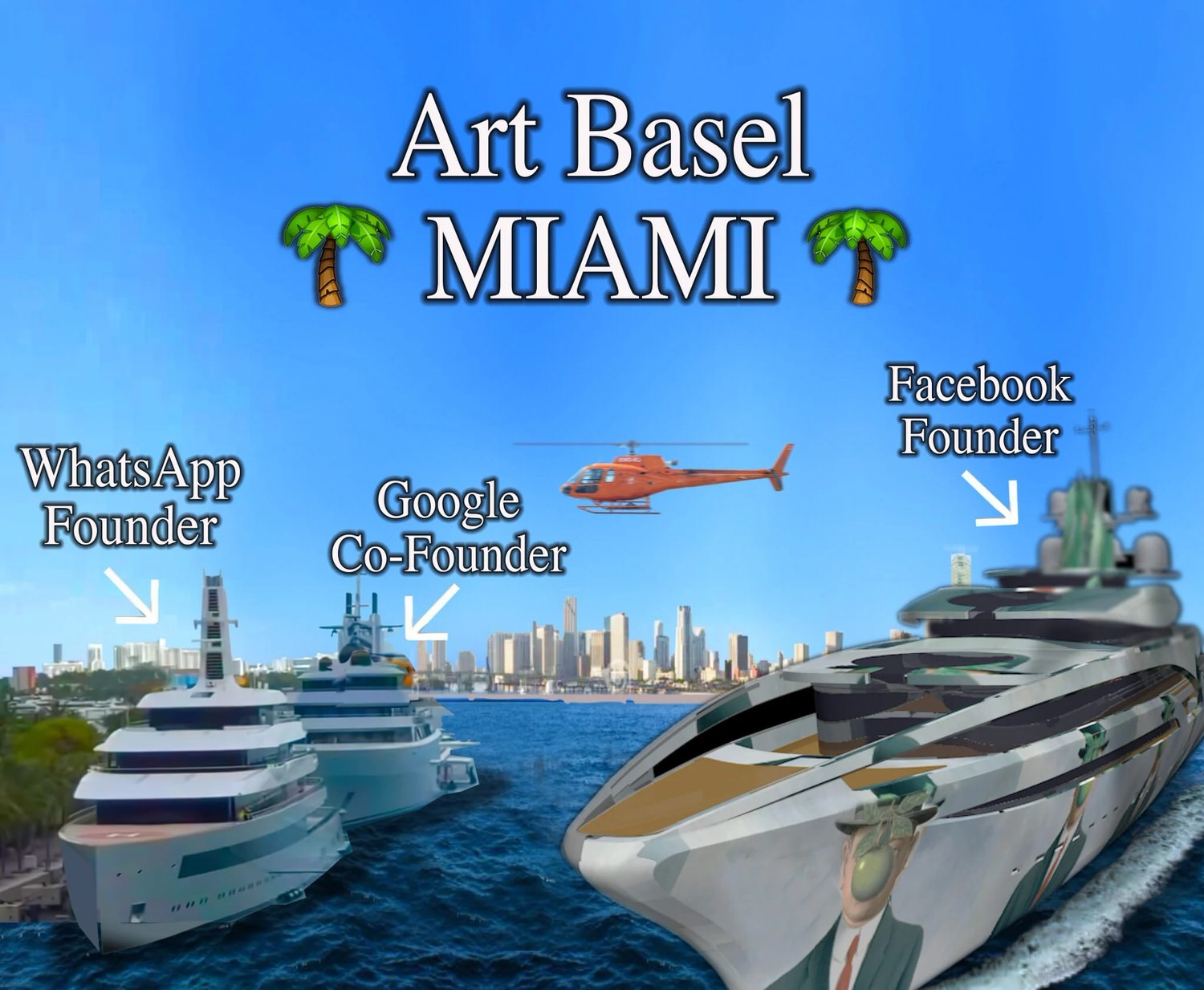
New kid on the block—as awful as he and his companies are, at least the money is beginning to flow into art, though we’d be better served if he gave it to a museum. And stop eavesdropping on everything I say in proximity to my phone and sending me f-ing spam non-stop! Photo courtesy Kenny Schachter
But let’s get to the $236 million question: the identity of the purchaser of Klimt’s Portrait of Elisabeth Lederer (1914–16) at Sotheby’s last month. It was Sheikh Mohamed bin Zayed Al Nahyan (MBZ), the president of the United Arab Emirates and ruler of Abu Dhabi, I was told by someone at the top of the auction field. MBZ holds the emirate’s economic reins via the Abu Dhabi Developmental Holding Company (branded as ADQ since 2020), which is chaired by his brother, Sheikh Tahnoun bin Zayed Al Nahyan. ADQ had a guarantee on Klimt’s Lady prior to her sale.
Sotheby’s executives denied the above to me (in repeated phone calls), while subsequently admitting as much to people more important than me that I know. (Auction execs would make ideal politicians, by the way.) ADQ coincidentally (ha, ha) invested $1 billion in 2024 to acquire a 30-percent stake (according to my sources) in Sotheby’s from its majority owner—for now—Patrick Drahi.
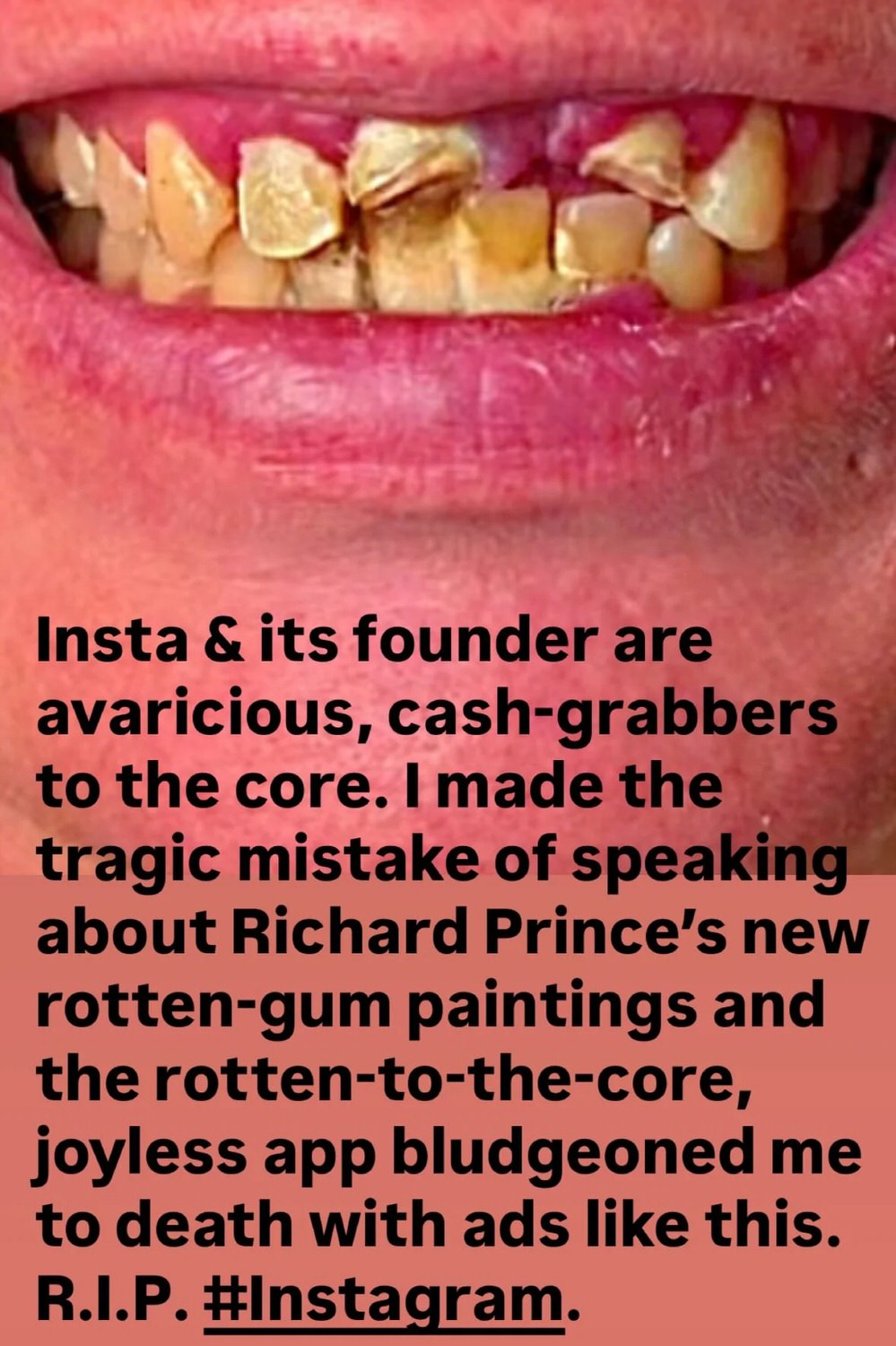
Power down your devices! Now. For if you so much as whisper about something, be forewarned you’re about to be inundated with ads no matter how horrific and off-putting. Photo courtesy Kenny Schachter
A Bloomberg article entitled “Billionaire Drahi Strikes Back, Bashing Altice Lenders” chronicled a unilateral, unbridled attack that Drahi launched a few weeks ago against his innumerable creditors (called a “drop-down”), catching them unawares and subjugating them in an effort to retain control of his debt-laden companies. Drahi treats his lenders worse than his Sotheby’s employees, as cringingly recounted in a now-infamous New Yorker profile, “How a Billionaire Owner Brought Turmoil and Trouble to Sotheby’s.”
In the Middle East, an all-out strategic scramble is underway to lure international sightseers. The Zayed National Museum opened in Abu Dhabi last week, and Frieze’s foray there is slated for next November. MBS’s $450 million Leonardo is destined for an unveiling at an as-yet-unspecified Saudi museum, and Qatar’s ruling Al Thani family has a long history of buying big-ticket art; it will premiere a Basel of its own in February. (Just what we need, another fair.) Peering into my crystal ball, I see imminent Middle Eastern investment into Art Basel, Frieze, and/or Christie’s, if not outright ownership of one or the other.
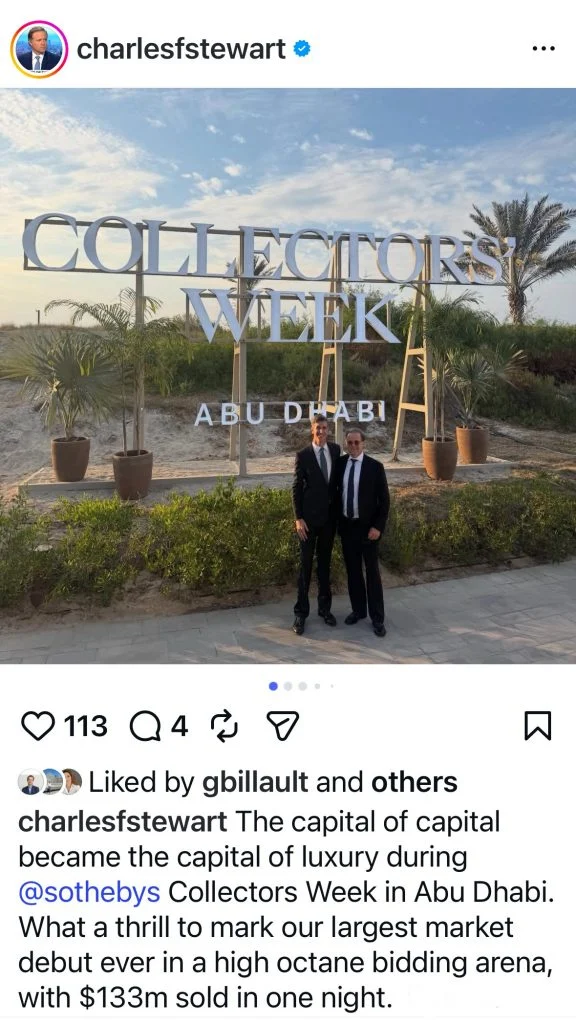
$1 billion of art, jewelry, watches, and cars for sale—OK, sounds plausible. Luxury goods make sense, but art’s more a matter of wishful thinking, other than the biggest-ticket masterpieces headed for the mausoleums to lure the tourists.
We live in an age when lines snake outside of garish retail shops selling stupidly overpriced luxury goods (or what passes for them) in the midst of a 0-degree New York City chill. High-end collectible baubles pass for the business of art nowadays. That or just pornographic gross dollar sums.

Shit’s going down in the Middle East, sort of—if you count jewels, $25 million McLaren sports cars, and watches—NOT art any time soon, though. Other than by the neighborhood Sovereigns. Courtesy of Ameen Mohamed via Instagram
Granted, it makes sense for Sotheby’s to have staged a preview in Abu Dhabi last week of its upcoming “Icon” exhibition, which also showcases cartoonishly overpriced items, before its opens this weekend at the Breuer Building in New York. Yet, it all just makes me pine that much more for the quaint old days when an icon symbolized a cultural exemplar, an artistic paradigm rather than a second-hand celebrity handbag or soiled basketball jersey.
Scott Reyburn, the OG doom-and-gloom prognosticator of market journalism, recently penned a piece for the Art Newspaper, “Was the autumn art market boom more than just a blip? Highly successful auctions and fairs do not solve the market’s deeper problems.” He quotes Roman Kraussl, a business school professor of finance whose claim to fame is “publishing extensively on art as an asset class” (eye roll): “I am not sure whether the current ecosystem will survive as it is.”
Is Professor Kraussl really the right person to ask? There are more students than ever studying fine art and—believe it or not—art and economics (when did that become a thing?) with a view to a professional career in the art market. I’ve lectured to a disparate batch myself in the past few months at the University of Zurich (where I’m a professor), Columbia University, and New York University. The students were uniformly excited by the prospect of a future in the art business—Warhol would have been proud—and as unflinchingly hopeful as I am that artists, collectors, and galleries will continue to thrive. (As they do now, which many refuse to acknowledge, for some odd reason.)

I happily didn’t go to Basel Miami, gratefully preferring being bundled up in bed, despite being offered a gig to cover the festivities for Bloomberg, to which I responded without hesitation: “I’d rather get shot in my penis.” Besides my allegiance to Artnet of course 😉 Photo courtesy Kenny Schachter
One case study: Is Jenny’s an exercise in futility, a valiant display of perseverance and tenacity, or both? Jenny Borland and Mathew Sova opened the gallery in Los Angeles in 2014 and relocated to New York in 2021, first in Chinatown and most recently in Hell’s Kitchen, on the 12th floor of 333 West 52nd Street, where they are a veritable island unto themselves, with a cracking view of the skyline. Ensuring the financial viability of their intrepid enterprise, they alternate days working at the dynamic little space while holding down part-time jobs. The result is a gallery teeming with exhilarating, infectious energy.
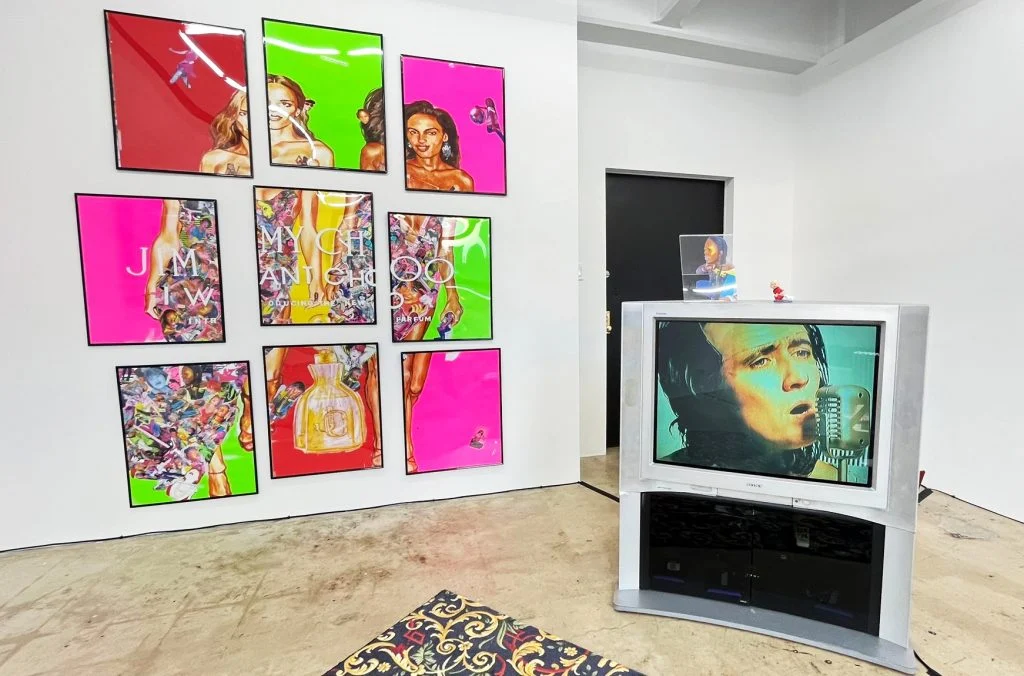
Ruth Angel Edwards & Chloée Maugile at Jenny’s: a big show at a tiny gallery, a restless array of riotous colors and media, humor and dread in an intimate dance. Don’t miss it. Photo courtesy Kenny Schachter
Presently on exhibit, until January 20, are Ruth Angel Edwards & Chloée Maugileis, a young collaborative duo showcasing experimental videos, installation, and paintings that employ dark humor, psychedelic imagery, and sound, an agnostic body of works flitting between exuberance and dread that brought to mind the mutant offspring of Vito Acconci and Alex Bag (@alexbag666 on Instagram).
What the doomsday market jockeys and people who think art history started with KAWS and Condo don’t seem to get is that art is about more than the analysis of assets or the exaltation of economics. It is characterized by primal human urges: passion, intellect, and creativity, combined in a witch’s brew that can’t be squelched. Ever.