
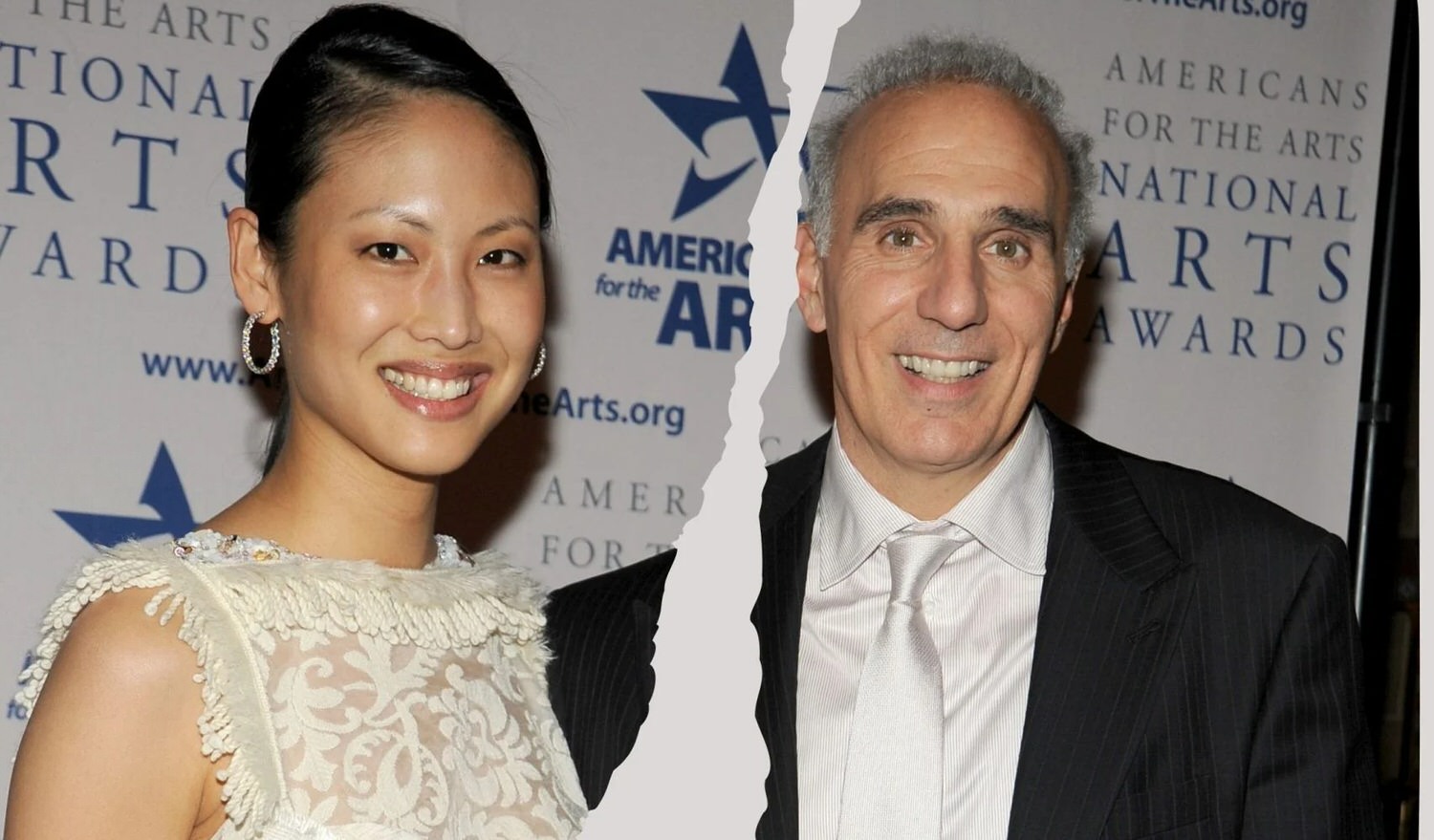
Emily Rales and Mitch Rales attend National Arts Awards at Cipriani 42nd St on October 18, 2010 in New York City. Photo: Clint Spaulding/Patrick McMullan via Getty Images.
As the dollar sinks to its lowest levels since the Nixon administration in 1973, and word of the art market circling the drain continues unabated this (scorchingly) hot summer, which has only just begun, there’s intrigue (to put it mildly) afoot—lots. Remember the quaint years past when summers were occasion for repose and replenishment? All I could say is, pff, that’s no longer quite the case.
With an endowment nearly equaling that of New York’s Metropolitan Museum of Art and net assets of $4.6 billion, the Glenstone Foundation founded by Mitch and Emily Rales in 2006 (they married in 2008) is a force to be reckoned with, armed with greater resources than the world’s contemporary art museums cumulatively. Emily cut her teeth working for Barbara Gladstone Gallery and Mitch is a corporate takeover investor who, along with his brother Steve, were dubbed “Raiders in Short Pants” (alluding to the ages of the youthful marauders) in a 1985 Forbes Magazine article.
An Artnet column I wrote eight years ago titled, “Kenny Schachter on Learning to Love the LA Art Scene (Except Those Wacky Private Museums)” encapsulated my gripes with the surfeit of private art “museums” across the U.S. and further afield, spreading like a rash:
I am still trying to determine if the Marciano brothers (Paul and Maurice, of the Marciano Art Foundation) retain ownership of the underlying collection and, along with it, the capacity to privately transact. I get the feeling these hybrid institutions eat up the natural audience painstakingly built by the local museums—as well as their future art donors—in a zero-sum game of one-upmanship.
Though they obviously add to the overall fabric of the city, perhaps these foundations make more sense in China, where there are just a handful of contemporary art museums at present. The curatorial voice of these upstarts reads more like a vibe, dictated by the founder’s fancies and follies (or those of their advisors) and what was recently on offer at the Basels and at auction. I am not judging whether art without scholarship is inherently good or bad—rather, they’re a bit of a ‘tweener, caught between institution and fun house. They all undoubtedly have something to offer; precisely what, history will tell.
Since then, the Marciano dissolved when employees attempted to unionize in 2019, only to reopen in 2024. Glenstone’s workers faced comparable resistance from the founders in 2024, see the article: “Workers at Glenstone Faced Union-Busting Tactics Before NLRB Vote.”
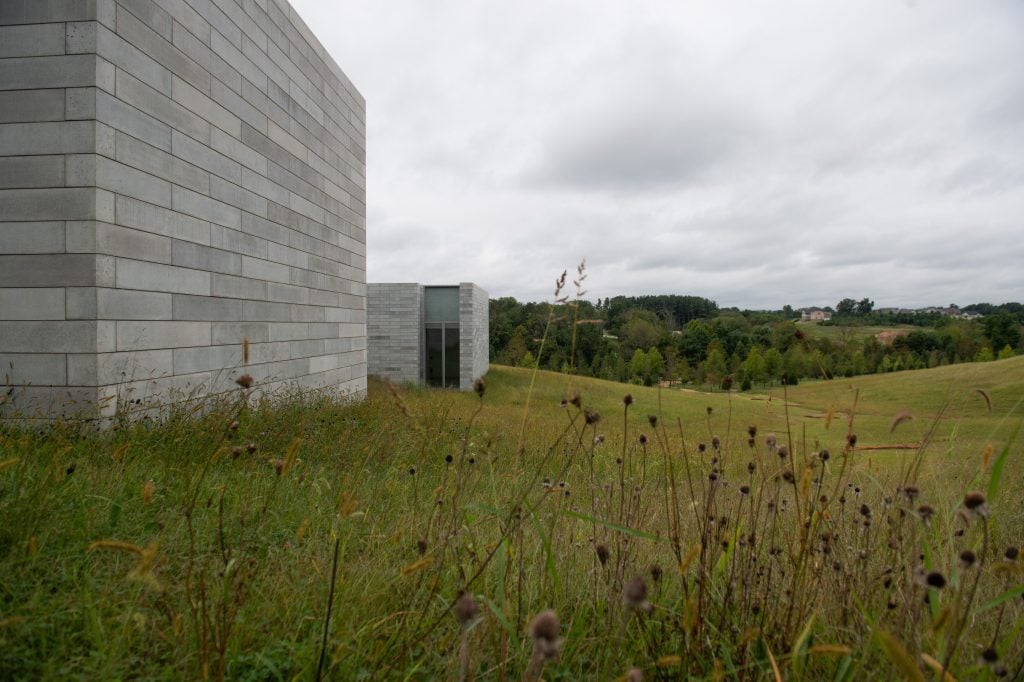
A view of the Pavilions, a building at the Glenstone Museum, combining art, architecture and landscape, during a media preview in Potomac, Maryland, September 21, 2018. Photo: Saul Loeb/AFP via Getty Images.
Glenstone is notoriously inaccessible, buried deep in the suburbs of Maryland, open only by appointment and off limits to visitors under 12 years old. For comparison’s sake, Jean-Michel Basquiat was all of six when his mother enrolled him as a Junior Member at the Brooklyn Museum. Glenstone’s proscription of gum chewing (guards will accompany you to the garbage if you get busted), though bordering on tyrannical, is kind of amusing.
In addition to the often-expressed gripes about the raison d’être of private institutions, namely, that they are pretexts for bottomless tax loopholes benefiting those least in need of them, they are also bald-faced maneuvers in garnering access and social cache. On gratuitous tax breaks for the affluent at the expense of just about everyone else, take a gander at the Big Beautiful (tax and spending) Bill about to be codified into law.
Worst of all, when extravagances such as Glenstone are opened in proximity to long established (legitimate) museums that painstakingly clawed their way to constituencies and funding over decades, if not centuries, it exhausts private monies that might have been redirected to more accessible and in-need venues. For example, the Corcoran Gallery of Art established in 1869 in Washington D.C., a mere 30 miles from Glenstone, was unceremoniously shuttered in 2014, after financial difficulties.
Into the mix, I can report the imminent divorce of Mitch and Emily Rales, a fait accompli according to multiple insiders with relationships with the couple I spoke to, shading the whole foundation with a cloud of uncertainty of unimaginable consequence. Reached by email, the Glenstone did not immediately respond to a request for comment. A DM to Emily Rales also went unanswered.
What will become of the Glenstone’s indeterminate future? The art? The premises? I’m happy to volunteer my services, moving into the Rales’s estate located on the front lawn of the foundation, to oversee the enterprise. But I acknowledge I’d do away with the reservation requirements and admit gum-chewing kids in the process.
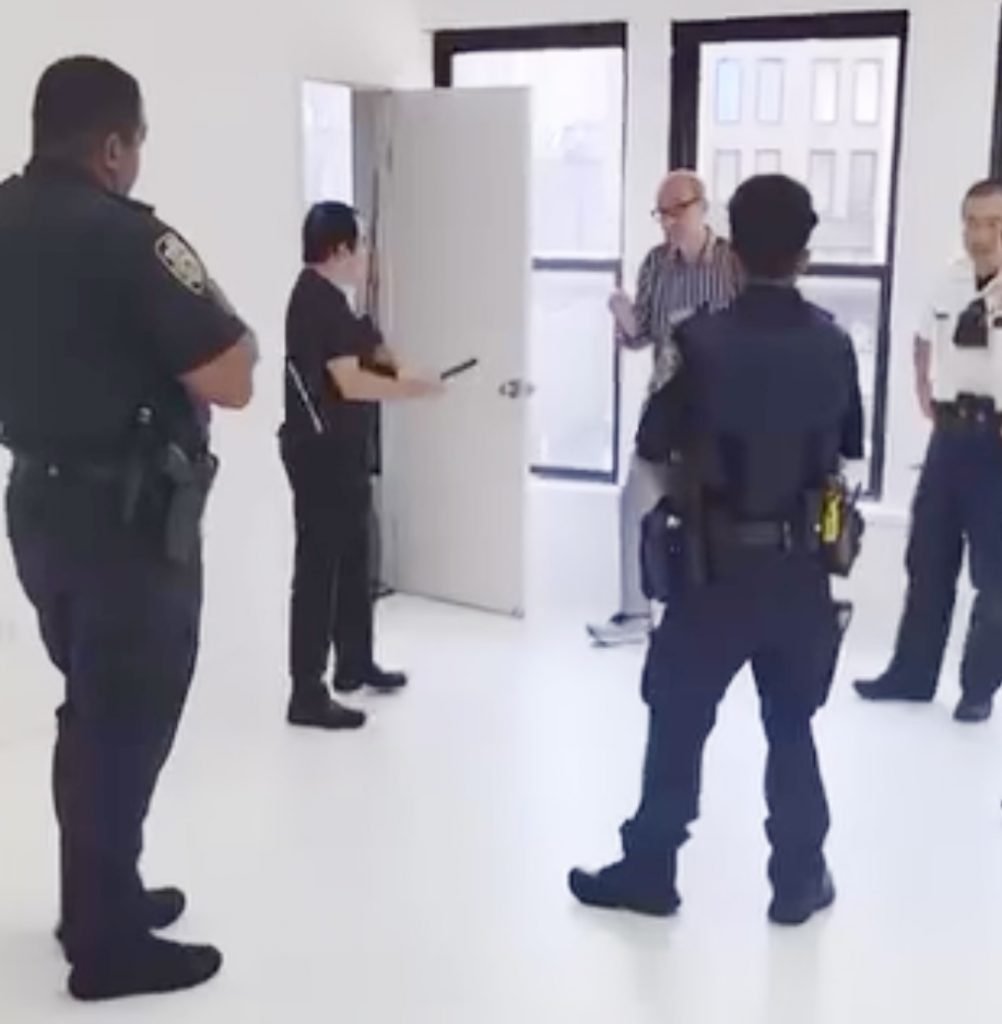
The scene of last Saturday’s alleged (near) violent altercation at Lubov Gallery featuring José Freire and a gaggle of New York’s finest that almost combusted into early onset, pre-July 4th pyrotechnics!
On an altogether different note, increasing numbers of galleries are suffering anemic sales, slow paying clients and invariably, unpaid artists, handlers and technicians. High-profile venues in NYC, London and elsewhere have succumbed in the past few years to such a fate and folded—others will unavoidably soon follow suit.
A still unsolved situation is that of José Freire of Team Gallery, who allegedly went on the lam after padlocking his gallery and fleeing to Spain back in 2020, facing lawsuits and disenfranchised, short-changed artists and collectors. The situation was previously recounted in Artnet. Inquiring into the events described above, I communicated with a handful of artists wronged by Freire. Prior to that, José opened Fiction/Nonfiction in 1987 which ultimately became José Freire Gallery in SoHo’s Bakery Building in 1993—then the costliest building in the neighborhood.
Evincing a pattern, Freire’s eponymous gallery morphed into Team—allegedly under circumstances similar to the most recent closure, hence why he no longer operated under his own moniker. Team had opened in 1996 with his then partner, now called Francis Ruyter, as the sole shareholder of the new corporation and lease signatory—it doesn’t take a Rhodes Scholar to figure out why, given what we now know of his business practices.
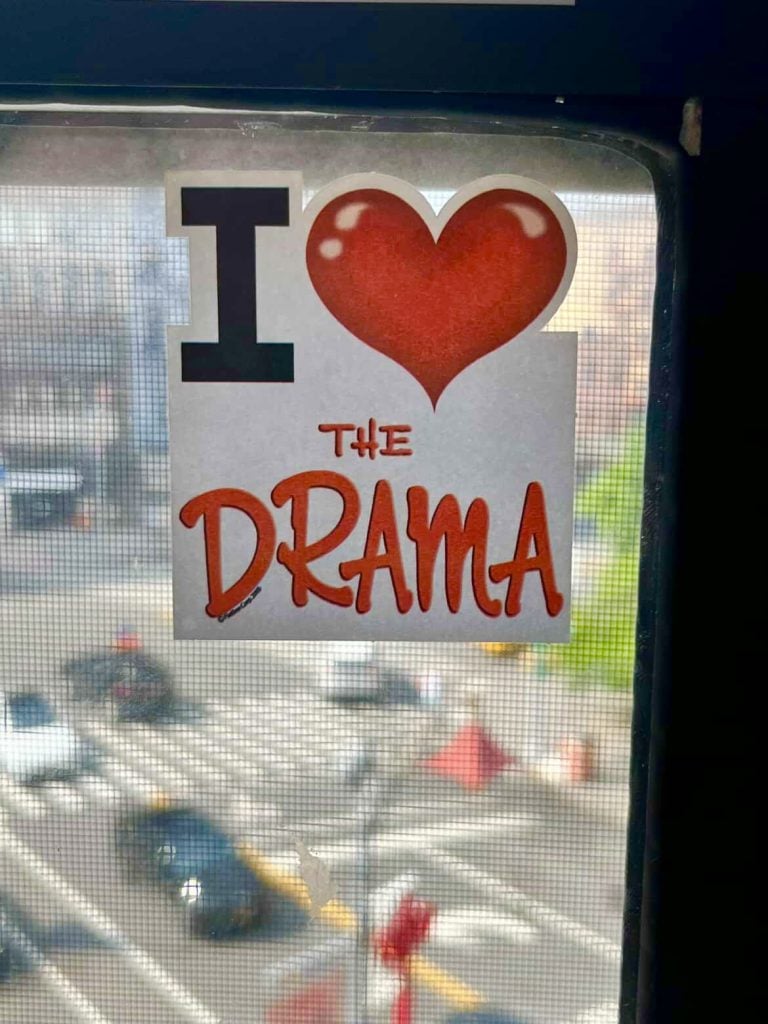
The sticker in Lubov Gallery’s window, undoubtedly the understatement of the year, after the alleged near brawl that escalated into a full blown police incident.
A few weeks ago, I received a random press release from a New York gallery I had heard of, but never visited. What caught my eye (in an otherwise generic summer outing) was the identity of the curator, José Freire, entitled “The Happiness Project: Episode 1, a series of ten exhibits to be held at a diverse group of galleries over the coming years.”
I replied to the spam (err, how else can you characterize the seemingly endless stream of gallery announcements?): “Did he pay back all his artists yet?!?!?!” To my surprise, I received a response to my unsolicited missive: “Let’s ask him! He’s in town for the opening.” The following exchange ensued shortly thereafter:
Gallery: Cops are here LOL I guess he hasn’t
KS: You’re joking obviously. Was he there? What did they want? Apparently, he skipped town owing tons TO ARTISTS.
Gallery: Yes Jose is here for the opening
KS: Are cops there for him or are they art collectors?
As the evening’s festivities got underway, collector Hadley Landau, grandson of legendary arts patron Emily Fisher Landau, told me he rocked up with a burly entourage in tow. He purchased a Slater Bradley work in 2012 from Team, which he never received despite innumerable entreaties. Freire, as you can imagine, was caught off guard and things reportedly escalated from there.
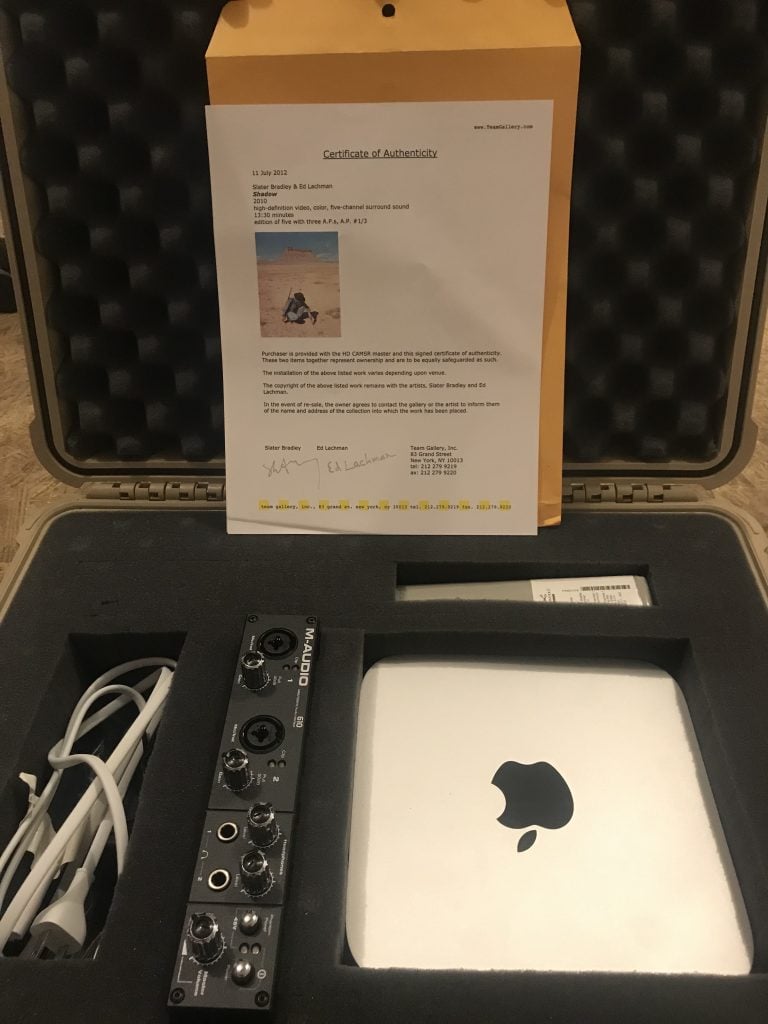
The as-yet-unaccounted for Slater Bradley at issue in the dispute between Team Gallery and Hadley Landau, image courtesy of the Hadley Landau Collection.
As related to me by a witness on site, a salvo of heated exchanges ensued between Landau (and his crew) and Freire, who allegedly pitched back in a palpable state of panic. Sensing impending bloodshed—his no doubt—Freire asked the gallery to summon the police. No less than a half-dozen of New York’s finest swiftly turned up in a wise (eye-roll) deployment of the city’s hard-pressed cops. Fitting that Trump just declared he is hosting an Ultimate Fighting Championship bout next year, with an audience of 25,000, on the grounds of the White House no less!
The only party missing was Mayor Adams, inclined to appear at the opening of a hot dog stand, who idiotically appointed a nightlife czar earlier in his administration in a municipality woefully short of funds with a crumbling infrastructure—and menacingly high crime rate.
Nowadays, if it’s not caught on someone’s ubiquitous phone camera, it didn’t happen, right? Exhibit A: the video!
Hadley and Co. said they demanded the art piece while José allegedly flip-flopped from initially retorting, “I gave it to Slater,” to “My staff threw it away.” According to those present, Freire’s offer to have Slater issue a new certificate was rebuffed; instead he agreed to draft an affidavit on the spot to the effect that the work was paid in full though never received. The ensuing document (see below) is about as worthless as German currency during the hyperinflationary Weimar Republic (1922–1923), when a wheelbarrow’s worth fetched a quart of milk. Literally.
Freire responded to me yesterday:
Hello Kenny,
Thanks for reaching out.
There was an altercation before the Lubov Gallery opening this past Saturday concerning an artwork that had been purchased from Team Gallery in either 2011 or 2012. Suffice to say that my position and that of the collector were in conflict but that hopefully it has been resolved.
Best wishes, José Freire
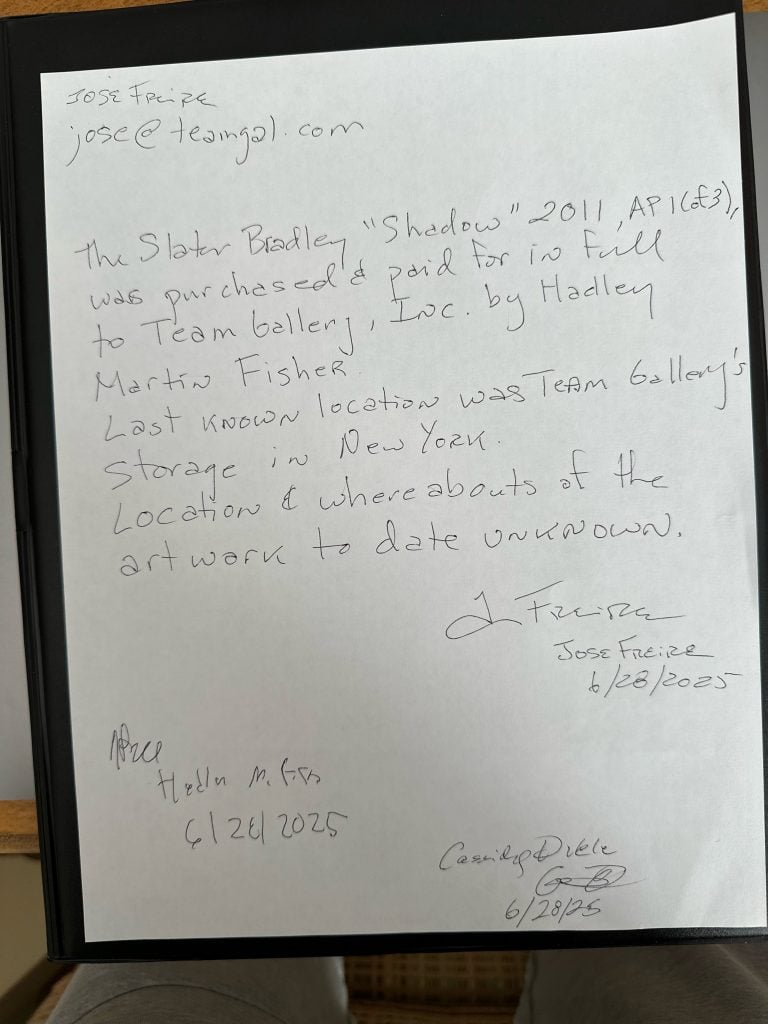
If you believe this document has any value whatsoever, can I interest you in a nearby bridge centrally located on New York’s 59th Street; or, better yet, an iconic masterpiece of a painting sporting an enigmatic smirking female figure on loan to a major museum in Paris?
As far as Hadley is concerned, when we touched base post-melee, it unequivocally hasn’t.
Lubov gallery owner Francisco Correa Cordero told me he had been led by Freire to believe he had resolved all his debts or was amicably in the midst. Such assumptions were misplaced—shedding old habits ain’t easy, if at all. “Happiness,” whose exactly is anyone’s guess, remains open at this juncture if you want to catch it. However, after Saturday’s hullabaloo, I’m less sure about the fate of parts two to ten, meant to follow. Passing by the gallery, I spotted an “I LOVE THE DRAMA” sticker on the window. Can’t argue with that.
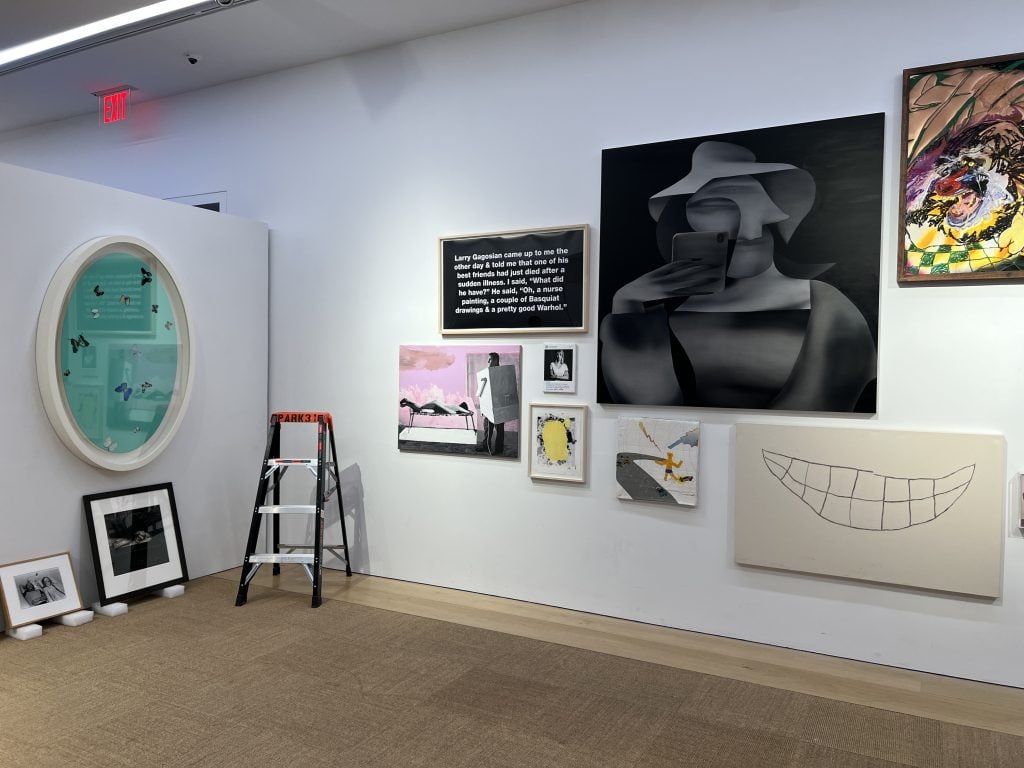
Beginning next week, Hoarder #6, the last in the series of online no-reserve auctions and exhibits, this year at Phillips, including (from left to right), Damien Hirst, Peter Hujar, Fred McDarrah, Franz West, me, Christopher Wool, Eric Doenger, Jingze Du, Misaki Kuwai, Bianca Fields and Joe Bradley, among others.
In closing, regarding Glenstone and private foundations of the ilk, I’m in no position to dictate how anyone should spread their largess; besides, I’m very laissez-faire about most things in life. Nevertheless, it’s not a stretch to see the negative repercussions of funds being sucked from public (authentic) museums by such endeavors, especially with public funds presently drying up faster than my skin in the premature dog days of summer.
Oh, and for the sake of the foundering art market (if for nothing else), don’t miss my no-reserve, save for two lots, online auction and exhibit at Phillips next week (July 8–17), the sixth in the Hoarder series of sales.