
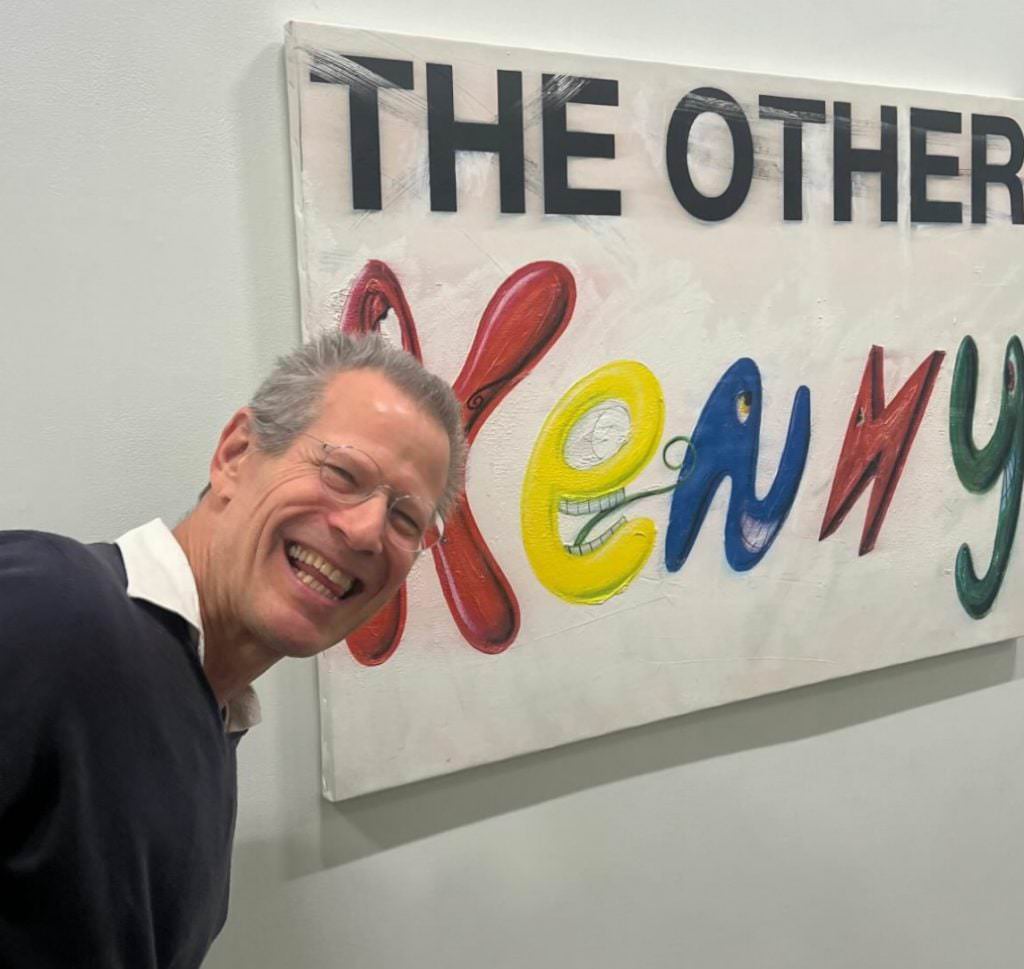
The other Kenny, you know who, that I am constantly getting mistaken for (due to the fact we share the first nine letters of our names), was kind enough to provide the ammo for this painting, by way of his personalized alphabet. Image courtesy of Inbal Safdie
Open a newspaper, switch on your phone, or turn on a TV, and you are confronted by nothing short of an incessant barrage of stories of tumbling shares, fretting investors, and soft landings (or hard). From the art side, it’s lenders calling in loans or demanding more expensive collateral, as well as museums and galleries staging fewer shows to diminishing audiences and sales.
For heaven’s sake, there’s no reason to buy a new suit—or another pair of old Adidas track pants—to paraphrase an old Richard Prince joke painting. It all makes a lovely backdrop for the staging of my 10th solo exhibition in seven years—it opened last week at Jupiter Gallery on Delancey Street in New York and runs through April 26—as I continue the transition to full-time artist.
The Magnificent 7, composed of Amazon, Apple, Meta, Nvidia, Alphabet, Microsoft, and Tesla (for now), are the tech highfliers that represent a barometer for measuring broad economic sentiment and performance.

We have our very own team USA mascot, a sign of excessively wacky times, if ever there was one. Image courtesy of Kenny Schachter
These companies, whose meteoric growth has far outpaced the rest of the stock market, are analogous to Hauser and Wirth, David Zwirner, Pace, and Gagosian, the four colossal contemporary galleries that continue to rule the roost, garnering the lion’s share of business. Call them the Ferocious 4; or perhaps another F-word would be more suitable, depending on your vantage point. That number may very well be whittled down amid rumors that Pace is in search of investors, dealing with excessive overhead (it has denied that), and mulling a possible Sotheby’s hook-up, and as Larry G fast approaches his 80th birthday next month.
In the financial sector, loss harvesting is when you willfully sell an investment at a loss to offset a realized gain from another transaction, thereby reducing the tax burden from the profit. The art world equivalent is when collectors and dealers sell art for less than its initial purchase price to generate cash flow, regardless of whether there are any counterbalancing tax benefits to be had. Things are so unsettled in today’s tumultuous times that losing (money) is the new winning. On that note: You may want to take a look at my next no-reserve, online “Hoarder” sale and exhibition at Phillips auction house in July. Its tagline is, “My loss is your gain.”
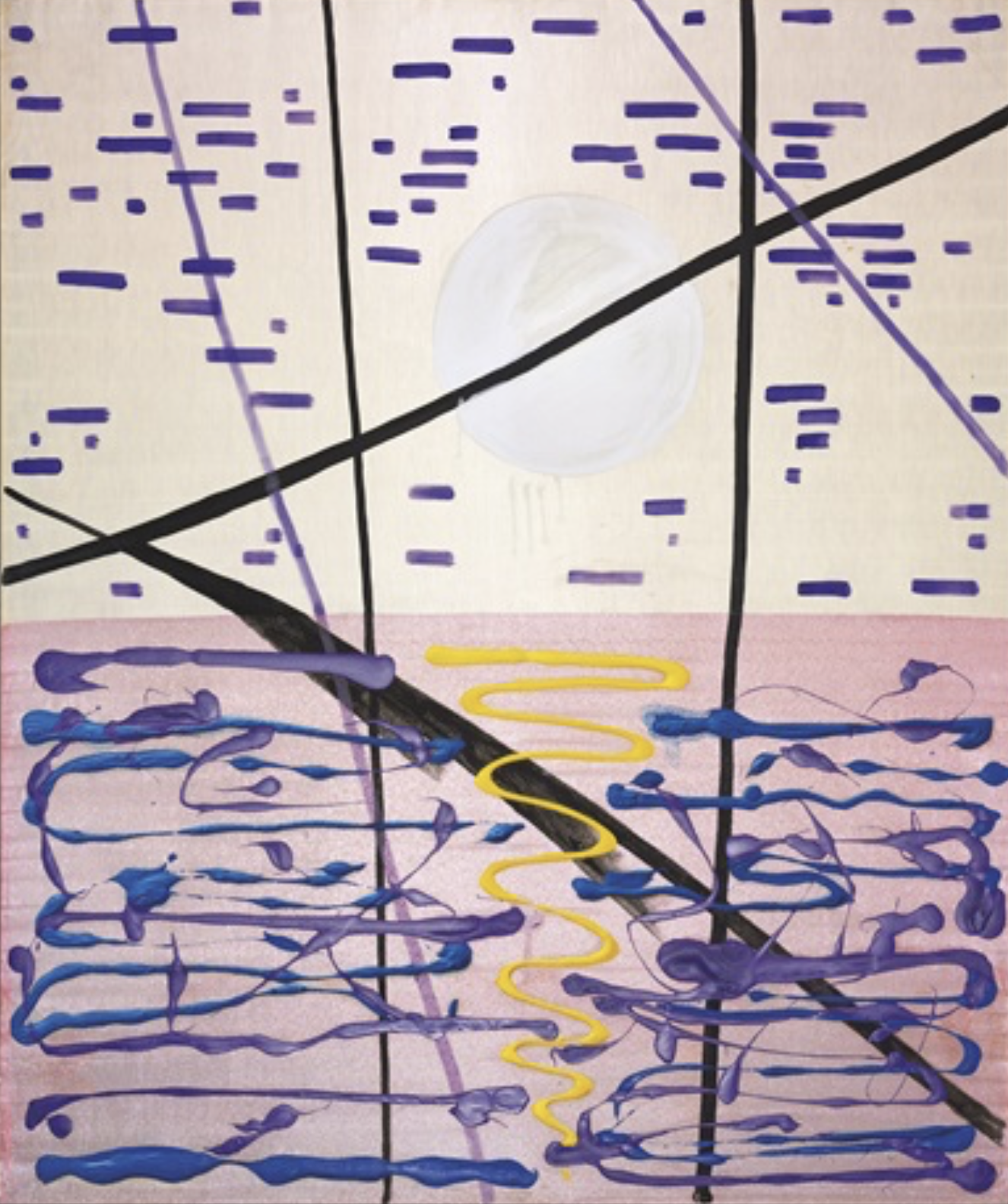
The Sigmar Polke painting withdrawn from auction last week, one of dozens that have gone unsold since the estate was closed; this work was said to have suffered a gravy stain years ago, to which Polke responded by slapping on a daub of his signature purpled pigmented paint. Image courtesy of Christie’s
A potentially related example is Sigmar Polke’s 1969 painting Moonlit Landscape with Reeds, which recently came and went after being withdrawn, presumably as a result of a lack of interest (about the only reason for doing so), just prior to Christie’s March 5 evening auction in London, on an estimate of £3 million to £5 million ($3.9 to $6.49 million). The painting was last sold at Christie’s London in June 2015, for nearly £4 million ($6.12 million) with an estimate of £3.5 million to £4.5 million.
Oddly, while the painting was exhibited at David Zwirner’s Los Angeles outpost, in a show celebrating his gallery’s 30th anniversary, just this past summer, that information was conspicuously left out of the provenance of the work’s auction catalogue listing. The painting also appeared in Zwirner’s one and only Polke show, in New York in 2016, after the gallery announced representation of the artist’s estate to much fanfare. This exhibition was duly cited by Christie’s (which did not reply to a request for comment).
A handful of dealers I spoke to about Moonlit Landscape with Reeds identified Zwirner as its buyer at the 2015 auction. Perhaps that accounted for the omission of the L.A. showcase? One might not want to draw attention to an artwork going unsold twice in less than 10 years. The catalogue seems to indicate that the present owner is the same person who acquired it at the 2015 auction.
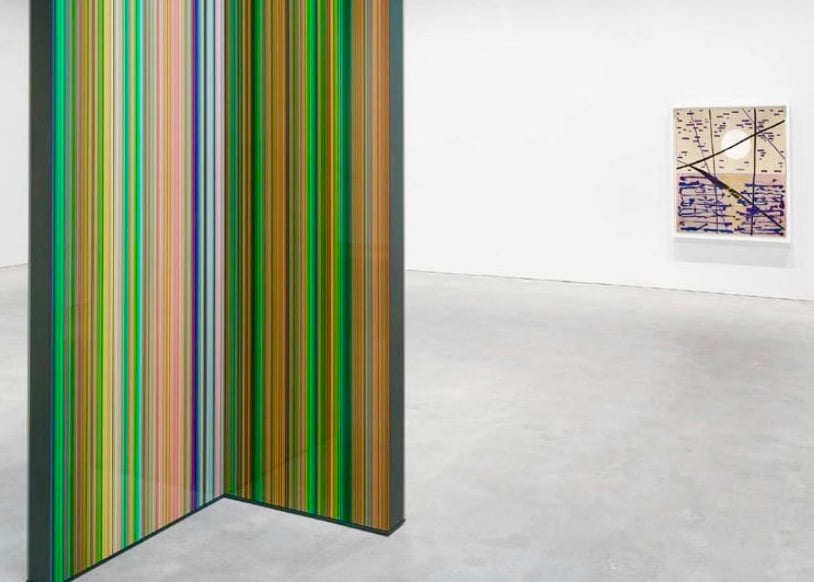
The Polke appeared in David Zwirner’s 30-year anniversary show in Los Angeles in August 2024, an exhibition that was absent from the recent auction catalogue listing before the work was withdrawn due to lack of interest. Image courtesy of Kenny Schachter
When queried by email, Zwirner told me that he wasn’t the consignor. “No, it was consigned to us by the owner,” he said. “I am sorry to hear it didn’t sell. I saw the Polke show at the Prado last month, the man was a genius!” As if he was just hearing about the lot’s withdrawal from me!
What prompted the (aborted) sale? Perhaps someone needed to raise cash, but sadly, for Polke devotees like me, a diehard fanatic, issues with the Polke estate may also be causing trouble for his legacy.
Augustina von Nagel, the widow of Sigmar Polke (they married in 2009, only a year shy of his death from cancer in 2010), is one of three heirs to Polke’s estate, along with his son, Georg, and daughter, Anna. A will has never been found. Though a cursory internet search revealed von Nagel as being instrumental in organizing the estate, she unceremoniously and unilaterally shut it down in 2018.

Loss harvesting in the financial sector is offsetting losses against agains. The art market version is cultivating losses for some much-needed liquidity events. Image courtesy of Kenny Schachter
Von Nagel effectuated this by halting staff payments, including to artistic director Michael Trier (the conservator for both Polke and Richter) and the esteemed members of the catalogue raisonné committee comprised of Trier, Bice Curiger (art historian, curator, critic, and publisher), Katharina Schmidt (scholar and museum director), and Goetz Adriani (art historian, art conservator, and art museum director). Things have languished from there.
According to multiple sources in the know, von Nagel has allegedly declined to assist in many institutional loans (there are said to be unanswered letters from the Prado museum for its recent two-person Goya exhibition) or even to grant reproduction rights for gallery and museum publications. Which I would argue has contributed to the artist’s flagging market.
A more concrete example is the time I received a random, unsolicited email in 2019 from von Nagel with an image of a high-profile 1970s Polke painting that had sold a few years prior from the Swiss Basel booth of Lévy Gorvy in the neighborhood of $10 million with an attached signed certificate allegedly signed by none other than Gerhard Richter(!) indicating that the painting was fake. When Richter assumed the role of sole authenticator of Polke, his nemesis, is anyone’s guess. The two had zero interaction or communication for decades. By the way, the work was previously accepted into the catalogue raisonné.
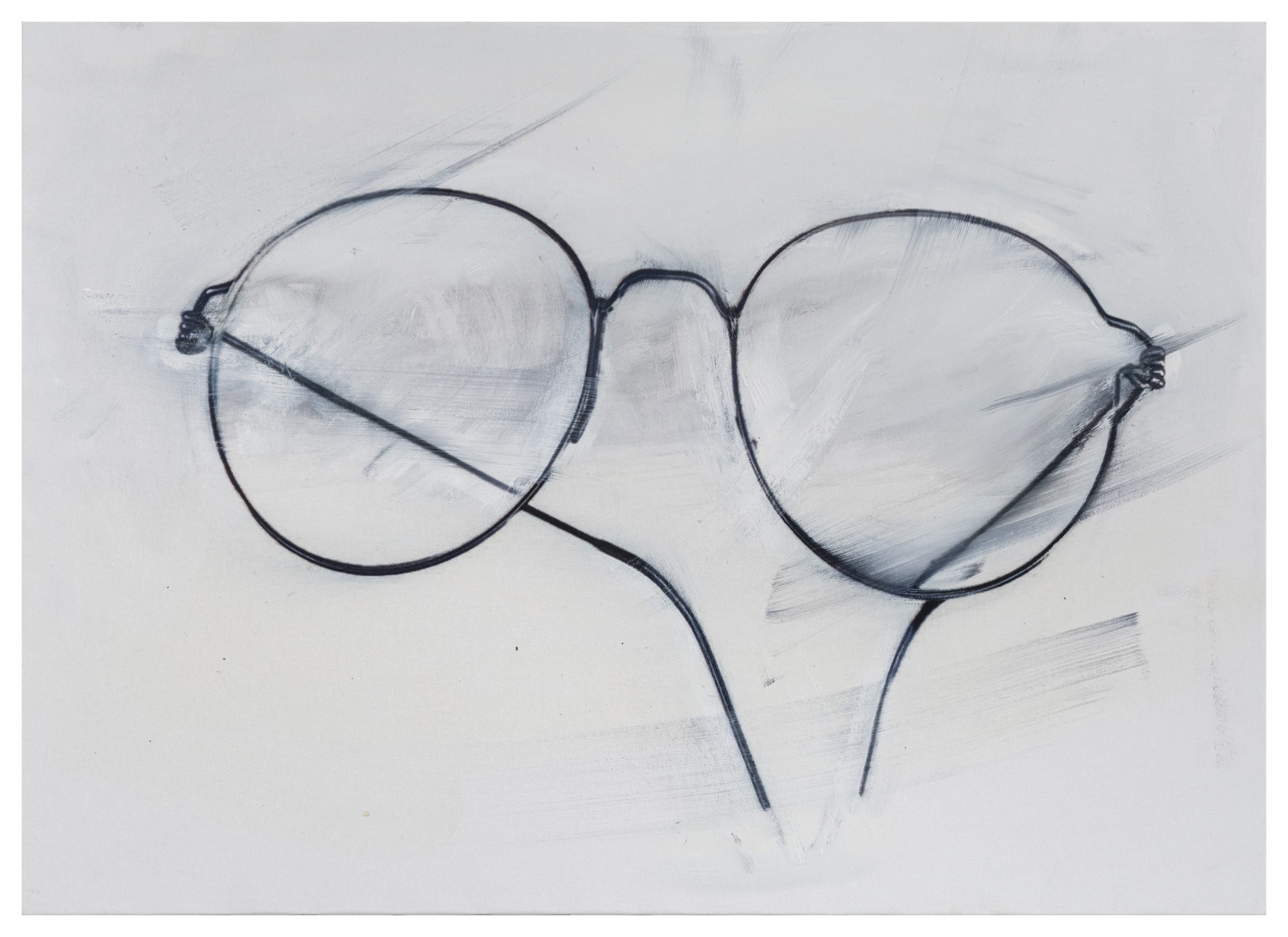
Many artists have painted their shoes, brushes, etc. These are the stand-in for my eyes, A good eye is not enough, 2025, robotically rendered in oil on canvas, 30 x 40 in., “Art in the Age of Robotic Reproduction” at Jupiter Gallery at 55 Delancey Street, New York, through April 26. Image courtesy Jupiter Gallery
spoke to Lévy Gorvy on the subject, and they recalled being contacted by von Nagel when she first attempted to to claim ownership of the subject painting; only after that proved to no avail, she followed up by claiming the work was forged.
Twice I wrote to von Nagel seeking comment on the languishing estate of a multifaceted artist that employed unparalleled levels of material experimentation (with great humor and painterly finesse): “May I ask why, nearly 15 years after his death, the Polke estate is not settled; the estate foundation closed; and catalogue raisonné abandoned? Thank you. Kenny.” When this mess is finally resolved (inevitably, I hope), look for Polke prices to mushroom on the upside, at which point the auction record of $27.1 million, achieved in 2015 at Sotheby’s in London, will undoubtedly be eclipsed. Mark my words.
In the end, great art like Sigmar Polke’s is irrepressible. The Foundation Vincent van Gogh Arles just opened an encyclopedic Polke exhibition, “Under the Paving Stones, The Earth,” curated by Curiger, showcasing a broad range of works spanning a wide area of media in spite of this fiasco (and roadblocks as described). It’s open until October, 2025. See it if you can!
As a multi-hyphenate artist/writer/lecturer, this Word logo, less the “W,” holds particular significance. Word picture, 2025. Robotically rendered to oil on canvas, 50 x 50 in., “Art in the Age of Robotic Reproduction” at Jupiter Gallery at 55 Delancey Street, New York, through April 26. Courtesy Jupiter Gallery.
On a (much) lighter note, excuse the indulgence, I couldn’t find much on Erica Pelosini, the latest Larry G GF, a person with a largely indeterminate background, other than idle chitchat on Reddit speculating as to how exactly she fuels her seven-star lifestyle. A friend spotted her trundling down Madison Avenue a few months ago, laden with designer shopping bags before she was spotted again, the very same day, at a discreet dinner party at Larry G’s manse, provocatively sucking on a popsicle smack in middle of the entree, to the astonishment and befuddled amusement of the small coterie of guests.
Add yet another celebrity to the long list of sufferers of what I call the-grass-is-greenerism syndrome, where being famous in one sphere is simply not enough (e.g. Brad Pitt, Johnny Depp, Jim Carey, Lucy Liu, et al.). Louis CK was clocked at the New York Studio School taking sculpture classes, categorically a more productive use of his hands after his very public self-pleasuring scandal.
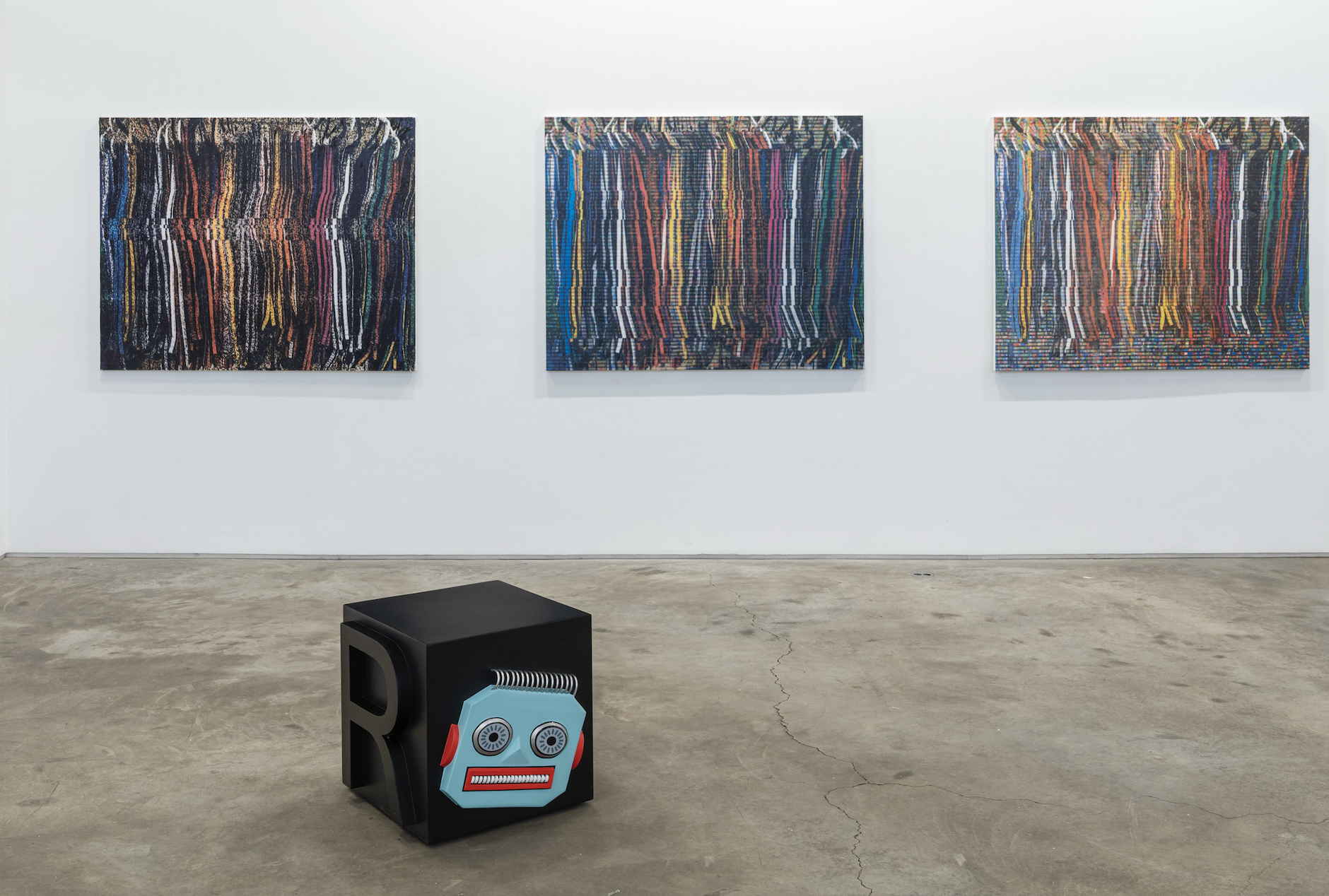
Some lowly troll with (way) too much time on their hands launched a weeklong hate campaign maligning my “fashion sense”—though I hardly ever professed to have one—yet I did develop a polyester-based color theory… Image courtesy of Jupiter Gallery
My exhibition at Jupiter, “Art in the Age of Robotic Reproduction,” features a series of paintings and sculptures satirizing and celebrating robots and the myth of the painter, with a group of works rendered by Matr Labs, a company that created bespoke hardware to reinterpret digital art into oil on canvas. In a twist on the parlance of the current market, you can refer to me as an aged ultra-contemporary artist. Being a person with a multilayered practice (sorry, lord knows I hate that term), I am even staging a lecture/performance on May 21 at Amant, the under-appreciated private museum founded by collector Lonti Ebers as part of the exhibition “On Education,” which opens this week.
The problem is that many crossing the gallery threshold come armed with preconceived notions of what I am and—more so—what I am not. Oh well, Paul Thek said (I am also curating a London gallery show of his work in May) that doing alone is succeeding, and in that regard, I have certainly never shied away from trying.

Dealer Gabriel Kilongo with my Robo Dealer at “Art in the Age of Robotic Reproduction,” my latest solo exhibition at his space, Jupiter Gallery at 55 Delancey Street, New York, through April 26. Image courtesy of Kenny Schachter
What a world we live in, where planes seem to be falling from the sky at an alarming frequency; where there’s less and less of more and more people, with the prevalence of weight loss drugs (soon being voluptuous will be considered a sign of social cachet); and, most unnervingly, we have become collectively inured to unprecedented levels chaos and mayhem. In this mad age of the Looney Tunes cartoon, art of any stripe has never been more essential. Even mine.