
There is something strange about the way a technology born to solve the problem of ownership ends up producing, at certain moments and against its own programme, images of that which ownership cannot fully account for, because if the NFT appeared accompanied by a rhetoric in which owning an image finally meant being able to prove that one owned something that until then seemed condemned to circulate without an owner (scarcity, authenticity, provenance, value and a long succession of words that for a time seemed determined to mean the same thing), some of the works Kenny Schachter inscribes on Tezos during the first months of 2023 appear to move in the opposite direction, not because they renounce ownership as one abandons a religion after discovering that the god does not exist, nor because they document with nostalgia the collapse of a scene that was still then producing images, markets and discourses, but because they introduce a rather more uncomfortable question, what happens when what deserves to be preserved is not a property, but the act through which someone decides to stop exercising it.
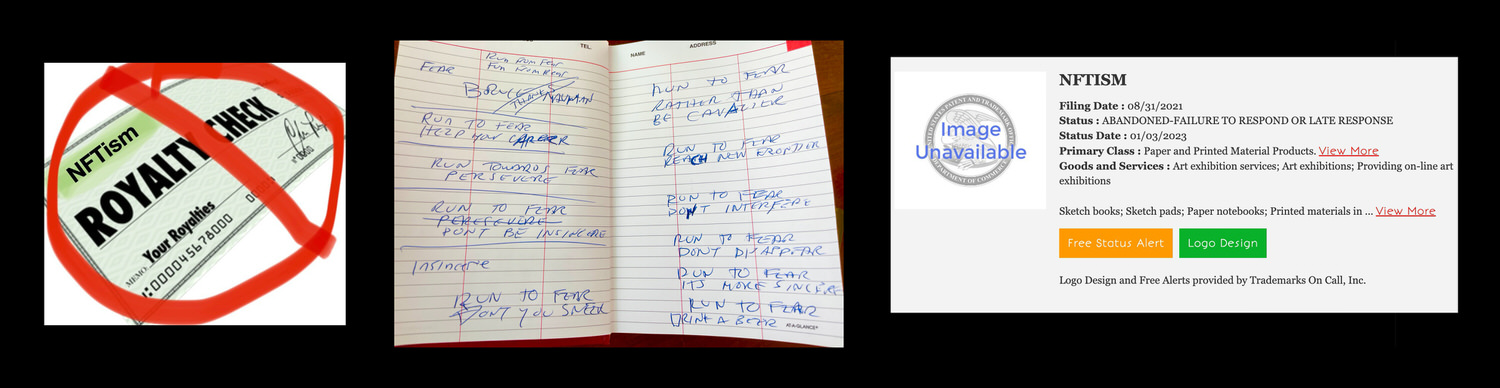
Between the 10th of February and the 30th of April of that year three works appear which, taken in isolation, have no reason to say anything to one another (there is no declared series here, nor a common title, nor an artistic will that would oblige us to read them as a set), yet which, seen from the distance that only the archive allows, acquire a strange proximity, and so RUN TO FEAR PERSEVERE / DON’T DISAPPEAR / HELP YOUR CAREER / DRINK A BEER / DON’T INTERFERE, Abolish Artist Royalties and NFTism: Trademark abandoned… seem to touch three different zones of Schachter’s practice and yet all three end up interrogating the same thing, what remains of an artist when some of the forms through which that artist could say “this is mine” begin to weaken. The triptych, therefore, was not there. It appears in the reading. And that difference matters because it turns the grouping into a critical operation and not into a secret property of the works that we might somehow have managed to discover.
Perhaps that is why Tezos is here less a place than a condition of reading, not because the chain grants these images an importance they would not otherwise possess (an inscription does not automatically turn a gesture into an event, just as a date does not turn every remnant into an archive), but because it allows certain decisions to remain there in a form different from human memory. A column can be corrected, a page can disappear, a statement can become buried under other statements and an artist’s discourse can change over the years without anyone knowing exactly when it changed; here, by contrast, there remains the strange materiality of having said it then, not the thought entire, but its trace, and perhaps preserving a trace is already a way of intervening in the future of something we do not yet know we are archiving.
It is in this sense that one can speak of a negative immutability, not the use of permanence to secure what one owns, but to preserve the moment in which owning ceases to be enough. The term does not designate a new technical property of the blockchain, but an aesthetic possibility that appears when the device turns against the promise that made it desirable, and if immutability had been imagined as a guarantee that ownership would survive circulation, here it can be understood as a guarantee that the renunciation will survive whoever remembers it. What is fixed is not only the object; what is fixed is a relation to the object. And then the chain begins to preserve something more difficult to represent than an image or a contract: the decision not to retain.
This becomes especially visible in RUN TO FEAR…, where the handwritten script might at first appear as one of those small analogue resistances that are so appealing whenever digital art needs to show that it still has a body (the hand against the interface, the stroke against the pixel, intimacy against circulation), but Schachter’s manuscript does not seem to be there to save any authenticity and rather does the opposite, it repeats, insists, contradicts itself in its own banality, persevere, do not disappear, help the career, drink a beer, do not interfere, and fear appears thus without the dignity that language normally grants it when it wants to turn it into a concept. It is not “the artist’s anxiety” as a subject; it is a succession of imperatives that mix with a beer, a professional career, a scene that demands presence and an almost absurd need to continue, and it is precisely that contamination between the elevated and the trivial that makes the work harder to reduce to a psychological document. There is something profoundly contemporary in the fact that anguish does not appear as tragedy but as the everyday administration of the self (keep going, insist, do not disappear, produce, reply, drink something, do not interfere too much), and the violence of the artistic and financial environment does not need to appear represented as violence because it has already entered the syntax, it already stains the sentence, it is already inside the chest of the one who writes and of the one who reads. Fear becomes writing and writing, once inscribed, ceases to be merely the place where someone speaks to himself and becomes that which others may later find, so that what was once discharge retrospectively acquires documentary condition, not because it has ceased to be discharge, but because the archive does not need to understand a gesture in order to preserve it.
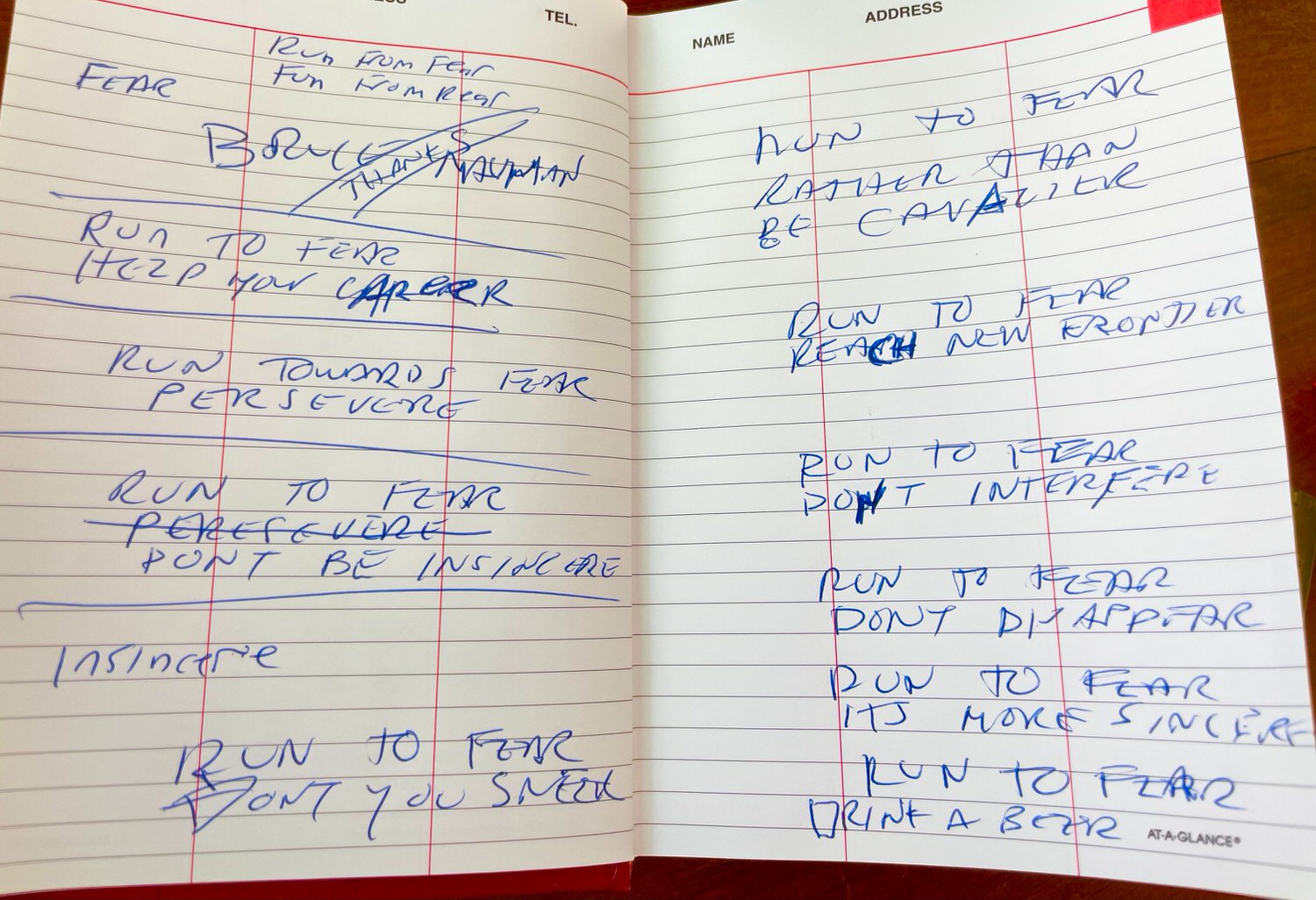
RUN TO FEAR PERSEVERE / DON’T DISAPPEAR / HELP YOUR CAREER / DRINK A BEER / DON’T INTERFERE,
by Kenny Schachter
Something similar, though displaced toward the economic, occurs with Abolish Artist Royalties. The question is not so much whether Schachter has found a solution to the problem of royalties (there is none, at least not in the grandiose sense in which Web3 discourse grew used to presenting its own tools), but what happens when an artist decides voluntarily to interrupt the economic prolongation of his authorship, because the royalty had introduced a peculiar temporality: the work could change hands, yet the artist remained economically bound to each of those later lives, and the emancipatory promise consisted precisely in that, that the creator would not be expelled from the future of his own work. Schachter introduces there an inversion that is more interesting than mere economic provocation. If the royalty turned the future of the piece into a prolongation of the origin’s rent, its abolition allows that future to detach itself from the artist. The work will continue to circulate, it may appreciate, depreciate, be sold or remain still; what disappears is the obligation that each of those movements produce once again an economic consequence for the one who made it. Authorship does not disappear. A particular way of making it profitable disappears. And there the paradox returns, because the artist who renounces a part of his property does not disappear from the archive, he remains precisely as the one who renounced, and the blockchain preserves the gesture of subtraction with the same efficacy with which it would have preserved the economic right. Property weakens and authorship, against what one might expect, becomes more legible.
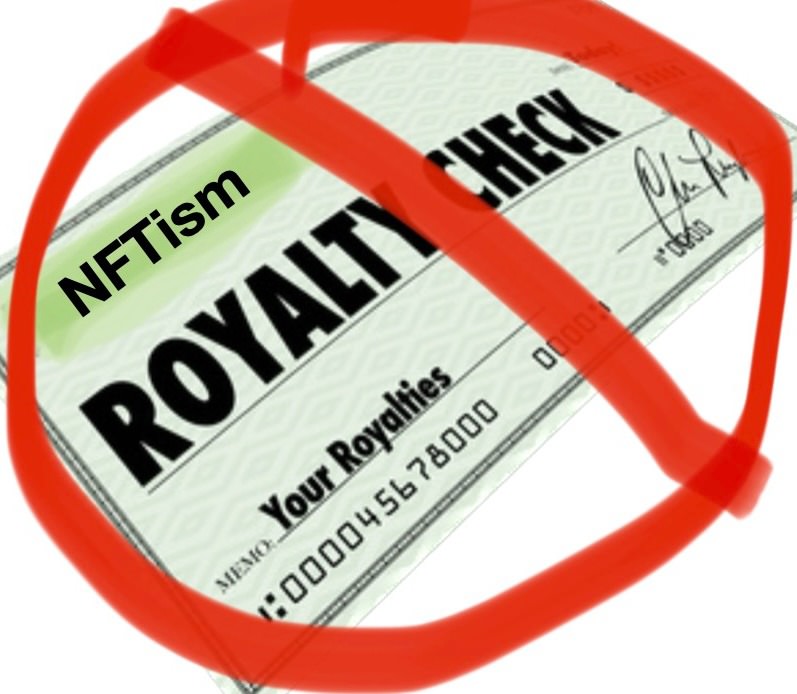
Abolish Artist Royalties by Kenny Schachter
Perhaps that is why NFTism: Trademark abandoned… is the work in which this contradiction reaches its most delicate form. A trademark tries to do with a word something similar to what an NFT tries to do with an image: delimit, protect, establish a border inside circulation. But a word does not stop circulating because someone registers it, just as it does not cease to belong to a history because someone renounces registering it, and the abandonment of the trademark does not therefore equal an absolute legal liberation of the term (it would be too simple to turn an administrative procedure into an allegory of emancipation), yet it does produce an extraordinarily precise image of the distance that exists between having invented a name and being able to own everything that name may come to mean. NFTism can continue to be spoken after the trademark has been abandoned. And perhaps there lies the true gesture. Schachter does not hand the concept over to the world as one donates an object, because a concept is never handed over in that way; what he does is renounce a particular form of blocking its circulation. The signifier ceases to be protected in one way and, precisely for that reason, begins to show that its existence never depended completely on that protection. Industrial property can delimit the use of a word; it cannot guarantee its sense.
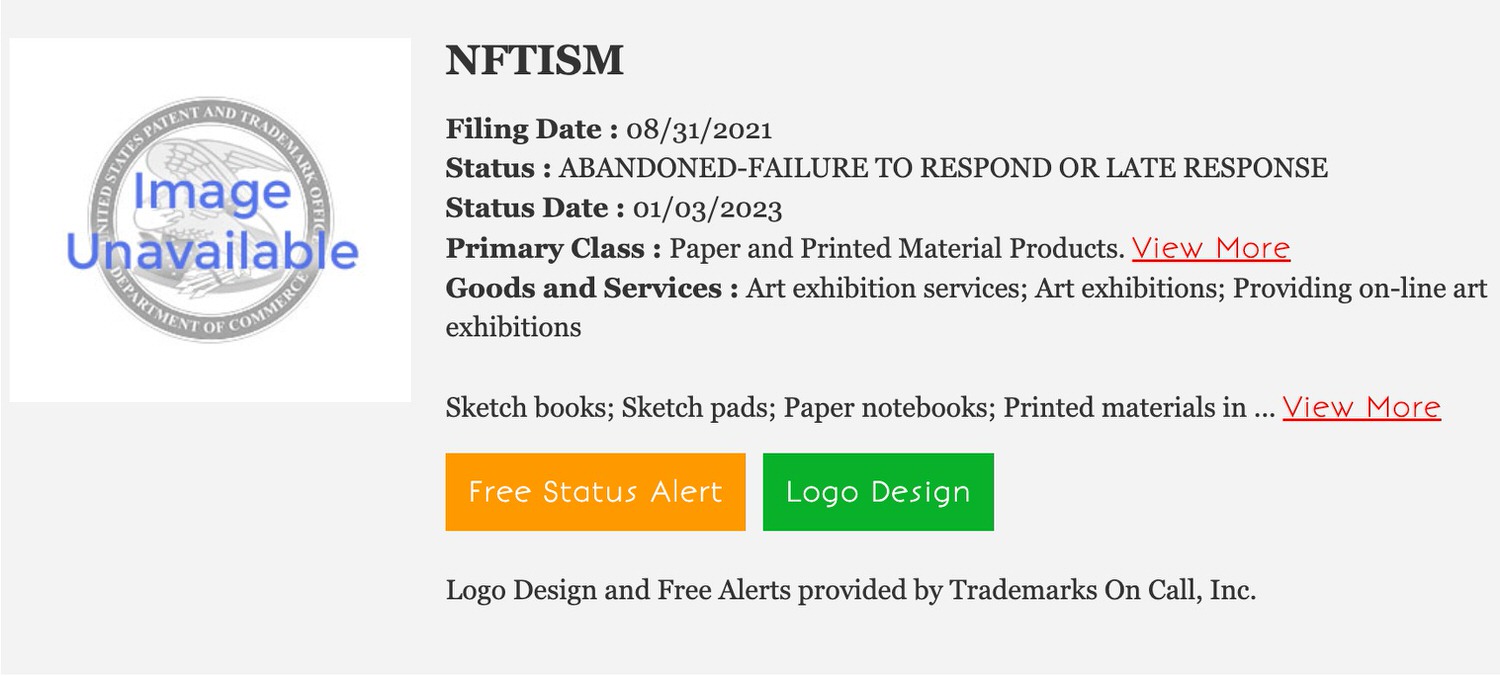
NFTism: Trademark abandoned… by Kenny Schachter.
The three works then begin to touch one another in a way that does not coincide with a logical progression. Fear, rent and the trademark are not three themes. They are three forms in which the proper name appears implicated with what surrounds it: a body that has to persevere in order not to disappear, a work that can continue circulating without producing rent for its origin, a word that goes on speaking after its author has weakened his right to claim it. What seemed a sequence of different gestures begins to reveal the same tension between authorship and possession, between what someone can call his own and what, once produced, inevitably begins to escape.
And perhaps it is here that the archive acquires its true aesthetic dimension, because to archive does not simply mean preserving what happened, it means deciding, even without knowing it, what will later be able to reappear as having happened. An inscription does not determine the future sense of a work, but it can prevent the future from having to depend exclusively on the memory of those who were there. The chain does not interpret. It does not canonise. It does not guarantee relevance. It does something stranger and less spectacular: it refuses to forget for us.
From there, these three works can be read less as documents of a supposed end of the NFT than as small alterations of its temporality. Faced with a medium obsessed with the circulation of value, Schachter leaves record of things whose value does not necessarily coincide with what can be sold (a state of mind, an economic renunciation, the abandonment of a trademark), and that shifts the question from how much the work is worth toward another that is considerably harder to answer: what kind of relation a work can preserve when what is being preserved is no longer exactly its value. The interest of the set does not therefore lie in Schachter having anticipated a particular history of digital art nor in turning those weeks of 2023 retrospectively into the secret moment when an artist understood where the medium was heading. That would be too convenient. What is interesting is that these works allow one to observe how a technology conceived to make ownership visible can end up making visible its insufficiency. The image remains, but so does the decision about it; the contract remains, but it may remain alongside the renunciation that empties part of its promise; the name remains even when its armour is withdrawn.
And then immutability ceases to be exactly what we thought it was, it does not consist only in the fact that something cannot be erased, it also consists in the fact that the act of having let it go may not disappear.
The triptych, which Schachter never needed to name as such, exists only in this reading. Outside it there are three tokens, three dates, three gestures and a chain that preserves them. But perhaps it is precisely that modesty that allows the montage to have any interest: not inventing an intention where there is none, but finding, between what the artist left inscribed and what the archive refused to lose, a relation that only appears afterwards. Not because the works were waiting to be turned into history, but because sometimes the history of art begins long before anyone decides to call it that.
Pablo Castellano