
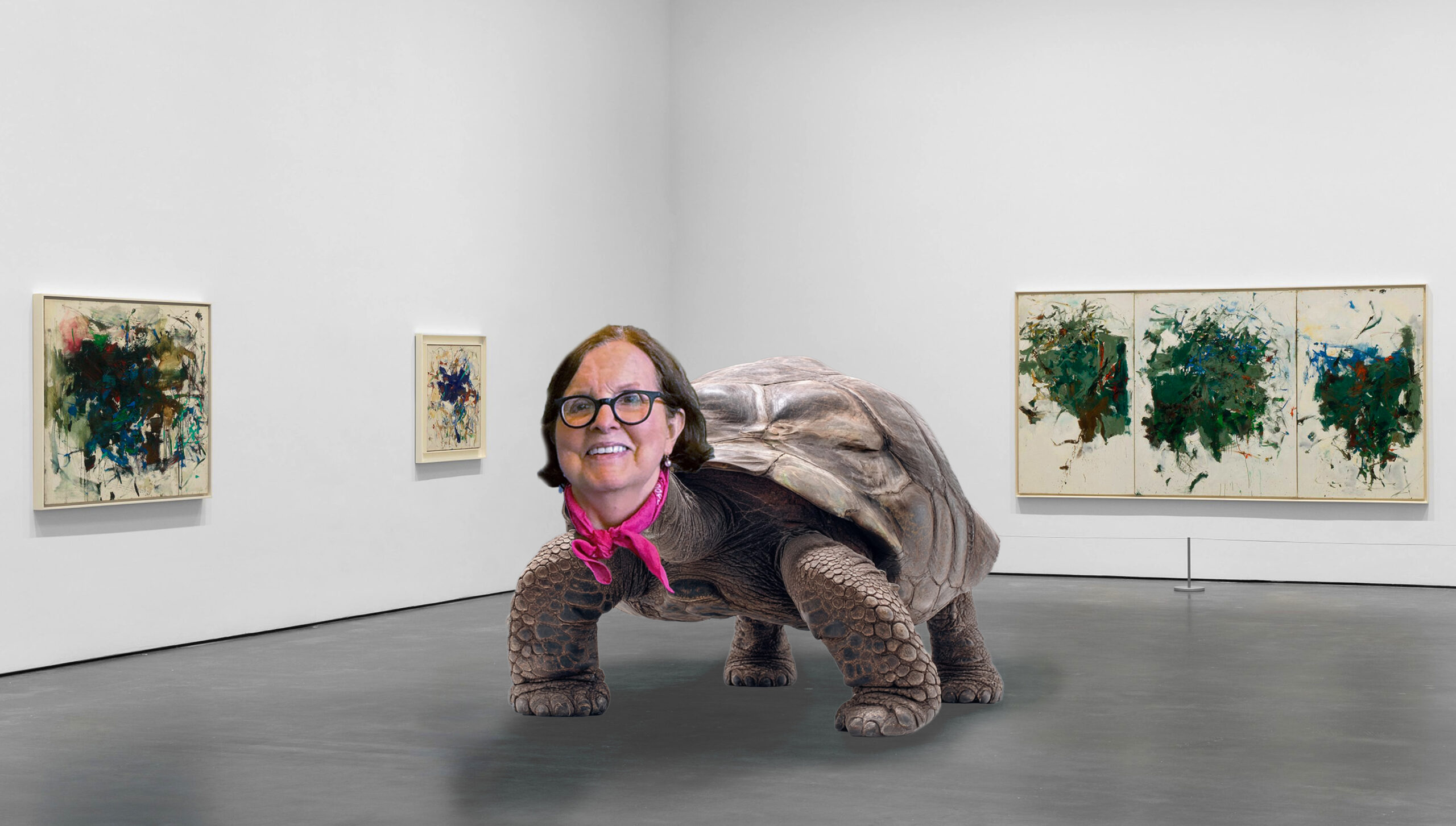
The shells of tortoises are fused to their bodies, which they can never slough. That used to be the case with inscrutable critic Roberta Smith, until the House of Criticism. Photo by Kenny Schachter
This column is more of a paean to Roberta Smith than a review of House of Criticism, the new documentary by Alison Chernick on the lives of Smith and Jerry Saltz. I’ve known them for 35-plus years and admired their writing with a passion that borders on obsession.
I watched the Roberta & Jerry Show—a better title—three times, far short of the 75 viewings of Matthew Barney’s Cremaster 19 (or whatever installment it was) that Saltz confessed to in his chronicle on the artist in Art in America in 1996. Still, I managed to spend the 56 or so hours that translates into taking notes on the film.
My interest in doing so lay in mining the mind of Smith, as I’ve already profiled Saltz, the secular Sister Wendy of art explication, in a 2016 story for GQ that was later updated and published by Artnet as “Jerry Saltz and the Future of the Critic-Artist: There are few critics like Jerry Saltz. Scratch that—there are none.” Below is an excerpt:
As a curator, all I ever wanted was to be reviewed by Saltz and Smith (she complied more than he)… Smith is a brilliant, stern, latter-day schoolmarm and Saltz a boundary-pushing populist who changed the game of how critics communicate and cultivate audiences… Like midwives, they walk us through a contemporaneously unfolding slice of art history in real time…
Regardless, I wasn’t interested in a cinematic analysis or retelling of the love story that constitutes a chunk of the content, annoyingly overlaid with piped-in, syrupy elevator Muzak. While we’ve all come to know intimately every crevice of Saltz’s life (oftentimes too intimately), Smith has by contrast always been the more inscrutable of the two—an understatement if ever there was.
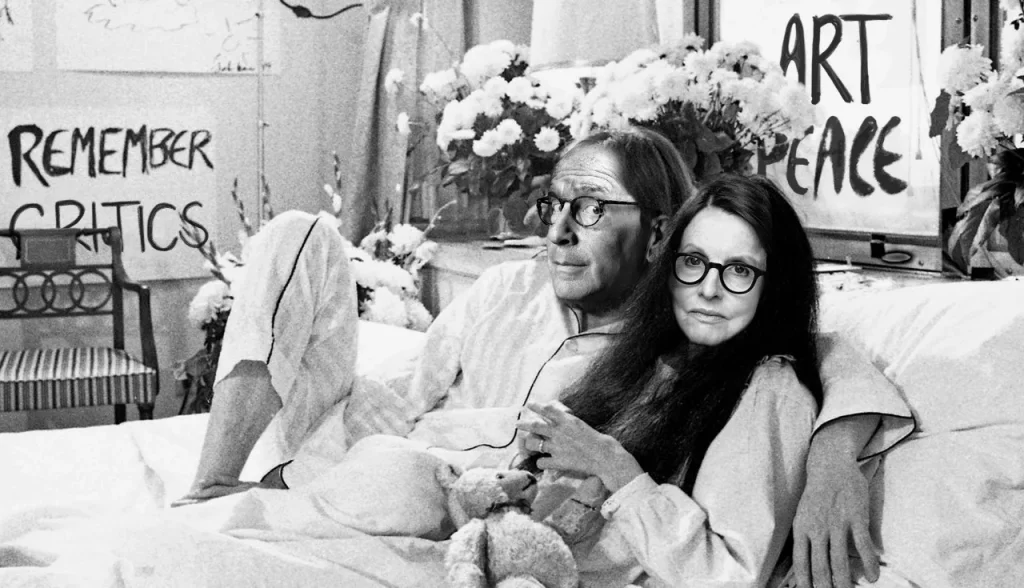
Jerry & Roberta as John and Yoko Art in their mutual quest for art peace… and/or more readers. Photo by Kenny Schachter
To this day, Smith is the only person that renders me speechless, a lesson learned the hard way when I approached her during an early curatorial effort, in 1991, to speak about a painting she was standing in front of. Without hesitation, she reeled around and scolded me, in no uncertain terms, that if she needed art explained she’d never leave her apartment again to see another gallery. With tail tucked between my legs, I reverted into a corner until she departed, at which point a tear fell down my cheek. Granted, she made me cry again 20 years later, but that was when she emailed to tell me how much she liked my writing.
Hell, Smith even put the fear of God into Larry G., a fact he readily admits to in an on-camera interview. Like the allegory expounded on by philosopher Georg Hegel in The Phenomenology of Spirit (1807), that humans gobble things up to manipulate, consume, and grasp reality, instead of passively engaging with the world, Larry being Larry, he pounced the moment she stepped down from the New York Times and commissioned her for an essay on Jasper Johns.
Through his reviews, ubiquitous social media presence, and public talks, Jerry is unassailably history’s most populist critic since John Ruskin (1819-1900), the widely celebrated artist, writer, and teacher of the Victorian era who promoted art as a moral endeavor versus baubles exclusively for the rich. Beyond artists, Ruskin championed the dignity of individual workers. On that note, have you noticed Saltz’s rants against, and disdain for, auctions and market machinations? It would be hard not to.
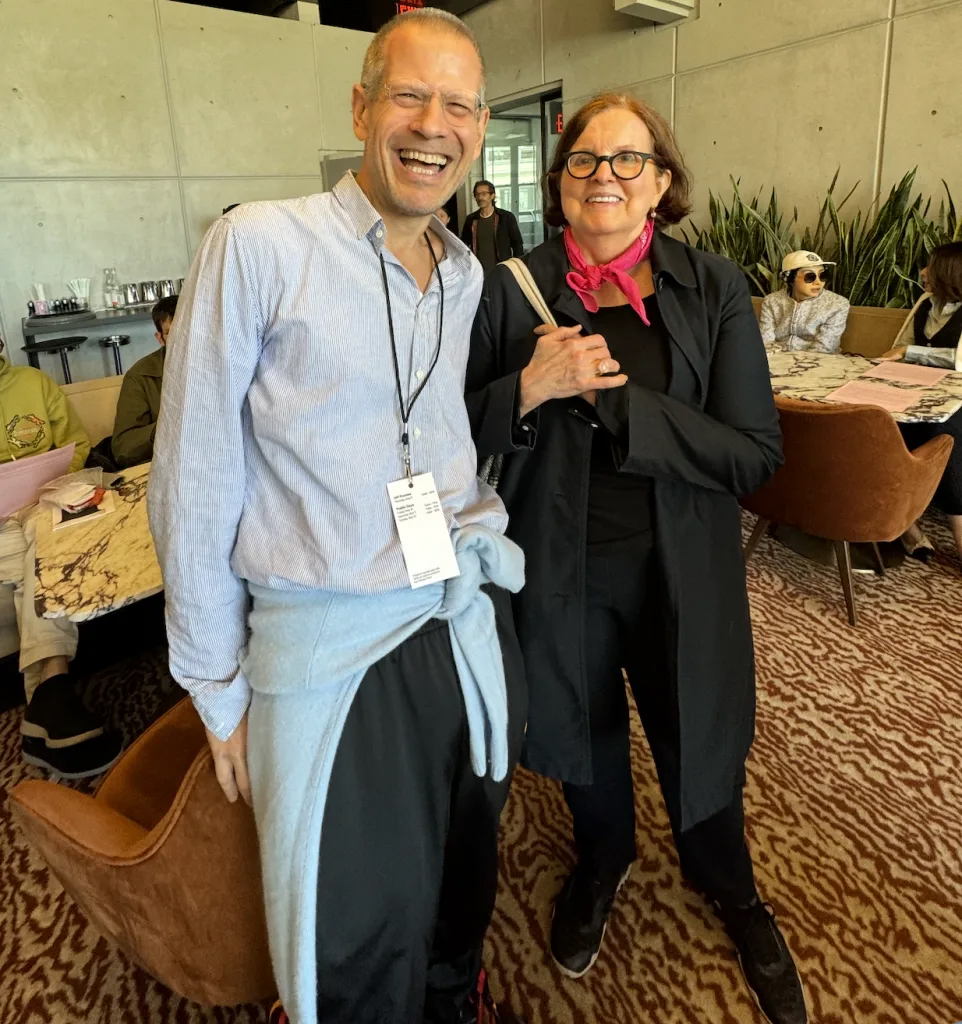
I conjured the strength to overcome my unflagging fear of Roberta Smith for this photo op, snagged when she spoke on the occasion of the Independent Art Fair a few years ago. Photo by Kenny Schachter
But recondite Roberta was far more of an enigma over her nearly four decades at the Times. She began at the paper on a part-time basis in 1986, became the first woman to be named its co-chief art critic in 2011, and retired in 2024, as the film was being shot.
The shells of tortoises are fused to their ribcage and spine, from which they can never slough their way out of. Much like those land-dwelling reptiles, Smith has always worn her protective shell well. Until now.
What I most enjoyed about the Roberta & Jerry Show was the voyeuristic opportunity it afforded to peer through a peephole into her life. Although we never get a full glimpse of Smith in nature’s garb, so to speak (there’s no mention of Smith’s previously documented dire health struggles), she does offer up a dollop of previously undisclosed biographical information. I relished every last crumb.
Smith concedes that she inherited her mother’s insecurity, wasn’t good at making friends, didn’t have many, and in her own words, was “not a hanging-out sort of person.” She also says that her Danish-modernism-collecting mom frequently asked her opinion of her furniture redecorations, at which point she realized that having an opinion, comparing and judging, were skillsets—and that she was good at it. Saltz divulges that Smith “hates her writing” until he informs her how many likes it has garnered on Instagram. (Even her? Shocking.)
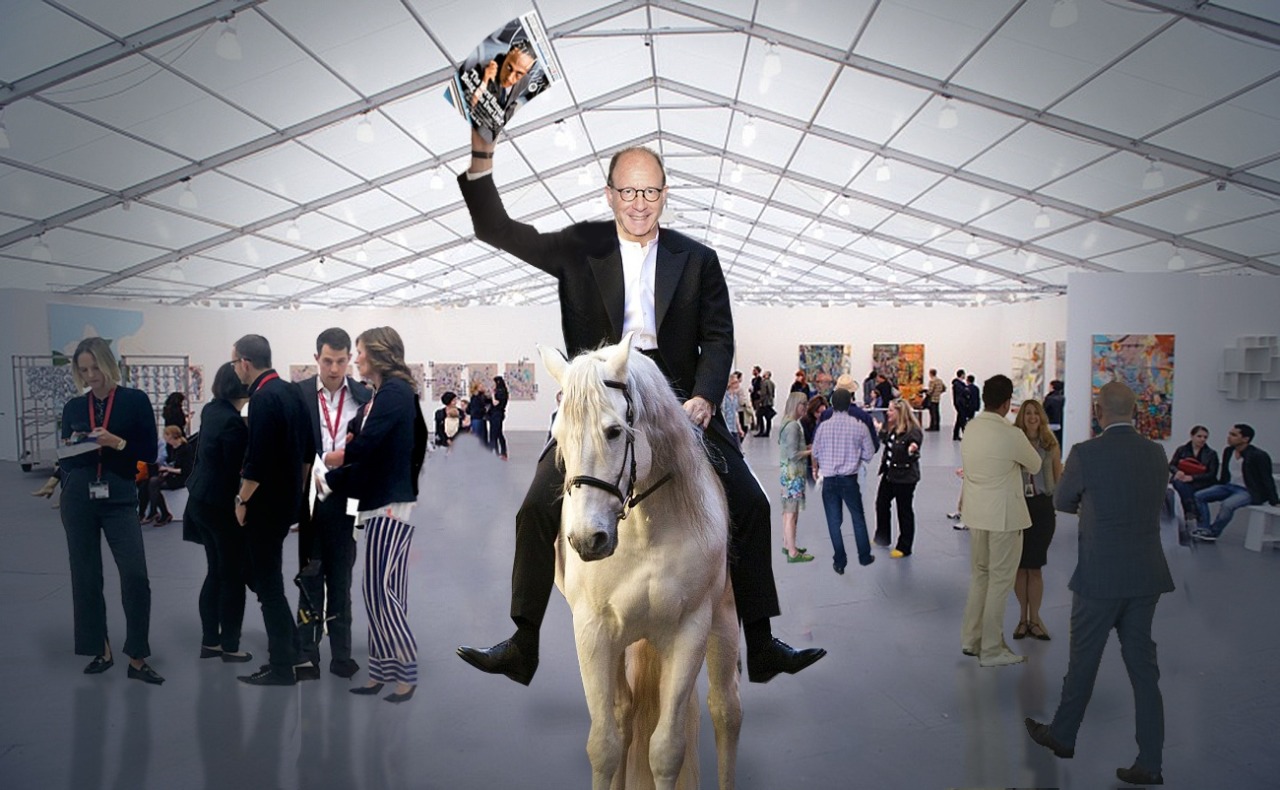
In an art fair near you, atop his high horse, preaching and preening in equal measure. Photo by Kenny Schachter
Deciding to be a critic was an acknowledgment that a writer’s life is an isolating job, and isolation was what Smith sought. As if on cue, as I was typing this, my son Gabriel walked into the room and asked why I haven’t been seeing more people this summer.
Smith didn’t attend graduate school, was not a great reader or equipped with a wealth of historical quotes to throw in her essays, and refers to her works “as very artisanal, or basic, or something.” After a school counselor recommended applying to the Whitney Independent Study Program, she was accepted due to Donald Judd agreeing to be her tutor and have her as his personal assistant. That led to her editing his cumulative criticism.
In retyping the breadth of Judd’s critical musings for a book of his writings, Roberta says that she was not quite sure how he got to his conclusions, but that she absorbed his texts and found them intriguing and funny (his “humor” continues to evade me), and that she valued his compression of language. Judd’s aesthetic had a tremendous impact on Smith’s approach, which involves learning to discover the world as you look at art, evaluating things in terms of what they add and subtract from the environment, with the understanding that everything has its best example.
Though she was initially struck by Judd’s glaring self-confidence (I had assumed hers was equally bulletproof) and his self-belief in his own importance, vision, and mission, she says it was also an influence to outgrow. Judd’s unflinching insistence that he was at art’s cutting edge, that everything by comparison was retrograde, might have been true for a while, but it lost its luster. By casting an inclusive net as a longtime proponent of outsider art, and by embracing the surfeit of currents within a single Manhattan neighborhood, Smith says that she never espoused a linear outlook of history but still managed to have an overall cohesive view of art.
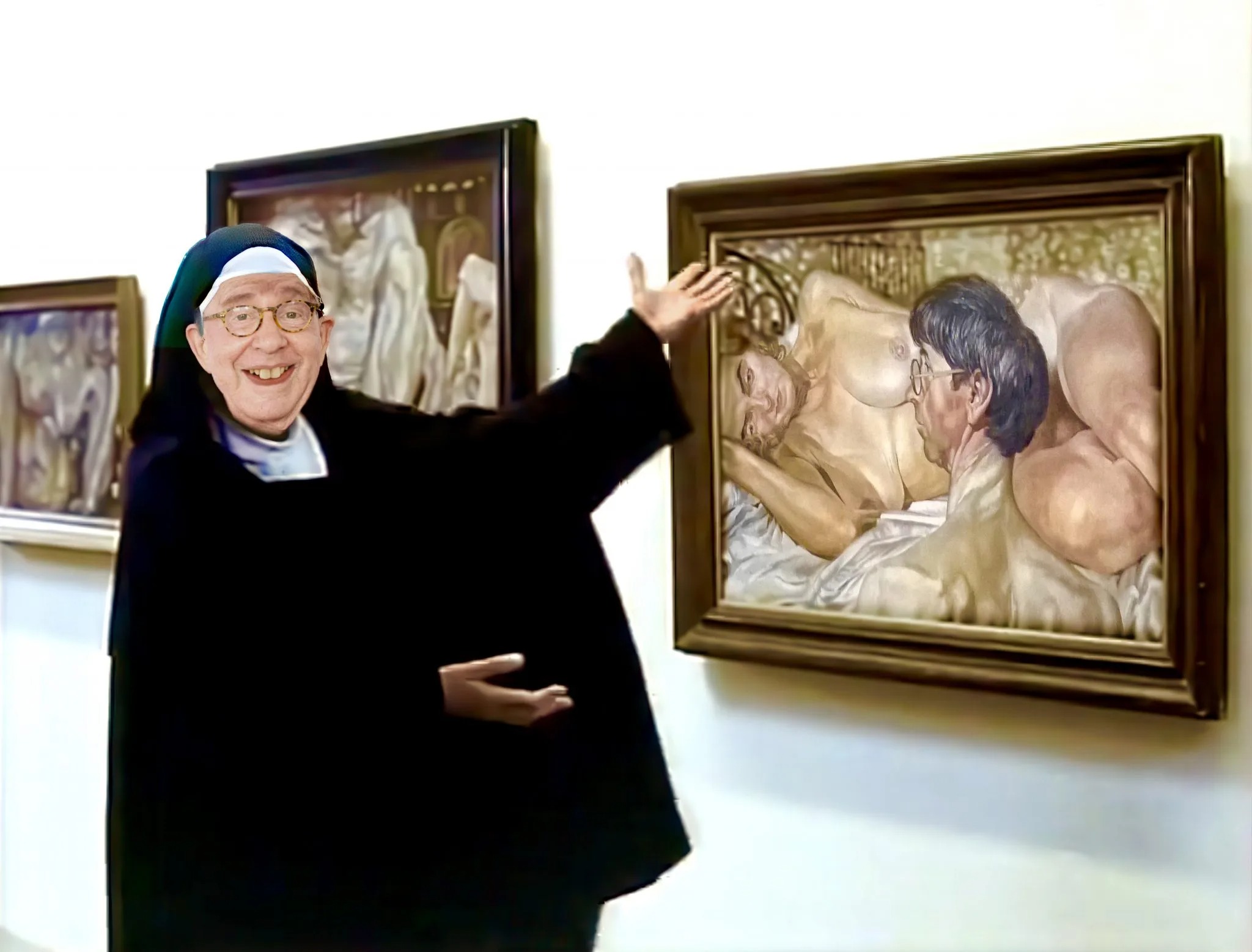
Our very own (sex-crazed) secular Sister Wendy, as featured in a scene from her infamous episode on the pubic hairs depicted in British artist Stanley Spencer’s Self-Portrait with Patricia Preece (1936). Photo by Kenny Schachter
Smith describes her approach as getting up close and piercingly scrutinizing how a painting was made, saying that the process and decisions that went into a work are essential to understanding and appreciating it. That practice registers for Smith as the “artist’s sensibility, their being or physical energy.” Not for me. I’m more interested in the thing itself in its totality: I like to eat, not cook. When I make art, I see it materialized in my mind’s eye, then want it before me, more like Judd, or by means of what David Hockney disparagingly termed manufacturism.
How that position accords with her admiration and appreciation of Donald Judd is baffling to me. Yes, the inlaid joints of his furniture and the manner in which his sculptures were welded and fastened are often visible, but neither were effectuated by him—factory fabrication was his ideational battle cry. I can’t argue with her stance that discovery begins when you get up close to artworks. She bemoans that “most people don’t even walk up to paintings,” although with faltering sight that comes with age, rubbing my nose against something is the only way I can discover what’s in front of me.
I can vividly recall running to the local newsstand late on Thursday evenings whenever I had an exhibit on view, hoping for not just a New York Times review, but a Roberta review that would shore up my artistic mettle, send people flocking to my exhibit, and, more significantly, drive buyers. Even negative nods by Smith were cherished by some dealers. I can specifically recall a handful of her particularly vituperative, mordant words and phrases verbatim from over the decades. They are sheer inspiration, but I’m Winnie-the-Pooh by comparison.
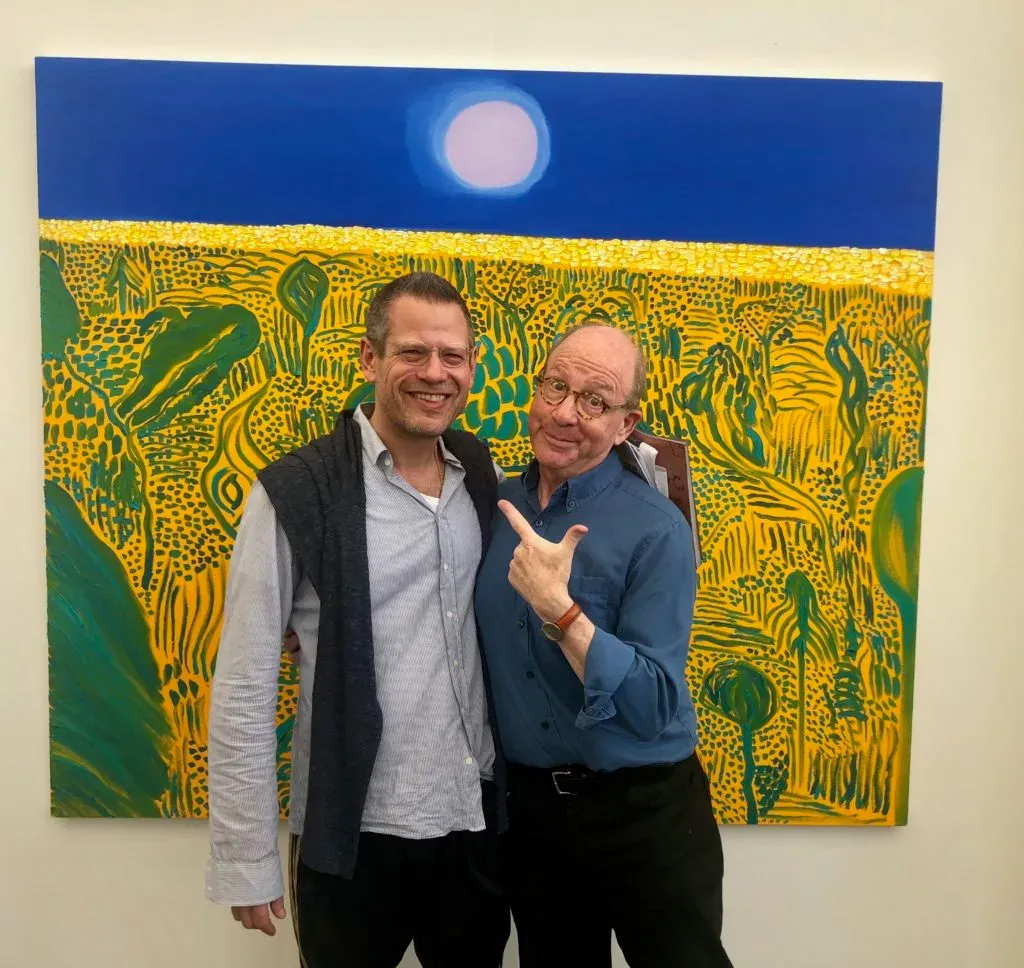
Self-taught painter Matthew Wong cherrypicked both Jerry and I to apprise him of the contemporary art landscape from our writings and social media presence. Photo by Kenny Schachter
I’ll never forget being taken aback reading Smith’s Orlan review at Sandra Gering Gallery in 1993, after Sandra approached me in the gallery gleefully waving a copy in my face; she was so grateful. Here’s a passage.
The French performance artist Orlan is proving that there’s more than one way to suffer in the name of art, and make a spectacle of yourself in the process. Her material is her own body and skin. Her medium is plastic surgery, usually performed on her on camera. Her work represents a small step for Conceptual art, and a big step for feminism–both in the backward direction.
Here’s another gem on a video from the exhibit: It had “all the charm of a Marx Brothers movie without the jokes” and “never transcends the level of a documentary, and a poor, rather boring documentary at that.” How could you not absolutely love her!
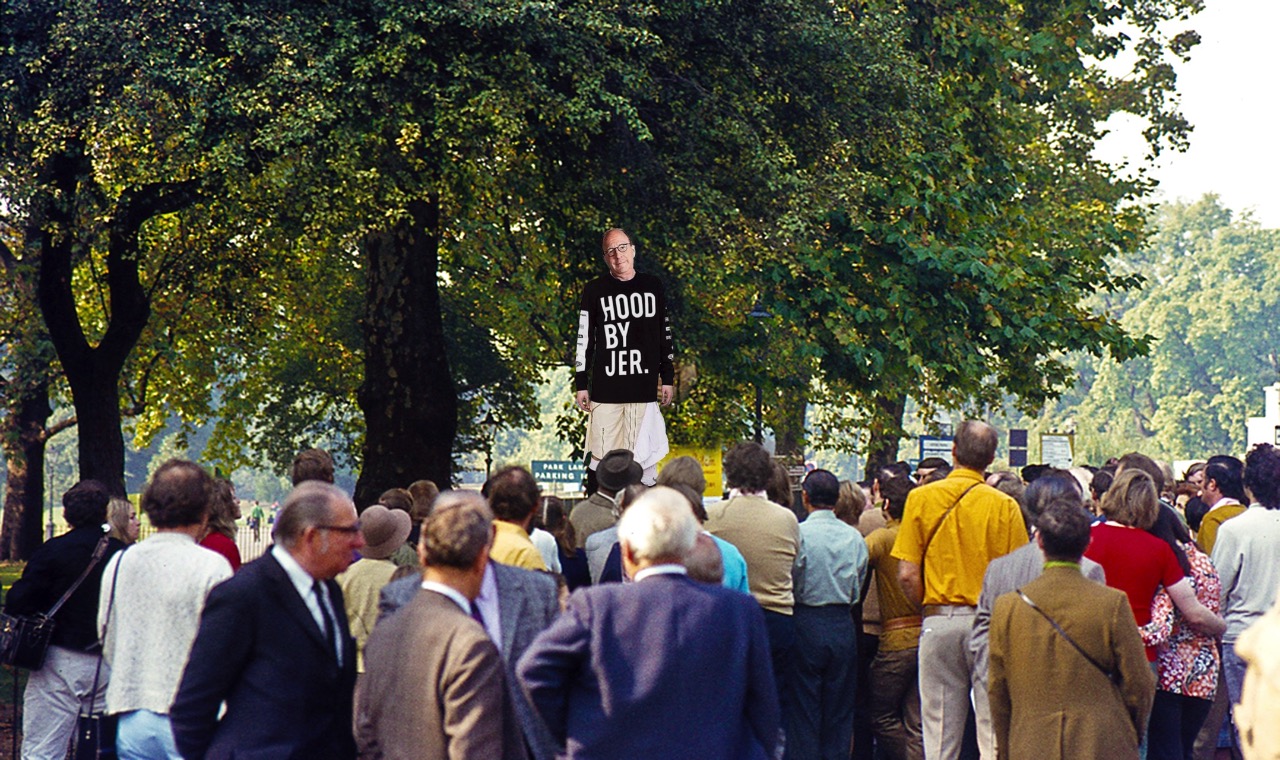
Jerry doesn’t much need his own stoop in London’s historic Hyde Park Speakers Corner, he’s carved out his own on Instagram. Photo by Kenny Schachter
Writing is a plodding, ponderous pursuit that takes its toll. Trust me. The upside, which you can never take for granted—you’re only as good as your last piece—is that there is a formidable weight that accompanies being read, having an audience that takes forever to cultivate. As articulated by Smith:
Power is something you got from your readers, not something you took; it is you establishing some kind of credibility that they could take away at any time. You realize when you age as a critic, opinions, I can get in trouble here, they don’t matter as much as you thought they did, opinions are out of style. Trying to have a genuine response, not what you think you should have or want to have in terms of what you believe will get attention. You must be prepared to be betrayed by your taste because it’s evolving all the time. You can’t decide what you liked first is best and spend your career enforcing or lamenting the idea is no longer dominant.
Then, in the style of fly-on-the-wall cinéma vérité, a rupture—literary violence—unfolds on screen. Roberta was the recipient of some harsh criticism herself, in this instance from her editor, who returned a piece for “radical revision” that she deemed “traumatic and destabilizing.” We bear witness to the pressure of relentless “deadlines becoming too deadly.” In (more of) her own words:
It [working for the Times] gives me an identity. It gives me … sort of everything. I don’t know who I am without the Times. It takes a certain kind of dedication. But it also is a kind of armor. I just sent an email: It’s time we talk about retiring, seriously. I had no idea I would ever feel like retiring, anticipating going out feet first. Writing is getting harder and slower for me and I am getting worse and worse at dealing with it. Aggravating editors and art directors—not a pretty picture. The art world is a good place to get older. We don’t have to be athletes, dancers, or singers and we have this kind of skill and propensity that gets cultivated. I’ve written art criticism for 50 years, when does enough become enough? I felt my head split open. I took this as a sign.
Squirming through this harrowing existential quagmire with her is mighty daunting, especially for us slogging in the trenches. It actually pained me.
Back to Saltz: I won’t flesh out, so to speak, the cringingly imprudent scene where he revisits his childhood living room, and to the dismay of the 80-something-year-old currently residing there (and everyone else watching the Roberta & Jerry Show) recounts masturbating to reproductions of Ingres. Surely the scene induced PTSD in the poor guy, who probably hasn’t experienced another normal day in the house since. At that age, no less.
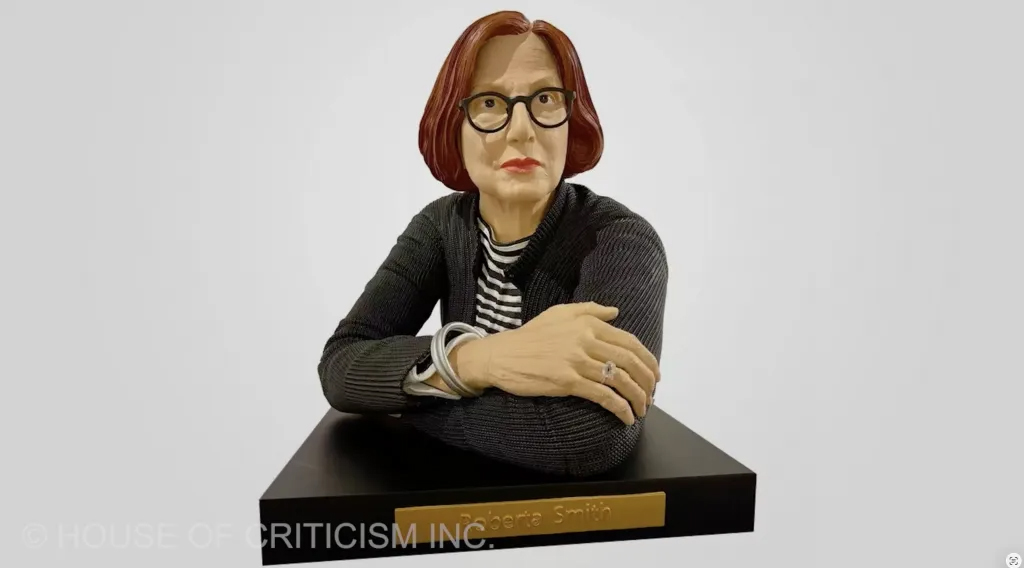
Composer Jean Sibelius (1865-1957) said he never read reviews of his music because no one ever erected a statue of a critic—until my 2023 sculpture that had an unattributed cameo in the House of Criticismdocumentary. Photo by Kenny Schachter
Art journals are akin to Fly Fisherman or Popular Mechanics. They’re trade publications. Our indubitable passions are not generally scalable to a wider public, unless you appeal to the lowest denominator (commercial practitioners I won’t name—some of whom are as known for designing toys and collectibles). Saltz has managed to transcend that via his social media escapades and lectures, which for years I’ve been trying to convince him to take on the road for a solo theater tour. I’ll even produce it for him.
The gross income that this documentary generates could be taken as a litmus test of our profession, of art’s true popularity and accessibility over and above the Kool-Aid–drinking hardcore. It’s not simply that Saltz and Smith have held two of the last full-time criticism jobs. In the film, we viscerally experience the extinction of a profession. Smith has willfully consigned herself to history, put herself out to pasture, which I regularly regret. Saltz’s columns appear less and less, in favor of short-form video content at the behest of New York magazine, a response to dwindling readership.
What hasn’t changed, for which I am eternally grateful, is Roberta’s sentiment that “artists and art make life worth living.” I would add children to the mix, and for Jerry and Roberta these days, their cats.
Kenny Schachter